IBJJF Rules Explained: Everything You Need to Know Before Competing
Complete guide to IBJJF competition rules including points system, illegal techniques, advantages, penalties, match duration, and overtime procedures.

Understanding IBJJF Rules
The International Brazilian Jiu-Jitsu Federation (IBJJF) has established the most widely used ruleset in competitive Brazilian Jiu-Jitsu. Whether you're preparing for your first tournament or looking to compete at the highest levels, understanding these rules is essential for success.
This comprehensive guide covers everything you need to know about IBJJF rules: the points system, advantages, penalties, illegal techniques, match duration, and what happens in overtime. If you are preparing for your first competition, also read our first IBJJF tournament preparation guide for practical tips on registration and competition day.
A clear breakdown of the complete IBJJF/BJJ ruleset for newcomers — covering scoring positions, submissions, and how matches are decided:
The IBJJF Points System
Points are awarded for achieving and maintaining dominant positions. For an even deeper dive into scoring strategy, see our dedicated IBJJF points system breakdown. Here's the complete breakdown:
Did You Know: The IBJJF points system is designed to reward positional dominance, not just submission attempts. A competitor who controls top position and advances through the hierarchy (side control, mount, back) will always outscore someone who only attempts submissions from guard.
Points Breakdown
| Action | Points | Requirements |
|---|---|---|
| Takedown | 2 | Take opponent from standing to ground, land in control |
| Sweep | 2 | Reverse position from guard to top, establish control |
| Knee on Belly | 2 | Establish and maintain knee on stomach/chest |
| Guard Pass | 3 | Pass opponent's guard, establish side control for 3 seconds |
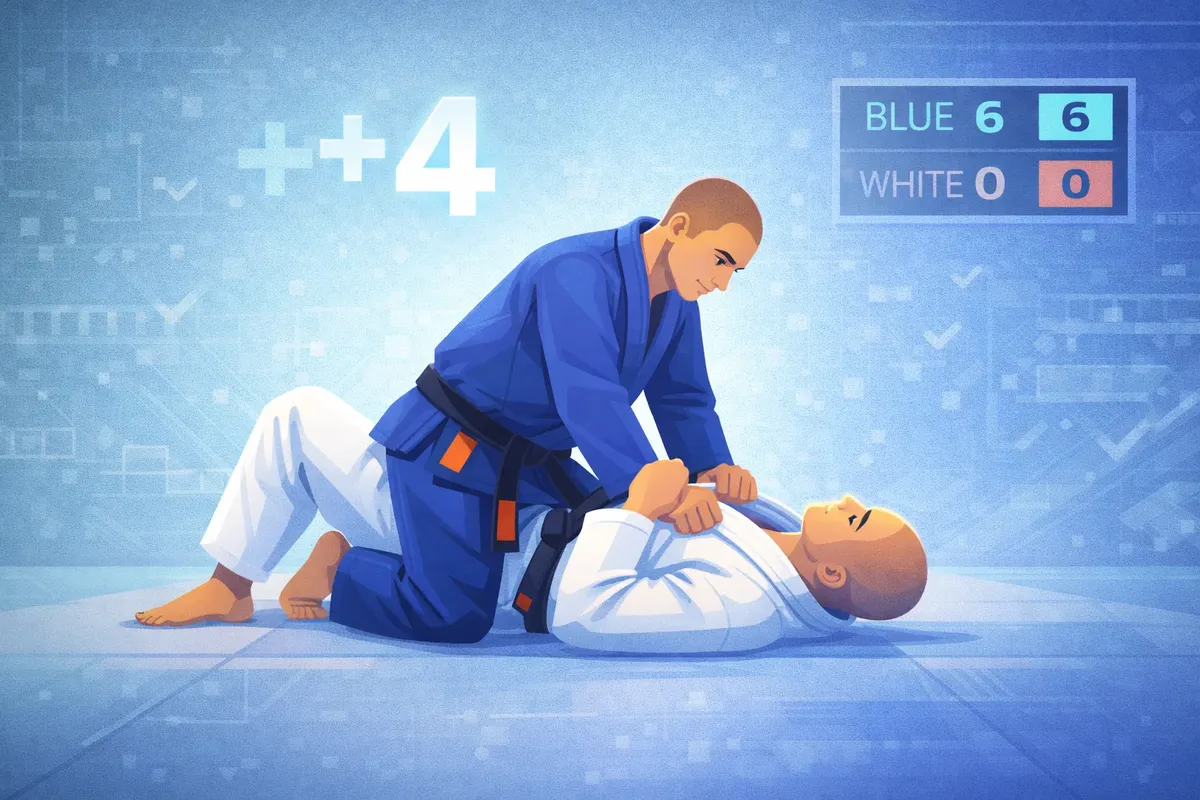
| Mount | 4 | Achieve and hold mount position for 3 seconds |
| Back Control | 4 | Take the back with both hooks (or one hook + body triangle) |
Key Points Rules
Stabilization Required: You must maintain a position for 3 seconds for points to be awarded. The referee will signal when points are given.
No Returning Points: If your opponent escapes and you immediately retake the position, you score again. There's no "diminishing returns."
Top Position Required: Sweeps only score if you end up on top. Coming up to a kneeling position after a sweep scores, but must lead to establishing top control.
Gracie Barra's visual breakdown of every scoring position — takedowns, sweeps, guard passes, mount, and back control — with the exact requirements for each:
How Advantages Work
Advantages are secondary scoring metrics used to break ties. They're awarded for:
Advantage Situations
- Near Submissions: Opponent defends a submission that was close to completion
- Almost Sweeps: Sweep attempt where opponent touches the mat but recovers
- Near Guard Passes: Close pass attempts where opponent barely defends
- Takedown Attempts: Close takedowns where opponent avoids being taken down
- Dominant Position Attempts: Almost achieving mount, back, or knee on belly
Advantage Value
Advantages only matter if points are tied. A competitor with fewer points but more advantages still loses. Think of advantages as a "tiebreaker" system.
Key Takeaway
Points always beat advantages, and advantages always beat referee decisions. Focus on scoring points first, accumulate advantages as a tiebreaker insurance, and only rely on referee decisions as an absolute last resort.
Track every roll — log sessions and techniques for free
Penalties in IBJJF Competition
Penalties can significantly impact match outcomes:
Minor Penalties (Warning, then Advantage to Opponent)
- Gripping inside opponent's sleeve or pants
- Stalling or lack of combativeness
- Running off the mat to avoid engagement
- Standing in opponent's closed guard without engaging
Serious Penalties (Immediate Advantage or Points)
- Pulling guard when opponent also attempts to pull guard (both penalized)
- Slamming from guard
- Intentionally leaving the mat
- Coaching misconduct
Disqualification Offenses
- Illegal techniques (appropriate for belt level)
- Severe or intentional rule violations
- Violent conduct
- Unsportsmanlike behavior
Warning: Stalling penalties escalate quickly. The first offense is just a verbal warning, but a second offense gives your opponent a free advantage, and a third gives them 2 points. Many close matches are decided by stalling penalties, so always be actively attacking or improving your position.
Illegal Techniques by Belt Level
IBJJF rules restrict certain techniques based on experience level to protect competitors:
White Belt Restrictions
Illegal Submissions:
- Heel hooks (inside and outside) -- for a deeper look at leg lock defense, see our heel hook defense guide
- Knee reaps
- Twisters
- Neck cranks (without choke)
- Scissor takedowns (jumping to closed guard)
- Slams
Illegal Positions:
- Jumping to closed guard
- Cervical locks
Blue Belt Additions (Still Illegal)
All white belt restrictions plus:
- Calf slicers
- Bicep slicers
Purple Belt
No additional submission techniques become legal at purple belt compared to blue belt.
Brown and Black Belt
Additional Legal Techniques:
- Knee bars
- Toe holds
- Bicep slicers
- Calf slicers
Still Illegal at All Levels:
- Heel hooks (Gi)
- Knee reaping (Gi)
- Small joint manipulation
- Spiking/slamming
- Neck cranks without choke
- Suplex with opponent landing on head
- Scissor takedowns
Warning: Using an illegal technique results in immediate disqualification -- there is no warning. Know the restrictions for your belt level before stepping on the mat. If you are unsure whether a technique is legal, ask your coach during training, not during your match.
Tyler Spangler on which moves are illegal in BJJ competition and why — covering the most commonly misunderstood restrictions by belt level:
No-Gi Rule Differences
No-Gi divisions (particularly advanced) allow additional techniques:
- Heel hooks (advanced No-Gi)
- Knee reaping (advanced No-Gi)
- Inside heel hooks (advanced No-Gi)
Check the specific event rules for No-Gi submissions allowed.
Match Duration by Division
Match times vary by belt level and age division. Make sure you also understand IBJJF weight classes so you register for the right division:
Adult Gi Divisions
| Belt | Match Duration |
|---|---|
| White Belt | 5 minutes |
| Blue Belt | 6 minutes |
| Purple Belt | 7 minutes |
| Brown Belt | 8 minutes |
| Black Belt | 10 minutes |
Adult No-Gi Divisions
| Division | Match Duration |
|---|---|
| Beginner | 5 minutes |
| Intermediate | 6 minutes |
| Advanced | 8 minutes |
Masters Divisions
| Division | Gi Duration | No-Gi Duration |
|---|---|---|
| Master 1 | 6 minutes | 6 minutes |
| Master 2 | 5 minutes | 5 minutes |
| Master 3 | 5 minutes | 5 minutes |
| Master 4+ | 5 minutes | 5 minutes |
Finals Matches
Finals matches at major championships may have extended times. Black belt finals at Worlds, for example, can be 10 minutes with overtime.
Overtime Rules
When a match ends with tied points and advantages, overtime determines the winner:
Referee Decision (Standard Events)
At most IBJJF events, if points and advantages are tied, the referee makes a decision based on:
- Who was more aggressive
- Who was closer to scoring
- Who had better positioning
- Overall activity during the match
Overtime Period (Major Championships)
At major championships like Worlds and Pans, tied matches go to overtime:
Format:
- Additional time period (varies by belt)
- First to score wins
- If still tied, referee decision applies
Golden Score (No Time Limit Overtime)
Some IBJJF events use golden score overtime:
- Match continues until someone scores
- Any points or submission ends the match
- Can make for dramatic extended battles
The Guard Pull Rule
Guard pulling is a common tactic with specific rules:
Single Competitor Pull
If one competitor pulls guard:
- No points awarded to either competitor
- Match continues from guard position
- Puller must engage (cannot stall in guard)
Double Guard Pull
If both competitors pull guard simultaneously:
- Both receive a penalty (warning first, then advantage)
- One must come up to top position within 20 seconds
- If neither engages, penalties continue
Strategic Considerations
- Pulling guard avoids takedown battle
- Top player gains scoring opportunities
- Guard puller must be active to avoid stalling calls
Pro Tip: If your opponent pulls guard, do not celebrate -- start passing immediately. The clock is ticking, and the top player has the scoring advantage. Conversely, if you pull guard, have an immediate sweep or submission attack ready so you do not get called for stalling.
Stalling Rules
IBJJF enforces anti-stalling rules to keep matches active:
What Constitutes Stalling
- Holding position without attempting advancement
- Running away from engagement
- Backing to edge of mat to stop action
- Excessive defensive posture without countering
Stalling Penalties
- First Offense: Verbal warning
- Second Offense: Advantage to opponent
- Third Offense: 2 points to opponent
- Continued Stalling: Disqualification
Position-Specific Stalling
Standing: Must engage and attempt takedowns Guard: Bottom player must attempt sweeps/submissions Top: Must attempt to pass or submit Mount/Back: Must attempt to finish
Out of Bounds Rules
Matches that go off the mat have specific procedures:
When Action Goes Out
- Referee stops the match
- Both competitors return to center
- Match restarts in the position they were in (approximately)
Standing Restart
If competitors were standing or no clear position, match restarts with both standing in the center.
Ground Restart
If a clear position existed:
- Competitors placed in that position
- Match resumes from there
- Close to submission attempts may result in advantage
Edge Playing
Intentionally going out of bounds is penalized. Competitors should stay in the center when possible.
Coaching Rules
Coaches have specific guidelines during IBJJF matches:
What's Allowed
- Verbal coaching from designated corner
- Encouragement and strategic advice
- Calling out time remaining
What's Prohibited
- Entering the mat area
- Physical contact with competitor
- Abusive language toward referees
- Coaching from multiple locations
Coach Penalties
Coaching violations can result in:
- Warning to coach
- Removal from corner
- Penalty points against competitor in severe cases
Medical Timeouts
Injuries during competition have specific protocols:
Minor Injuries
- Brief stoppage allowed
- Must be able to continue
- Match resumes from current position
Serious Injuries
- Medical staff evaluates
- Competitor may continue if cleared
- Match stopped if unable to continue
Blood
- Bleeding must be stopped before continuing
- Reasonable time allowed for treatment
- Excessive blood results in stoppage
Injury Default
If a competitor cannot continue due to injury:
- Opponent wins by default
- Unless injury was caused by illegal technique
Competition Brackets
Understanding how brackets work:
Single Elimination
Most divisions use single elimination:
- Lose once, you're out
- Winners advance until final
- Bronze medal match for 3rd place (sometimes)
Round Robin
Small divisions may use round robin:
- Everyone faces everyone
- Record determines placement
- Point differential breaks ties
Points for Bracket Tiebreakers
If competitors have same record in round robin:
- Head-to-head result
- Submission wins
- Points scored
- Advantages scored
Competition Day Checklist
To comply with all IBJJF rules on competition day, review the complete IBJJF Gi uniform requirements well in advance:
Documents:
- IBJJF membership (current)
- Photo ID
- Registration confirmation
Equipment:
- Legal Gi (proper color, size, patches)
- Belt (correct color for division)
- No-Gi attire (if applicable)
- Mouth guard (recommended)
- Cup for men (optional but recommended)
Physical:
- Nails trimmed
- No jewelry
- Hair secured (if long)
- Clean and hygienic
Common Rules Questions
Can I Jump to Closed Guard?
No, jumping directly to closed guard is illegal at all belt levels due to injury risk. You can pull guard to open guard or sit to guard.
What If My Gi Rips?
You'll have reasonable time to change. Bring a backup Gi to every competition.
Can I Slam to Escape Submissions?
No, slamming is never legal regardless of the situation.
What About Knee Reaping?
Knee reaping is illegal in Gi at all belt levels. In advanced No-Gi, it's typically legal. Check specific event rules.
Key Takeaway
IBJJF rules revolve around three pillars: positional scoring (hold for 3 seconds to earn points), technique legality (know what is allowed at your belt level), and combativeness (always be attacking or advancing). Master all three and you will avoid penalties, maximize your scoring, and compete with confidence.
Ready to Compete?
Now that you know the rules, plan your competition year. See the 2026 IBJJF tournament schedule for all major championship dates and registration deadlines, or use one of the best BJJ training apps to track your preparation.
Official Sources
- IBJJF Books & Videos - Complete competition rules and regulations
Ready to compete under IBJJF rules? Download Rollbook to track your competition preparation, study technique notes before events, and log your tournament results. Our session logging helps you identify areas to improve before your next competition. Start your free trial today.
Oss!