IBJJF Points System Explained: How Scoring Works in BJJ Competitions
Complete breakdown of the IBJJF points system including point values, advantages, penalties, referee signals, and strategic tips for scoring in BJJ competition.
Understanding the IBJJF Points System
The International Brazilian Jiu-Jitsu Federation uses a points-based scoring system that rewards positional dominance and control. Understanding how points work is essential for competitive success in BJJ tournaments. For the full overview of all IBJJF competition rules, including penalties and illegal techniques, see our complete rules guide.
This guide breaks down every aspect of IBJJF scoring: point values, advantages, penalties, referee signals, and strategic considerations for maximizing your score.
The Point Values
Quick Reference Table
| Action | Points | Requirement |
|---|---|---|
| Takedown | 2 | Take opponent down, establish control |
| Sweep | 2 | Reverse from guard to top, hold 3 seconds |
| Knee on Belly | 2 | Establish and maintain position 3 seconds |
| Guard Pass | 3 | Pass guard, establish side control 3 seconds |
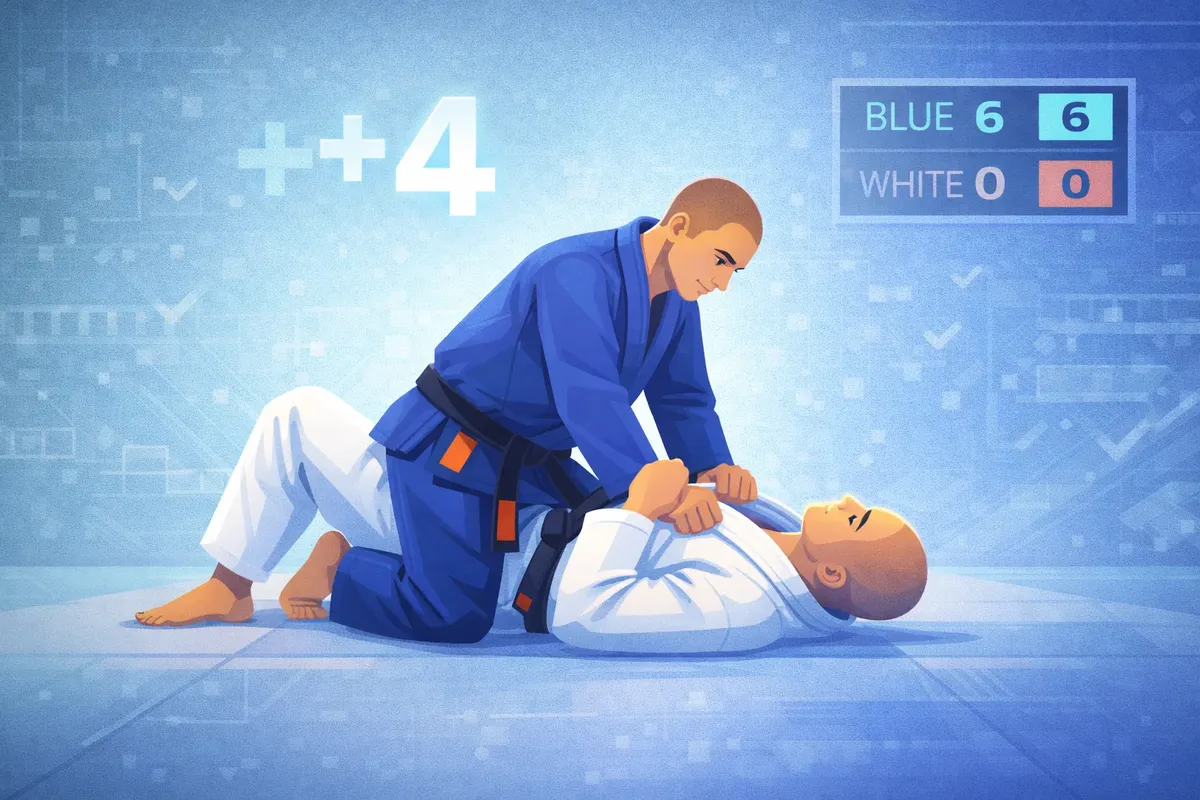
| Mount | 4 | Achieve mount, hold 3 seconds |
| Back Control | 4 | Take back with hooks/body triangle, hold 3 seconds |
Pro Tip: Memorize the point values by thinking of them as a positional hierarchy: the more dominant the position, the more points it is worth. Side control (via guard pass) is 3 points, while mount and back control -- the most dominant positions -- are each worth 4.
Detailed Scoring Breakdown
Takedown (2 Points)
What Counts:
- Foot sweep taking opponent down
- Single or double leg takedown
- Throw or trip to the ground
- Any technique bringing standing opponent to ground
Requirements:
- Must land in controlling position
- Opponent's back or side touches mat
- Top player establishes control
- 3-second stabilization
What Doesn't Count:
- Pulling guard (no points to either)
- Opponent falls without clear technique
- Top player doesn't establish control
- Landing in opponent's guard without passing
Sweep (2 Points)
What Counts:
- Reversing from bottom guard to top
- Coming up from half guard to top
- Any reversal from inferior to superior position
Requirements:
- Must start in guard or half guard
- End in stable top position
- 3-second control required
- Clear reversal of position
What Doesn't Count:
- Technical stand-up to feet (escape, no points)
- Scrambles without clear sweep
- Opponent pulling you into mount
- Coming up without establishing top control
Knee on Belly (2 Points)
What Counts:
- Knee placed on opponent's stomach/chest
- From side control position
- Clear control established
Requirements:
- Knee (not shin) on belly
- Other leg posted for base
- 3-second hold
- Control of opponent evident
Returning to Knee on Belly: If opponent escapes and you immediately retake knee on belly, you score again. There's no limit to how many times you can score from this position.
Did You Know: Knee on belly is one of the most underutilized scoring positions in competition. Because you can score 2 points every time you reestablish it, alternating between knee on belly and side control against a scrambling opponent can rack up points quickly.
Guard Pass (3 Points)
Passing the guard is one of the highest-value skills in competition. If you want to sharpen your passing game, check out our guard passing fundamentals guide.
What Counts:
- Getting past opponent's legs
- Establishing side control
- Bypassing any guard variation
Requirements:
- Clear both legs
- Establish lateral or north-south control
- Hold for 3 seconds
- Opponent's guard cleared
What Doesn't Count:
- Landing directly in mount (score mount points instead)
- Landing directly on back (score back points instead)
- Half-passes where leg is still trapped
Mount (4 Points)
What Counts:
- Sitting on opponent's torso
- Knees on both sides of opponent
- High mount or low mount
- Technical mount (one leg extended)
Requirements:
- Both legs past opponent's guard
- Seated position on opponent
- 3-second stabilization
- Clear top control
Mount Variations:
- Standard mount
- S-mount
- High mount
- Low mount
- Technical mount (grapevine position)
All count for 4 points if held 3 seconds.
Back Control (4 Points)
What Counts:
- Taking opponent's back
- Having both hooks in
- OR one hook plus body triangle
- Clear back control established
Requirements:
- Chest to opponent's back
- Hooks (feet hooked inside thighs) OR body triangle
- 3-second hold
- Controlling position
Back Control Variations:
- Seat belt + hooks
- Body triangle
- Rear mount
The 3-Second Rule
Why 3 Seconds?
The stabilization requirement ensures:
- Actual control, not just passing through
- Reward for positional dominance
- Prevention of scramble-only points
- Clear scoring for referees
How Referees Count
- Referee mentally counts to three
- Hand signal indicates points awarded
- Scoreboard updated after signal
- Verbal confirmation sometimes given
Continuous Action
If you transition between scoring positions:
- Each position counts separately
- Must hold each for 3 seconds
- Can score multiple point combinations
- Example: Pass (3) to Mount (4) = 7 points if both held
Key Takeaway
The 3-second stabilization rule is the most misunderstood aspect of IBJJF scoring. Simply passing through a position does not score -- you must hold and demonstrate clear control. Train yourself to pause and settle into each position before transitioning to the next one.
Advantages
What Are Advantages?
Advantages are secondary scoring criteria used to break ties:
Awarded For:
- Almost sweeping (opponent touches mat but recovers)
- Almost passing guard (close but not completed)
- Near submissions (opponent escapes tight position)
- Almost taking back
- Almost achieving mount
Advantage Value
- Points always beat advantages
- 10 advantages don't beat 1 point
- Only matter if points are tied
- Can influence referee decisions
When Advantages Matter
End of Match Scenarios:
| Points | Advantages | Winner |
|---|---|---|
| 4-2 | 0-5 | 4 points (points beat advantages) |
| 2-2 | 3-1 | 3 advantages (advantages break tie) |
| 2-2 | 2-2 | Referee decision |
Warning: Never rely on advantages to win a match. If you have the lead on advantages, keep pushing for actual points. Many competitors lose by getting comfortable with an advantage lead, only to have their opponent score a late sweep or pass that makes those advantages irrelevant.
Penalties
Warning to Advantage Progression
Minor infractions follow a progression:
- First Offense: Verbal warning
- Second Offense: Advantage to opponent
- Third Offense: Points to opponent
- Continued Offense: Disqualification
Common Penalties
Stalling:
- Not attacking from any position
- Running from engagement
- Backing to edge of mat
- Holding closed guard without attacking
Illegal Grips:
- Inside pants or sleeves
- Fingers inside Gi openings (except collar)
- Gripping for control without attack
Guard Pull Penalty:
- If both competitors pull guard simultaneously
- Both receive penalty
- One must come up within 20 seconds
Referee Signals
Point Signals
Referees use hand signals to indicate scoring:
- 2 Points: Two fingers raised toward scoring athlete
- 3 Points: Three fingers raised
- 4 Points: Four fingers raised
- Advantage: Closed fist toward advantaged athlete
- Penalty: Finger point to penalized athlete
Other Important Signals
- Match Start: Forward hand motion
- Match Stop: Raised arm/whistle
- Reset Position: Hands brought together
- Submission Win: Arm raised toward winner
Strategic Scoring Considerations
High-Percentage Points
Most Common Scoring Patterns:
- Guard pass to side control (3 points)
- Side control to mount (4 points)
- Sweep from guard (2 points)
- Back take from turtle (4 points)
Point Fighting Strategy
When Ahead:
- Maintain position
- Don't take unnecessary risks
- Keep opponent from scoring
- Let clock work for you
When Behind:
- Must be aggressive
- Take calculated risks
- Go for sweeps and submissions
- Create scrambles
Submission vs Points
Consider:
- Submission always wins immediately
- Failed submissions can give up position
- Sometimes securing points is safer
- Balance risk and reward
Pro Tip: The highest-percentage competition strategy is "secure points, then hunt submissions." Pass the guard (3 points), advance to mount (4 points), and then attack submissions from your dominant position. If the submission fails, you still have a comfortable points lead.
Match Duration Impact
Short Matches (5 minutes)
- Every point crucial
- Time pressure significant
- Quick scorers have advantage
- Late comebacks difficult
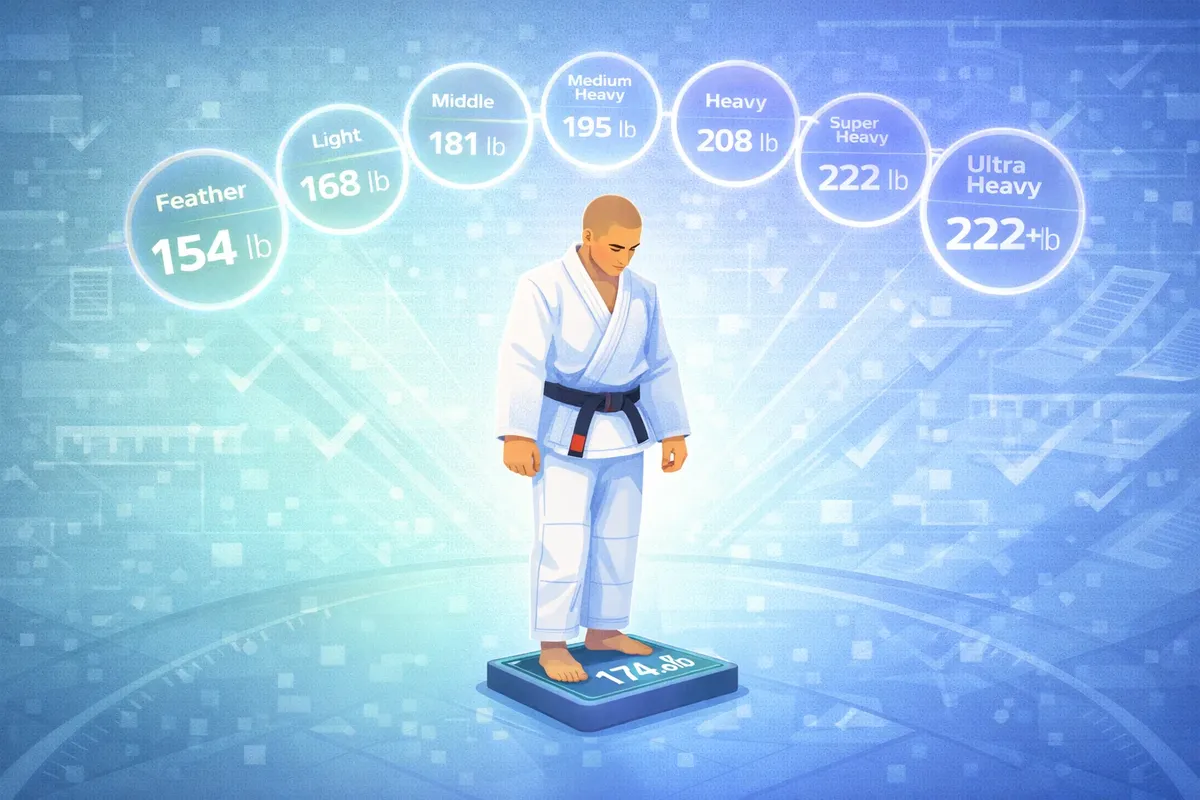
Make sure you understand IBJJF weight classes and match durations so you know exactly how much time you have.
Longer Matches (8-10 minutes)
- More time for strategy
- Can recover from early deficit
- Conditioning matters more
- Position battles intensify
Scoreboard Awareness
During Your Match
- Glance at scoreboard when safe
- Know the score before final minutes
- Adjust strategy based on score
- Don't obsess over watching
Scoreboard Information
Typical display shows:
- Athlete names
- Points for each
- Advantages for each
- Penalty indicators
- Time remaining
Common Scoring Scenarios
Scenario 1: Guard Player
You pull guard, sweep, and mount:
- Guard pull: 0 points
- Sweep: 2 points
- Mount: 4 points
- Total: 6 points
Scenario 2: Guard Passer
You take down, pass, take back:
- Takedown: 2 points
- Guard pass: 3 points
- Back control: 4 points
- Total: 9 points
Scenario 3: Back-and-Forth
Multiple reversals:
- Opponent sweeps you: 2 points
- You pass guard: 3 points
- Opponent sweeps again: 2 points
- You take mount: 4 points
- Score: 7-4 in your favor
Key Takeaway
Winning on points requires a clear plan: score early, advance positions methodically, and maintain awareness of the scoreboard. The guard passer who chains pass (3 pts) into mount (4 pts) or back take (4 pts) creates an almost insurmountable 7-point lead from a single sequence.
Official Sources
- IBJJF Books & Videos - Official scoring rules and point values
If this is your first time competing, our first IBJJF tournament guide walks you through registration, weigh-ins, and competition day logistics.
Master the points game with Rollbook. Track your competition results, analyze your scoring patterns, and identify areas to improve. Our detailed session logging helps you become a smarter competitor. Start your free trial today.
Oss!