By Philipp — Rollbook · Updated November 3, 2026
Darce Choke (D'Arce): How It Works, Setups and Defense
The darce choke traps your opponent's arm against their own neck. How it works, the five setups that land it, how to finish without cranking the jaw, how it differs from the anaconda, and how to defend it.
On this page
What Is the Darce Choke?
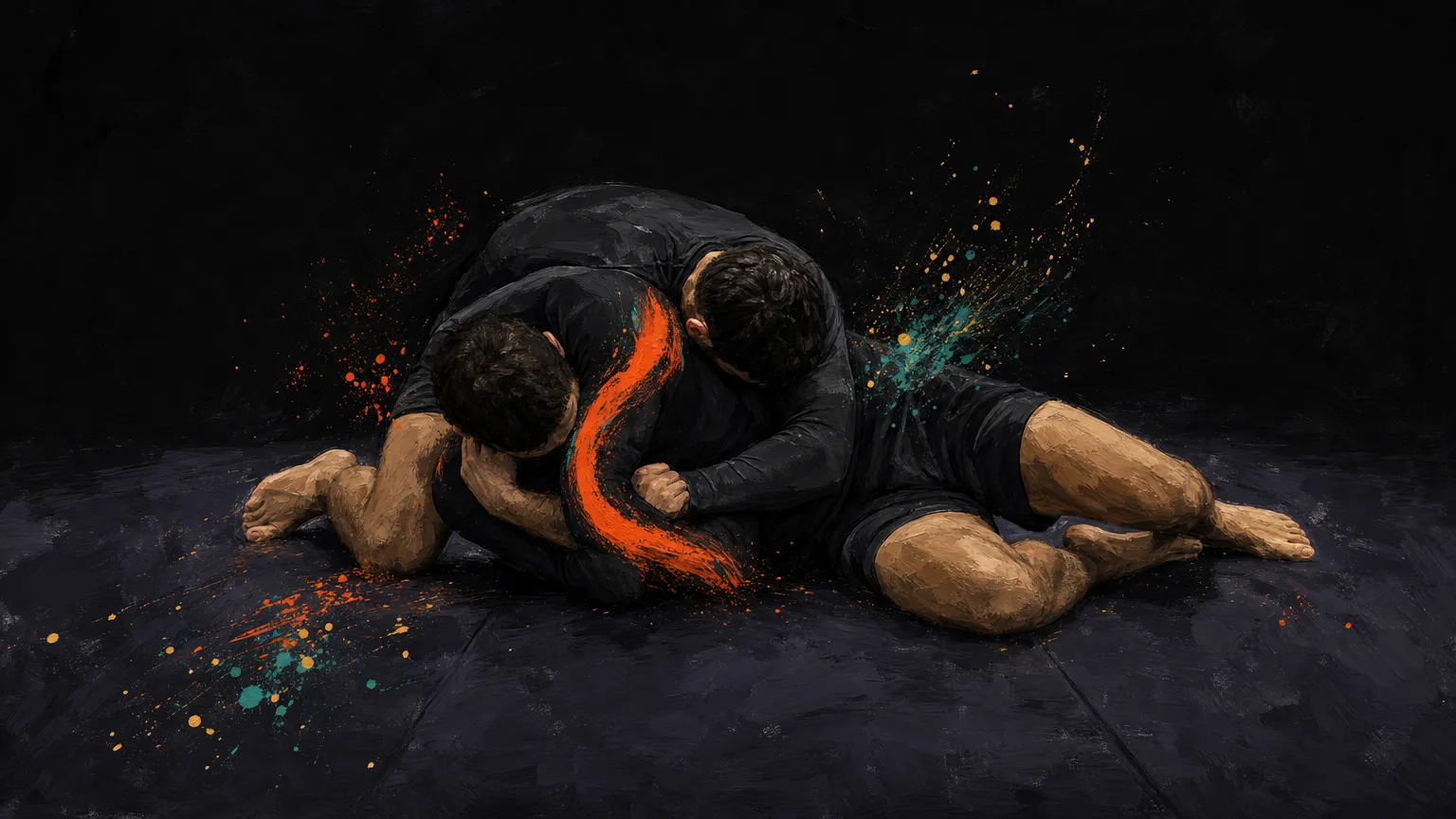
The darce choke (also spelled D'Arce) is a head-and-arm choke. Your arm goes under your opponent's arm and across the front of their neck, and you lock your hand on your own biceps. Their trapped shoulder presses into one side of their neck and your arm presses into the other. That squeezes both carotid arteries, so it is a blood choke, not a windpipe choke.
It belongs to the arm triangle family, next to the anaconda and the mounted arm triangle. You'll find it wherever an opponent's head and one arm end up together in front of you: after a sprawl, in top half guard when they fight for an underhook, and on a turtled opponent. It is a staple of modern no-gi grappling, and it still wins titles. At the 2026 IBJJF Pan No-Gi Championship, Maia Matalon won the women's heavyweight final with a darce.
The darce in one sentence: your arm goes under their arm, then across their neck, and their own shoulder does half the choking.
Darce vs Anaconda Choke: The Difference
The darce and the anaconda look alike and finish with the same biceps grip. The difference is the path of your arm and how you finish.
- Arm path: darce, under the arm and then the neck. Anaconda, under the neck and then the arm.
- Where your hand ends up: darce, past the far side of their neck. Anaconda, out through their armpit.
- Usual position: darce, top half guard, side control or turtle. Anaconda, the front headlock.
- Usual finish: darce, a sprawl and a walk to side-on. Anaconda, the gator roll.
In the darce, your choking arm goes under their armpit first, then in front of their neck, and your hand comes out past the far side of their neck. You finish by flattening them and walking your body side-on.
In the anaconda, you start from a front headlock: your arm goes under their neck first, then up through the armpit of the trapped arm. You usually finish with a gator roll, rolling them over their trapped shoulder so it drives into their neck.
A quick way to tell them apart in the moment: if your hand pops out through their armpit, it's an anaconda. If it pops out on the far side of their neck, it's a darce.
Where the Name Comes From
The choke is named after Joe D'Arce, a third-degree black belt under Renzo Gracie. He didn't invent it, but he hit it so often in jiu-jitsu and submission grappling tournaments that it became his. The name came from Jason Miller, the MMA fighter, who got caught by it while sparring with D'Arce. D'Arce had no name for the move, so Miller called it the "Darce". Most gyms still say it that way, to rhyme with "farce", although the family name is pronounced closer to "dar-see".
Others have a claim to it too. Luta Livre practitioners credit Björn Dag Lagerström, who is said to have found it while getting an anaconda wrong in training.
In Brazil the same choke is the Brabo choke. Leonardo "Leo" Vieira, the founder of Checkmat, saw one of his white belts fall into the position by instinct and started working on it. He used it to submit most of his opponents at the 2004 Pan American Championship and the 2004 World Cup. His friend Kid Peligro named it after Vieira's email address, which started with "leobrabo". Brabo means fierce or angry in Portuguese. Today "Brabo" usually means the gi version, where you can use your opponent's gi to lock the choke.
How to Finish the Darce Choke
Every setup ends with the same finish. Do these steps in order:
- Trap the arm close to the neck. Their arm has to end up against their own neck. If there's a gap between their shoulder and their head, there's no choke.
- Thread deep. Slide your choking arm under their armpit and across the front of their throat until your hand comes out past the far side of their neck. A shallow arm lands on the jaw.
- Lock the grip. Your choking hand grabs the biceps of your other arm, and that other hand goes onto their back or behind their head. Some players lock a gable grip (palm to palm) instead. Either works if the arm is deep.
- Get your chest onto their trapped shoulder. This is what closes the last bit of space. In half guard, drop your weight onto the front of that shoulder and flatten them to the mat.
- Turn side-on. From a front headlock or turtle, sprawl your hips and walk your feet toward their hips, until your body points across theirs. Squaring up gives them room to breathe and turn.
- Squeeze with your back, not your biceps. Pull your elbows together and expand your chest. If you're yanking with your arms, your forearms will give out before they do.
If they stand up or post on their hands, you can roll through. Keep the lock, sit to your side toward their trapped arm, and finish from there.
Safety: A deep darce can put someone to sleep in seconds. Squeeze gradually in training, and let go the moment your partner taps. If it feels like a crank on the jaw or neck, you're too shallow: fix the angle instead of squeezing harder.
Darce Choke Setups
From the Front Headlock
This is the classic entry. When someone shoots a takedown and you sprawl, or you snap their head down, you end up in front of them with their head under your chest.
- Control the head and pull one of their arms in tight, so their elbow sits next to their face.
- Step a little to the side of that arm.
- Thread your arm under that armpit and across their throat, then lock the grip.
- Sprawl, walk toward their hips on the trapped-arm side, and squeeze.
From the same front headlock you can also go for the anaconda or a guillotine. Good front headlock players chain all three, depending on which way their opponent moves.
From Top Half Guard When They Underhook
This is the most common darce in modern grappling. The bottom player gets an underhook, coming under your armpit to climb to your back or sweep you. That underhooking arm is exactly the arm you need to trap. Grapplearts breaks it down like this:
- Overhook their underhooking arm, so it can't climb any higher.
- Your other arm goes under their head and grips the back of their neck, to stop their head pulling away.
- Slide your overhooking arm deeper until your hand comes out past their head.
- Lock that hand on your other biceps, and put your other hand on their back.
- Drop your weight back and down, so your upper chest lands on the front of their trapped shoulder.
- Drive forward off the balls of your feet to flatten them, and squeeze.
The darce doesn't just finish here. It's also the best answer to a strong half guard underhook, because it turns their attack into your submission. For more top half guard work, see our guard passing guide.
From the Turtle
A turtled opponent who reaches forward, posts a hand, or leaves an elbow away from their knee gives you the arm. Pull that arm away from their body, thread under it and around the neck, and lock. Then sprawl, or roll through as they try to sit out or stand.
From Side Control When They Turn In
When the bottom player turns onto their side to face you and recover guard, their near arm comes up toward their neck. Thread under it as they turn, lock the grip, and follow their turn with your chest so they end up flat on their trapped shoulder.
From the Bottom
You can also hit the darce from butterfly guard or seated guard, usually when your opponent dives in with their head low. Get the head and an arm, thread, lock, then sit through or roll toward their trapped arm. Don't try to finish lying flat under them. You need your hips and your body turned to close the space.
Common Darce Mistakes
- A shallow thread. Your forearm sits on their jaw and nothing happens, or it turns into a jaw crank. Your hand has to come out past the far side of their neck.
- No shoulder in the neck. If their trapped shoulder isn't driven across their own throat, you're just hugging them.
- Staying square. Facing them head-on leaves them room to turn into you. Get side-on.
- Squeezing with your arms only. Pull your elbows together and expand your chest instead.
- Head high. Keep your head low, near their ear or the mat, so they can't turn into the space.
- Locking the grip before you control the head. A grip without head control just gets peeled off.
How to Defend the Darce Choke
Most darce defense happens before the grip is locked. Once a deep darce is set and your shoulder is across your throat, it's usually time to tap.
Before the arm gets in:
- Keep your elbows tight to your ribs. Don't post a hand on the mat in front of you from a front headlock or turtle.
- Keep your head up and your posture strong after a sprawl or snap-down. The darce lives on a bent-over opponent.
- In bottom half guard, commit to the underhook, with your head tight to their chest and coming up onto your side, or give it up. A lazy, half-in underhook is the arm the top player wants.
While the arm is threading:
- Pull your trapped elbow down and back toward your hip before their hand clears your neck.
- Use your free hand to block or strip the wrist of the threading arm, so it can't reach the biceps.
- Square your chest back toward them, so they can't get side-on.
- In half guard, recover your knee shield or your frames, so they can't drop their chest onto your shoulder.
Once the grip is locked:
- Late escapes exist, but they're unreliable against someone who knows the finish. If your shoulder is across your throat and the squeeze is on, tap and reset. Rolling with a choke on is how people get hurt.
Is the Darce Choke Legal in IBJJF?
Yes, for every adult and every juvenile (16-17) competitor. IBJJF's table of illegal techniques doesn't name the darce, but it bans the arm triangle, the family the darce belongs to, for its two youngest age groups:
| Division | Darce |
|---|---|
| Kids 4-12 | Illegal |
| Kids 13-15 | Illegal |
| Juvenile 16-17 | Legal |
| Adults, all belts | Legal |
It's legal in gi and no-gi, at white belt as well as black belt. The same table also bans the frontal guillotine for kids under 16. Other organizers write their own kids rules, so check the event's rulebook before a kids tournament. For everything else that's banned and at which belt, see our IBJJF illegal techniques guide.
How to Drill the Darce
- Front headlock reps. Your partner kneels while you snap them down, thread, lock, walk and finish. Do 10 slow reps on each side, focusing on getting your hand past the far side of their neck.
- Half guard underhook reps. Your partner plays bottom half guard and gives you the underhook. You overhook, thread and flatten them. The underhook should feel like an invitation.
- Positional rounds. Start in a front headlock for one minute. The top player wins with a darce, anaconda or guillotine, and the bottom player wins by standing up or recovering guard.
Need a partner or an open mat for reps? Find a BJJ gym near you.
Darce Choke FAQ
Who invented the darce choke?
Nobody knows for sure. Joe D'Arce, a Renzo Gracie black belt, popularized it in competition, and Jason Miller named it after him. Luta Livre practitioners credit Björn Dag Lagerström. In Brazil, Leo Vieira made the same choke famous as the Brabo choke in 2004.
How do you pronounce darce?
Most people say "darce", rhyming with "farce". Joe D'Arce's family name is pronounced closer to "dar-see".
What's the difference between a darce and an anaconda?
The path of your arm. In the darce, your arm goes under their arm first, then across their neck. In the anaconda, it goes under their neck first, then through their armpit. The anaconda is usually finished with a gator roll and the darce with a sprawl and walk. There's a side-by-side comparison above.
What is a Brabo choke?
The same choke under its Brazilian name, after Checkmat founder Leo Vieira. Today it usually means the gi version, where the gi gives you extra grips to lock it.
Is the darce a blood choke?
Yes. It squeezes the carotid arteries on both sides of the neck, between their own shoulder and your arm. Done right, it shouldn't press on the windpipe.
Is the darce legal for kids?
Not in IBJJF. Arm triangles are illegal for ages 4-12 and 13-15. From 16, at every belt, they're legal. Other organizers set their own kids rules.
Can white belts use the darce?
Yes. Under IBJJF rules it's legal for adult white belts in both gi and no-gi.
Why does my darce feel like a jaw crank?
Your arm is too shallow, or you're squaring up. Get your hand past the far side of their neck, drive your chest onto their trapped shoulder, and turn side-on before you squeeze.
Does the darce work in the gi?
Yes, but you'll see it more in no-gi, where front headlocks and underhook battles happen all the time. In the gi it often goes by the name Brabo.
Sources
- Arm triangle choke (Wikipedia): the darce, Brabo and anaconda, and where the names come from
- Joe D'Arce explains his namesake choke (BJJEE, August 2018)
- Step by step D'Arce choke vs the half guard (Grapplearts)
- IBJJF Books & Videos: the rules book and the "Illegal moves by age and category" table (January 2024 edition)
- IBJJF Pan No-Gi 2026 results: Maia Matalon's darce in the women's heavyweight final
Drilling the darce this month? Log your front headlock and half guard rounds in your Rollbook technique journal, and see which setup actually lands in sparring. Rollbook is free on iOS and Android.
Oss!