By Philipp — Rollbook
Summer BJJ Training: Stay Sharp When Everyone Else Takes a Break
How to maintain and even improve your BJJ game during the summer months when training attendance drops and the heat makes everything harder.
On this page
The Summer Drop-Off
Walk into any BJJ academy in June and count the heads on the mat. Now compare that to February. Summer is when academies thin out. Training partners disappear for weeks. Evening classes that normally pack thirty people shrink to twelve. Open mats that used to have a waiting list suddenly have empty space along the walls.
This happens every year, at every gym. And it creates one of the biggest opportunities in your entire training year — if you know how to use it.
The practitioners who keep training through summer do not just maintain their skills. They gain ground. While everyone else is at the beach, the summer regulars are sharpening their game, getting more mat time per class, and building a fitness base that pays off when fall competition season arrives.
Why Summer Attendance Drops
Understanding why the mats empty out helps you recognize that this is normal — not a sign that your training partners lost dedication.
Vacations. Families take trips. A two-week vacation means two weeks off the mat, and re-establishing the routine after time away is always harder than expected. Many people never quite get back on track until September.
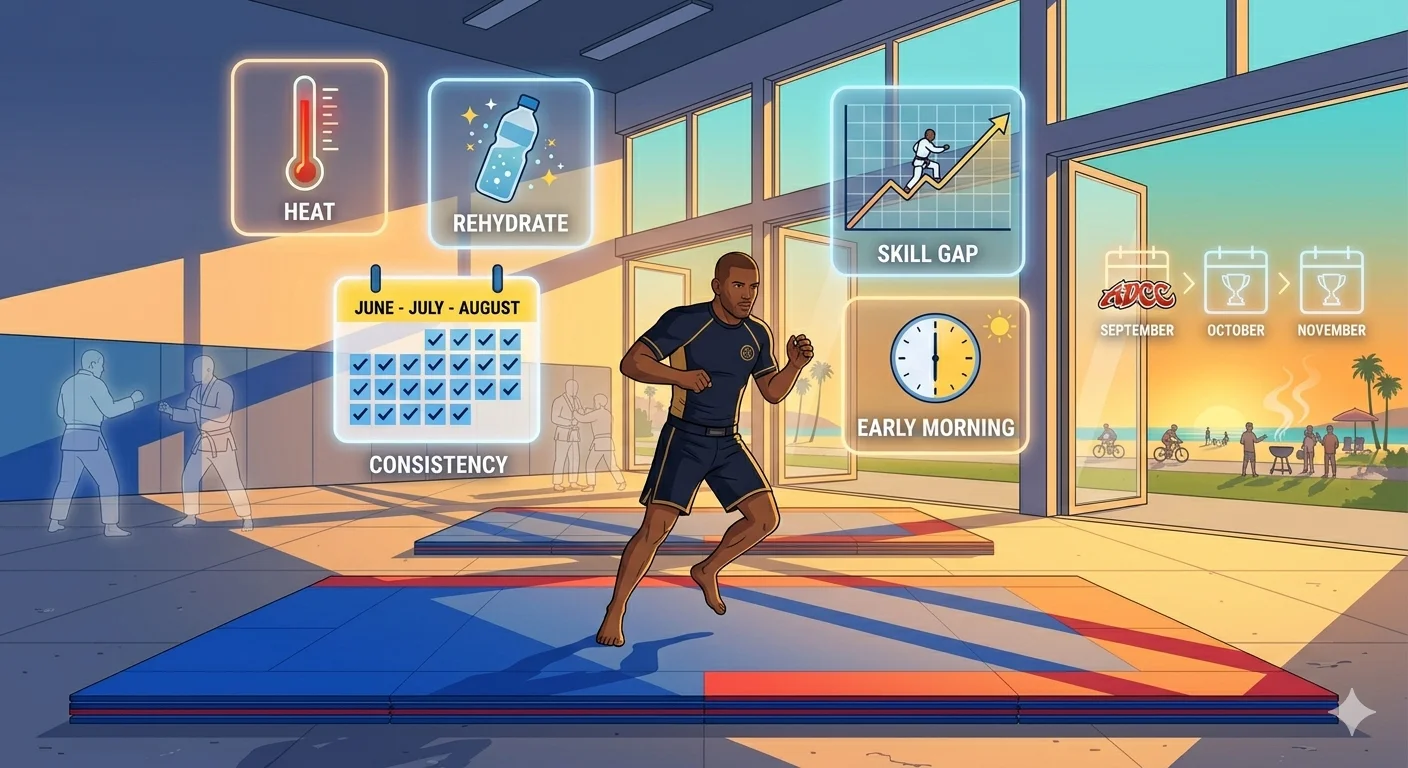
Heat. Training in a gi when it is 35 degrees outside and the gym has mediocre air conditioning is genuinely miserable. The heat saps energy, makes warm-ups feel like the main workout, and turns every roll into a sweat-soaked endurance test.
Kids out of school. Parents face childcare gaps and schedule conflicts. The evening class that fit perfectly during the school year no longer works when the kids are home all day.
Competing activities. Surfing, hiking, cycling, barbecues, travel — summer offers a dozen alternatives to spending an hour in a hot room wearing a heavy cotton uniform.
Did You Know: Many academy owners report a 30 to 40 percent drop in class attendance during June through August. Some gyms adjust their schedules accordingly, adding early-morning sessions to capture the training window before the heat peaks.
Why Summer Is Actually the Best Time to Train
The attendance drop is everyone else's loss and your gain.
Smaller Classes Mean More Mat Time
When twenty people become ten, everything changes. You get more rounds of sparring instead of sitting out. Your instructor has time to watch your rolls and give individual feedback. Drilling is uninterrupted because nobody is waiting for your spot. Smaller classes are functionally equivalent to semi-private instruction at your regular membership rate.
Competitors Are Peaking for Fall
The fall calendar is loaded. ADCC 2026 in Krakow happens in September. IBJJF No-Gi Worlds and other major events stack up through October and November. Serious competitors use summer as their primary preparation window. Training alongside them elevates everyone on the mat.
The Gap Widens
While your training partner takes the summer off and comes back in September rusty, you have been training consistently for three straight months. The gap has widened — not because you did anything extraordinary, but because you simply showed up. Summer is where consistency separates the serious practitioners from the casual ones.
Track every roll — log sessions and techniques for free
Training in the Heat
Heat is the defining challenge of summer training. Managing it properly is the difference between a productive session and a dangerous one.
Hydration Strategies
Hydration does not start when you walk into the gym. It starts hours before.
| Timing | Protocol |
|---|---|
| Morning of training day | Drink 500 ml of water upon waking |
| 2-3 hours before class | Consume 500-700 ml of water with a balanced meal |
| 30 minutes before class | Drink 250-350 ml of water or an electrolyte drink |
| During class | Sip 150-250 ml every 15-20 minutes during water breaks |
| After class | Drink 500-750 ml within the first 30 minutes post-training |
Plain water is not enough when you are sweating heavily. Add an electrolyte supplement to at least one of your pre- or post-training drinks. Look for products with sodium as the primary electrolyte — most sports drinks under-dose sodium relative to what grapplers lose in a hot session.
Pro Tip: A simple DIY electrolyte drink: 1 liter of water, 1/4 teaspoon of salt, a squeeze of lemon, and a tablespoon of honey. It replaces what you are sweating out and costs almost nothing.
Adjusting Intensity
Prioritize technique over intensity. Use the heat as a forcing function for efficiency. When you are too hot to muscle through positions, you have no choice but to rely on proper technique. Many practitioners report technical breakthroughs during summer precisely because the heat removes their ability to rely on athleticism.
Shorten rounds. If your gym normally runs six-minute rounds, consider four or five minutes with slightly longer rest periods. You get the same number of quality exchanges with less cumulative heat stress.
Drill more, spar less. A session built around 40 minutes of drilling and positional sparring with 15 minutes of live rolling is safer and often more productive than a full hour of open sparring in oppressive heat.
Cooling Strategies
Cold towels. Keep a small towel in a cooler or freeze one before training. Drape it on the back of your neck during breaks — the neck has major blood vessels close to the surface, and cooling them drops your core temperature quickly.
Time your sessions. Choose classes that avoid peak heat. Early morning sessions before 9 AM or evening sessions after 7 PM are significantly cooler in most climates.
Cool down actively. After training, splash cold water on your wrists, neck, and face. Drink cold fluids. The faster you lower your core temperature, the better you recover.
Chewjitsu on whether training in a hot BJJ gym with no air conditioning actually has benefits — and how to decide when to push through the heat versus when to back off:
When NOT to Train
Stop training immediately if you experience: dizziness that does not resolve with rest, nausea or vomiting, confusion, cessation of sweating despite continued exertion (a sign of heat stroke), cramps that do not respond to hydration, or a heart rate that stays elevated during rest.
Heat exhaustion and heat stroke are medical emergencies. No training session is worth a hospital visit. Practitioners who are over 40 or newer to physical training are especially vulnerable, but heat illness can affect anyone.
Important: If you take medications such as antihistamines, beta-blockers, or diuretics, be aware that these can impair your body's temperature regulation. Consult your doctor about training in heat if you take any medications that affect heart rate, blood pressure, or sweating.
Building a Summer Training Plan
Summer's slower pace is perfect for structured skill development. Instead of just showing up and rolling, use these months to work on specific areas of your game with intention.
Set Specific Summer Goals
Pick two or three concrete targets. If you set goals at the start of the year, summer is the perfect checkpoint for a mid-year review and course correction.
Examples of good summer goals:
- "Develop a reliable half guard game with two sweeps and one submission by September 1"
- "Hit a triangle from closed guard in live rolling at least once per week for 12 weeks"
- "Compete in one local tournament before September"
Attack Your Weaknesses
During the busy season, it is tempting to lean on your strengths every roll. Summer, with its smaller, more familiar groups, is the time to deliberately put yourself in bad positions. Play bottom when you normally play top. Pull guard when you normally wrestle. Your short-term sparring results will suffer, but your long-term development will accelerate because you are closing the holes opponents will eventually exploit.
Open Mats and Cross-Training
Summer is an ideal time to visit other gyms. Training with unfamiliar partners exposes you to techniques and styles you never see at your home gym. Even one visit per month to a different school broadens your understanding of jiu jitsu significantly.
Solo Drill Days
Some days you cannot make it to the gym. On those days, a solo drill session at home keeps your movement patterns engaged. Our complete guide to solo BJJ drills provides 25 exercises you can do with minimal equipment. Even 20 minutes of shrimps, bridges, and technical stand-ups maintains your baseline.
Jason Scully's comprehensive reference of 54 solo grappling drills — the go-to home training resource with nearly half a million views:
Strength and Conditioning in Summer
Your off-mat training needs adjustment during the hot months.
Adjusting S&C for Heat
Reduce overall volume by 10 to 20 percent during peak summer weeks. Your body is already working harder to cool itself, and cumulative fatigue from hot BJJ sessions plus hot strength sessions adds up fast. Focus on maintaining your lifts rather than chasing personal records. For a complete framework, see our BJJ conditioning guide.
Outdoor Training Alternatives
Summer opens up conditioning options unavailable the rest of the year:
- Swimming — builds cardiovascular capacity without joint impact and keeps you cool. Even 20 to 30 minutes of laps twice a week transfers directly to the mats
- Trail running or hiking — develops leg endurance and ankle stability on uneven terrain
- Cycling — excellent for zone 2 cardio development, low-impact, and easy to schedule before the heat peaks
- Park workouts — pull-ups, bodyweight circuits, and sprints on grass combine S&C with fresh air
Mobility and Flexibility
Summer heat actually makes flexibility work more productive. Your muscles are warm, your connective tissue is more pliable, and deep stretches feel more accessible. Dedicate two to three sessions per week to focused mobility work. Our stretching and mobility guide provides targeted routines for the hips, shoulders, and spine. Mobility gains made during summer, when your body is naturally more receptive to stretching, tend to stick better than those forced during cold months.
Summer Competition Calendar
The misconception that summer is a dead period for competition is wrong.
Regional tournaments run throughout June, July, and August, often with smaller brackets that give you more matches and shorter waits. These are ideal for testing new techniques without the pressure of a major championship.
ADCC Trials continue through the summer as athletes prepare for the ADCC World Championship in the fall. IBJJF events run year-round — check the 2026 schedule for summer events in your region.
In-house competitions at many academies are perfect for beginners who want their first competition experience or experienced athletes looking to test new game plans.
Pro Tip: Register for a summer tournament early and use it as an anchor for your training plan. Having a date on the calendar transforms aimless rolling into focused preparation.
Staying Motivated
Chewjitsu on how to handle the motivation slump that hits when training partners disappear and the mats empty out — and why waiting to "feel motivated" is the wrong approach:
Track Your Consistency
What gets measured gets managed. Recording every session creates a visual record of your commitment. When you can see twelve consecutive weeks of consistent training, skipping a session becomes harder because you do not want to break the streak. A dedicated training tracker makes this effortless.
Set a Summer Challenge
- The consistency streak: Train at least three times per week for 13 consecutive weeks. If life forces you to miss a gym session, a solo drill session at home counts
- The technique project: Choose one position and learn it deeply. Film yourself, take notes, track what works and what fails
- The 100-session summer: Hit 100 training sessions between June 1 and August 31 across BJJ, S&C, solo drills, and open mats
Find Your Summer Training Partners
Identify two or three people at your gym who will train through the summer. Text each other before class. Hold each other accountable. Having a partner who expects you to show up changes the calculus when the alternative is staying home.
Mid-Year Goal Review
If you set goals in January, summer is the halfway point. Pull out your original goals and be honest: are you on track? Adjust your targets for the second half of the year based on six months of real data rather than January optimism.
Preparing for the Fall Season
Everything you do in summer is an investment in the fall.
Fall Is Tournament Season
The biggest events in competitive BJJ land between September and December — ADCC Worlds, IBJJF No-Gi Worlds, and dozens of regional championships. Athletes who trained through summer arrive sharp and conditioned. Those who took the summer off arrive scrambling to get back in shape.
Even if you do not compete, the gym atmosphere shifts in the fall. Training intensity increases. New students arrive. Your summer training base means you are ready for that elevated pace instead of struggling to keep up.
Build Your Game Plan
Use August to consolidate the techniques you developed over the summer. Narrow your focus from exploration to refinement.
| Position | Primary Technique | Secondary Technique | Submission |
|---|---|---|---|
| Top (passing) | Your best pass | Backup pass | N/A |
| Bottom (guard) | Primary sweep | Secondary sweep | Best sub from guard |
| Mount | Maintain + advance | Transition to back | Cross collar / armbar |
| Back | Seatbelt control | Body triangle | Rear naked choke |
Fill this out based on what actually works in live rolling, not what you wish worked. Your summer training data should make the answers clear.
Progressive Intensity Increase
If you dialed back intensity during peak heat, gradually ramp it up as temperatures cool. Add one extra sparring round per week. Increase S&C volume back to pre-summer levels. Do this over three to four weeks rather than jumping to maximum intensity on the first cool day. This progressive approach prevents the injuries that happen when athletes go from summer mode to competition mode overnight.
Key Takeaway
Summer is not the off-season. It is the opportunity season. Smaller classes mean more personal instruction. Heat forces technical efficiency. The competition calendar keeps rolling. And every session you attend while others take a break widens the gap between you and the practitioners who press pause for three months. Train smart, hydrate aggressively, adjust your intensity for the heat, and use the quieter months to attack specific weaknesses in your game. When fall arrives and the mats are packed again, you will be the one who is ready.
Make this your best training summer yet. Download Rollbook to track every session, monitor your consistency streak through the summer months, log techniques you are developing, and see your progress in real time. When September arrives and your training partners ask how you got so sharp, you will have the data to show exactly what you did. Start your free trial today.
Oss!