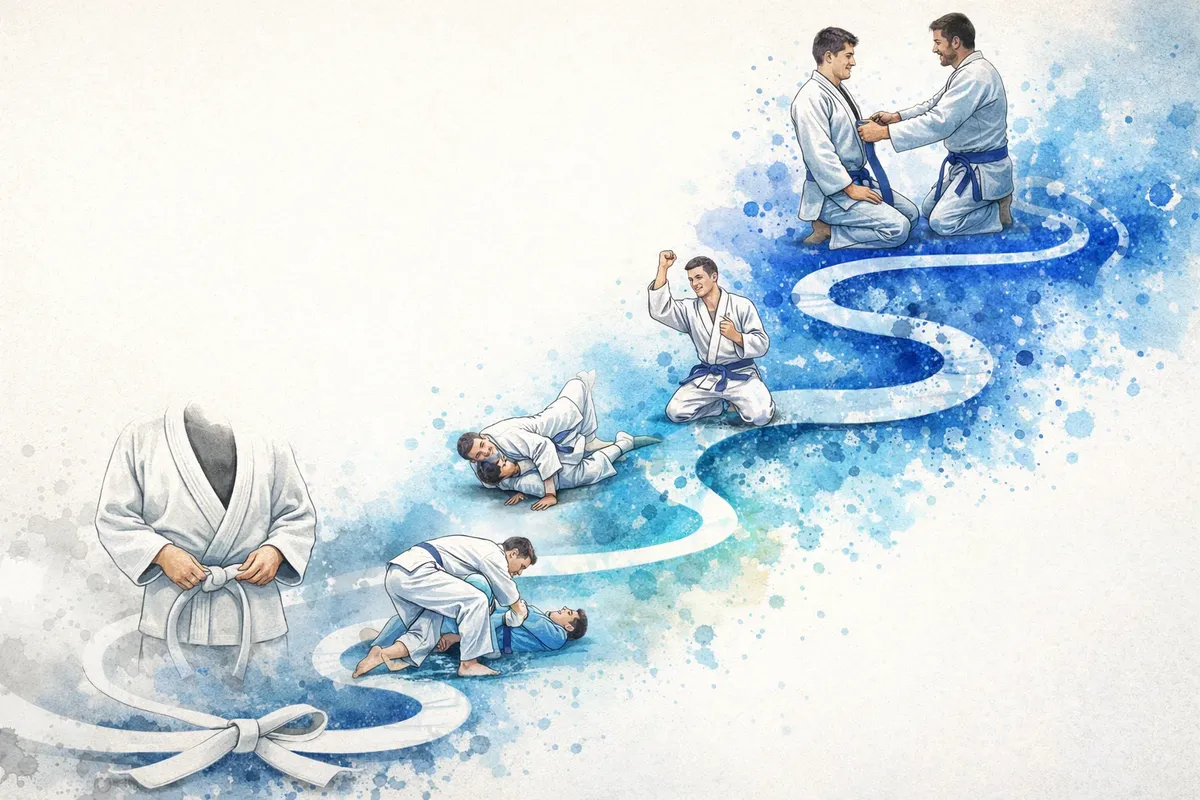
BJJ Belt Progression System Explained: From White to Black Belt
The definitive guide to the Brazilian Jiu-Jitsu ranking system, including time-in-grade requirements, stripe promotions, and what each belt level represents in your martial arts journey.
Understanding the BJJ Ranking System
The Brazilian Jiu-Jitsu belt system is one of the most respected ranking structures in martial arts. Unlike some arts where belts can be earned in months, BJJ belts represent years of dedicated training, rolling, and proven ability against resisting opponents.
This guide covers everything you need to know about BJJ belt progression: the belt colors and their meanings, promotion requirements, the stripe system, IBJJF age requirements, and realistic timelines for each level. For a data-driven look at reaching your first major milestone, see our guide on how long it takes to get a blue belt.
The BJJ Belt Hierarchy
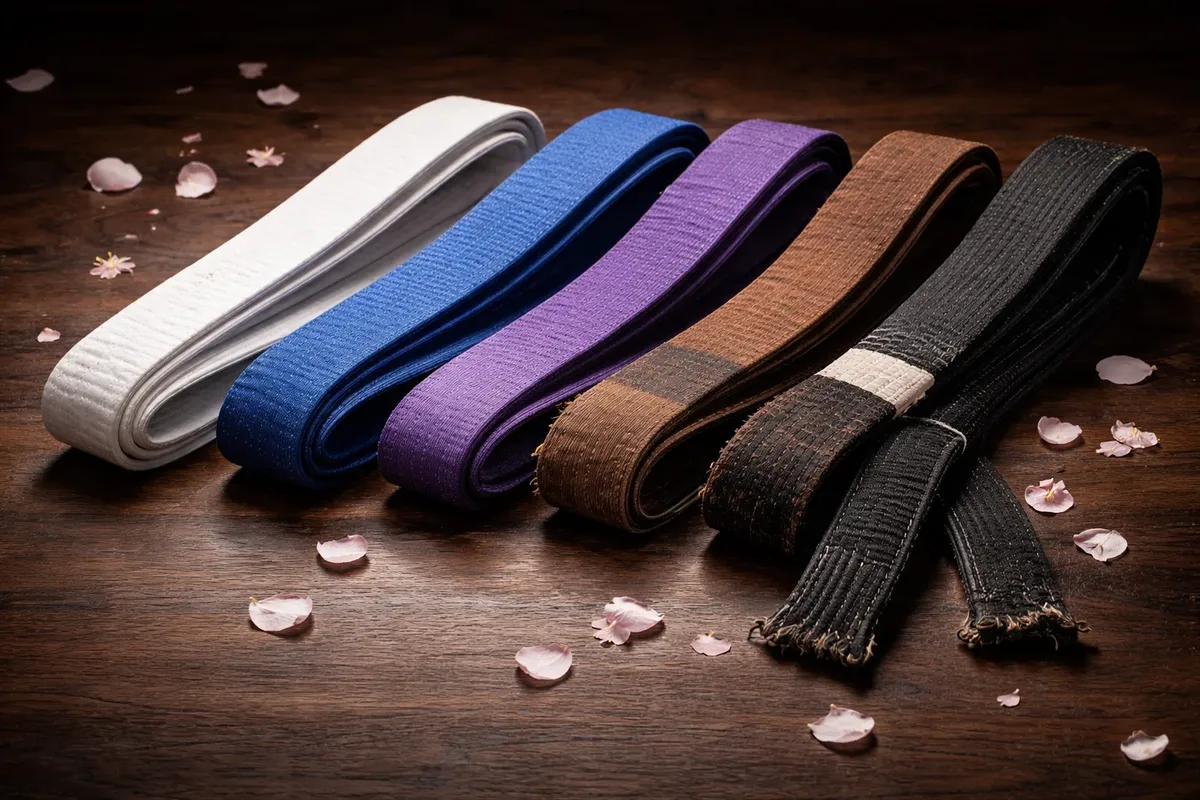
BJJ uses five main belt ranks for adults:
- White Belt - The beginning
- Blue Belt - The first major milestone
- Purple Belt - The intermediate expert
- Brown Belt - The advanced practitioner
- Black Belt - Mastery and teaching
Beyond black belt, there are additional ranks:
- Red/Black Belt (Coral Belt) - 7th degree black belt
- Red/White Belt (Coral Belt) - 8th degree black belt
- Red Belt - 9th and 10th degree (reserved for BJJ pioneers)
Did You Know: The BJJ red belt (9th and 10th degree) is so rare that only a handful of people in history have held it. The 10th degree red belt has only ever been awarded to the founding members of Brazilian Jiu-Jitsu, including the Gracie family pioneers.
A concise breakdown of every BJJ belt — what each level represents, what you should be able to do, and what separates one rank from the next:
White Belt: The Foundation
What White Belt Represents
The white belt is where everyone begins, regardless of background or prior martial arts experience. If you haven't started yet, our complete beginner's guide covers everything you need to know for your first class. White belt represents:
- A blank slate, ready to learn
- Beginning understanding of basic positions
- Introduction to the philosophy and etiquette of BJJ
- Development of "mat fitness" and grappling endurance
White Belt Timeline
Most practitioners spend 1-2 years at white belt. Factors affecting this timeline include training frequency, prior grappling experience, and academy promotion standards.
What You Should Learn at White Belt
Positional Awareness:
- Recognize and name the major positions (mount, side control, guard, back control)
- Understand the positional hierarchy (which positions are dominant)
- Learn basic survival from inferior positions
Fundamental Techniques:
- Hip escape (shrimping) and other defensive movements
- Basic closed guard attacks and sweeps
- Guard passing concepts
- Mount and side control escapes
- 2-3 reliable submissions
Rolling Ability:
- Survive against higher belts without panic
- Execute techniques against resisting opponents
- Roll safely without injuring yourself or others
White Belt Stripes
Most academies use stripes (1-4 on the white belt) to indicate progress toward blue belt:
- 1st stripe: Shows commitment and basic understanding
- 2nd stripe: Developing defensive awareness
- 3rd stripe: Beginning to mount offense consistently
- 4th stripe: Approaching blue belt readiness
Pro Tip: Don't obsess over stripes. Some academies give them out every few months, while others barely use them at all. Focus on skill development rather than counting the tape on your belt. The techniques you can execute under pressure matter far more than the number of stripes you have.
Key Takeaway
White belt is about building a foundation of basic survival, positional awareness, and mat fitness. Your only job at white belt is to show up consistently, learn to defend yourself, and develop comfort with the chaos of grappling.
Track every roll — log sessions and techniques for free
Blue Belt: First Major Achievement
What Blue Belt Represents
The blue belt is often called the "first real belt" in BJJ. It signifies:
- Solid foundational knowledge
- Ability to defend against most untrained opponents
- Beginning development of a personal game
- Technical knowledge to start helping beginners
Blue Belt Timeline
Blue belts typically train for 2-3 years before purple belt promotion. This is one of the longer belt periods because:
- There's an enormous amount to learn
- Students are developing and refining their style
- Technical depth increases significantly
- Many practitioners focus on competition during this period
What You Should Develop at Blue Belt
Technical Breadth:
- Multiple guard variations (closed, half, open guards)
- Comprehensive passing game
- Submission chains and combinations
- Counter-techniques and defensive systems
- Takedown/pulling options
Strategic Depth:
- Understanding of timing and distance
- Ability to set traps and bait reactions
- Competition strategy and game planning
- Ability to adapt mid-roll
Teaching Fundamentals:
- Help white belts with basic techniques
- Explain concepts, not just movements
- Model good training partner behavior
The "Blue Belt Blues"
This is the belt level where the most practitioners quit. Common reasons include:
- Achieving a major goal removes motivation
- Realizing how much more there is to learn
- Life circumstances changing
- Frustration with apparent plateau
- Competition losses to other blue belts
Tracking your progress and setting new goals helps combat blue belt blues.
Warning: The "blue belt blues" is the most dangerous quit point in BJJ. Statistics suggest more practitioners quit at blue belt than any other rank. Combat this by setting new goals beyond just belt promotion — focus on competition, developing a specific guard game, or learning a new submission system to keep your training fresh and purposeful.
Jocko Willink on how long it takes to get a BJJ blue belt — his honest take on timelines, what the belt actually means, and why the journey matters more than the destination:
Purple Belt: The Intermediate Expert
What Purple Belt Represents
Purple belt is often considered the "first advanced belt." Purple belts:
- Have developed a distinctive game and style
- Possess comprehensive technical knowledge
- Can give higher belts trouble on good days
- Are trusted to lead classes and teach
Purple Belt Timeline
Purple belts typically spend 2-3 years at this level. Many consider this the "seasoning" period where:
- Technical knowledge becomes intuitive
- Details and micro-adjustments are refined
- Teaching ability develops significantly
- Students often become assistant instructors
What You Should Master at Purple Belt
Technical Mastery:
- Deep knowledge of your preferred positions
- Ability to improvise and create techniques
- Understanding of leverage and biomechanics
- High-level defensive systems
Mental Game:
- Reading opponents and anticipating reactions
- Managing pace and intensity of rolls
- Competition mindset and pressure handling
- Problem-solving in real-time
Contribution to Academy:
- Leading warm-ups and drilling
- Teaching fundamentals classes
- Mentoring lower belts
- Representing the academy in competition
Purple Belt Statistics
Interestingly, many practitioners stay at purple belt the longest. This is because:
- The jump to brown belt is significant
- Life often interferes during these years (career, family)
- Some practitioners are content at purple and train recreationally
- Competition at purple belt is extremely high-level
Brown Belt: The Final Preparation
What Brown Belt Represents
The brown belt is the final preparation for black belt. Brown belts:
- Possess near-complete technical knowledge
- Can handle most situations instinctively
- Often run classes and coach competitors
- Represent the academy's highest non-black belt standard
Brown Belt Timeline
Most brown belts spend 1-2 years at this level. This is typically the shortest colored belt period because:
- The gap between purple and brown is larger than brown to black
- Brown belts are polishing rather than learning new systems
- The focus shifts to mastery of details
- Teaching responsibilities often increase
What Defines Brown Belt Level
Near-Complete Game:
- No significant holes in technique
- Multiple options from every position
- Ability to roll effectively with anyone
- Seamless transitions and flow
Problem-Solving Ability:
- Can figure out new techniques by feel
- Adapts quickly to unfamiliar situations
- Creates solutions to unique problems
- Analyzes and addresses weaknesses systematically
Leadership and Teaching:
- Trusted to run the entire academy in instructor's absence
- Coaches competitors at tournaments
- Develops curriculum for lower belts
- Embodies the academy's values and culture
Black Belt: Mastery Achieved
What Black Belt Represents
The black belt represents mastery of BJJ fundamentals and the beginning of true expertise. Black belts:
- Have complete technical competency
- Can teach all aspects of the art
- Often open their own academies
- Contribute to the art through teaching or competition
Time to Black Belt
The average time from white to black belt is 8-12 years of consistent training. However, this varies significantly:
- Elite competitors: 4-6 years (rare)
- Consistent trainers (4+ days/week): 7-10 years
- Recreational trainers (2-3 days/week): 10-15 years
Black Belt Degrees
Black belt has its own progression system:
| Degree | Time Required | Minimum Age | Notes |
|---|---|---|---|
| 1st | 3 years as black belt | 19 | First degree |
| 2nd | 3 years at 1st degree | 22 | - |
| 3rd | 3 years at 2nd degree | 25 | - |
| 4th | 5 years at 3rd degree | 30 | - |
| 5th | 5 years at 4th degree | 35 | - |
| 6th | 5 years at 5th degree | 40 | Master |
| 7th | 7 years at 6th degree | 50 | Red/Black coral belt |
| 8th | 7 years at 7th degree | 57 | Red/White coral belt |
| 9th | 10 years at 8th degree | 67 | Red belt (Grand Master) |
| 10th | - | - | Reserved for pioneers |
The IBJJF Requirements
The International Brazilian Jiu-Jitsu Federation (IBJJF) has established official minimum age and time-in-grade requirements. For a complete breakdown of IBJJF regulations, see our IBJJF rules guide:
Age Requirements
| Belt | Minimum Age |
|---|---|
| White | Any age |
| Gray/Yellow/Orange/Green | Under 16 only (kids belts) |
| Blue | 16 years old |
| Purple | 16 years old |
| Brown | 18 years old |
| Black | 19 years old |
Minimum Time at Each Belt
| Belt | Minimum Time |
|---|---|
| White to Blue | No minimum (instructor discretion) |
| Blue to Purple | 2 years minimum |
| Purple to Brown | 1.5 years minimum |
| Brown to Black | 1 year minimum |
Note: These are minimums. Most practitioners spend longer at each belt.
Did You Know: The IBJJF minimums are just that — minimums. The actual average time at each belt is significantly longer. For example, while the minimum time at blue belt is 2 years, most practitioners spend 3-4 years before being promoted to purple. Your instructor's standards and your own development pace matter far more than these official floors.
The Stripe System Explained
Stripes are small pieces of tape added to the belt to indicate progress within a rank. Most academies use 4 stripes per belt (except black belt, which has a different degree system).
How Stripes Work
Timing: There's no universal standard—some academies award stripes monthly to progressing students, while others are more selective.
Criteria: Common stripe criteria include:
- Attendance and consistency
- Technical improvement
- Rolling ability against peers
- Knowledge and understanding
- Competition participation (at some schools)
Meaning: Stripes indicate progress toward the next belt:
- 1 stripe: Progressing normally
- 2 stripes: On track, developing well
- 3 stripes: Advanced for belt level, approaching promotion
- 4 stripes: Imminent promotion consideration
Stripe Variations
Not all academies use stripes:
- Some give all 4 stripes at once before promotion
- Some don't use stripes at all
- Some use different numbers of stripes
- Competition-focused schools may skip stripes entirely
Kids Belt System
Children under 16 have a separate belt system with more ranks to provide frequent milestone achievements:
Kids Belt Colors (IBJJF Standard)
Ages 4-15:
- White
- Gray/White
- Gray
- Gray/Black
- Yellow/White
- Yellow
- Yellow/Black
- Orange/White
- Orange
- Orange/Black
- Green/White
- Green
- Green/Black
Ages 16+: Kids belts convert to adult belts (typically to white, blue, or purple depending on skill level and instructor evaluation).
Factors Affecting Promotion
What Instructors Look For
Technical Competence:
- Can you perform techniques correctly?
- Do you understand why techniques work?
- Can you execute under pressure?
Rolling Ability:
- How do you perform against peers?
- Can you submit lower ranks consistently?
- Can you survive and learn against higher ranks?
Consistency and Dedication:
- Do you show up regularly?
- Do you train through difficulties?
- Are you committed to improvement?
Knowledge and Understanding:
- Do you understand concepts, not just movements?
- Can you teach what you know?
- Do you study outside of class?
Character and Contribution:
- Are you a good training partner?
- Do you help others improve?
- Do you represent the academy well?
Common Promotion Approaches
Surprise Promotions: Called up after class unexpectedly Formal Testing: Scheduled belt tests with technique demonstrations Milestone-Based: After certain classes or time requirements Competition-Based: Requiring competition participation Pure Discretion: No set criteria, purely instructor judgment
A realistic benchmark for what your rolling and technique should look like at each belt — white through black — and what coaches and training partners are actually evaluating:
What Each Belt Really Means
Beyond the Physical Belt
The belts in BJJ represent more than technique:
White Belt: Humility, willingness to learn, persistence through difficulty
Blue Belt: Dedication, foundational competence, the decision to continue
Purple Belt: Understanding, creative expression, contribution to community
Brown Belt: Responsibility, near-mastery, teaching the art
Black Belt: Mastery of fundamentals, beginning of true learning, obligation to give back
The Paradox of Black Belt
Many black belts say they learned more after black belt than before. This is because:
- The pressure of promotion is removed
- You can focus purely on learning
- Teaching deepens understanding
- You attract higher-level training partners
A deep exploration of what BJJ belts truly represent — not just the technique, but the character, identity, and meaning behind each rank:
Comparing BJJ to Other Martial Arts
Why BJJ Takes Longer
BJJ black belts typically take longer than most other martial arts:
| Martial Art | Average Time to Black Belt |
|---|---|
| Brazilian Jiu-Jitsu | 8-12 years |
| Judo | 4-6 years |
| Taekwondo | 3-5 years |
| Karate (varies by style) | 4-6 years |
| Muay Thai (no belt system) | N/A |
| Wrestling (no belt system) | N/A |
Reasons for Longer Timeline
- Testing against resistance - You must prove your techniques work
- No forms or patterns - Everything is proven through sparring
- High competitive standards - You're measured against live opponents
- Comprehensive curriculum - Extensive techniques to learn
- Quality over quantity - Most gyms don't mass-promote
Pro Tip: If you're comparing your timeline to other martial arts, remember that BJJ's longer promotion periods reflect a fundamentally different testing standard. Every technique must work against a fully resisting opponent. This makes BJJ belts some of the hardest-earned ranks in any martial art, and that's exactly what makes them meaningful.
Key Takeaway
The journey from white to black belt in BJJ takes an average of 8-12 years. Each belt represents a genuine leap in ability verified through live sparring. Rather than comparing your timeline to others or to different martial arts, focus on consistent training, deliberate practice, and enjoying the process at every stage.
Your Belt Progression Journey
Making Progress at Every Level
No matter your current belt, focus on:
- Consistent training - Show up regularly
- Deliberate practice - Work on weaknesses, not just strengths
- Open mind - Stay receptive to learning
- Help others - Teaching improves your own understanding
- Track progress - Document your journey
Visualizing Your Journey
One of the most valuable things you can do is track your training over time using a dedicated BJJ training app. This helps you:
- See progress that feels invisible day-to-day
- Identify patterns in your development
- Stay motivated through plateaus
- Have concrete data for belt promotion discussions
The journey from white to black belt is long—typically a decade or more. Having a record of that journey is invaluable, both for your own development and as a memory of your progression.
The Belt Is Just a Symbol
Here's the truth that every experienced practitioner knows: the belt doesn't matter as much as you think.
The belt is a symbol of your journey, but it doesn't define your ability. You'll meet purple belts who can handle most black belts and blue belts who are dangerous to everyone. Focus on:
- Learning and improving
- Enjoying the journey
- Being a good training partner
- Contributing to your community
The belt will come when it comes. Your job is to show up and train.
Official Sources
- IBJJF Graduation System - Official belt requirements, age minimums, and time-in-grade rules
Ready to visualize your belt progression? Download Rollbook to track every session on your path from white to black belt. Our belt progression feature helps you see exactly where you are in your journey, while detailed session logging ensures you capture every step of your development. Start your free trial today and begin documenting your BJJ story.
Oss!