How Long Does It Take to Get a Blue Belt in BJJ? Realistic Timeline & Tips
A data-driven analysis of blue belt timelines in Brazilian Jiu-Jitsu, with actionable advice on how to accelerate your progress through consistent training and smart tracking.
The Question Every White Belt Asks
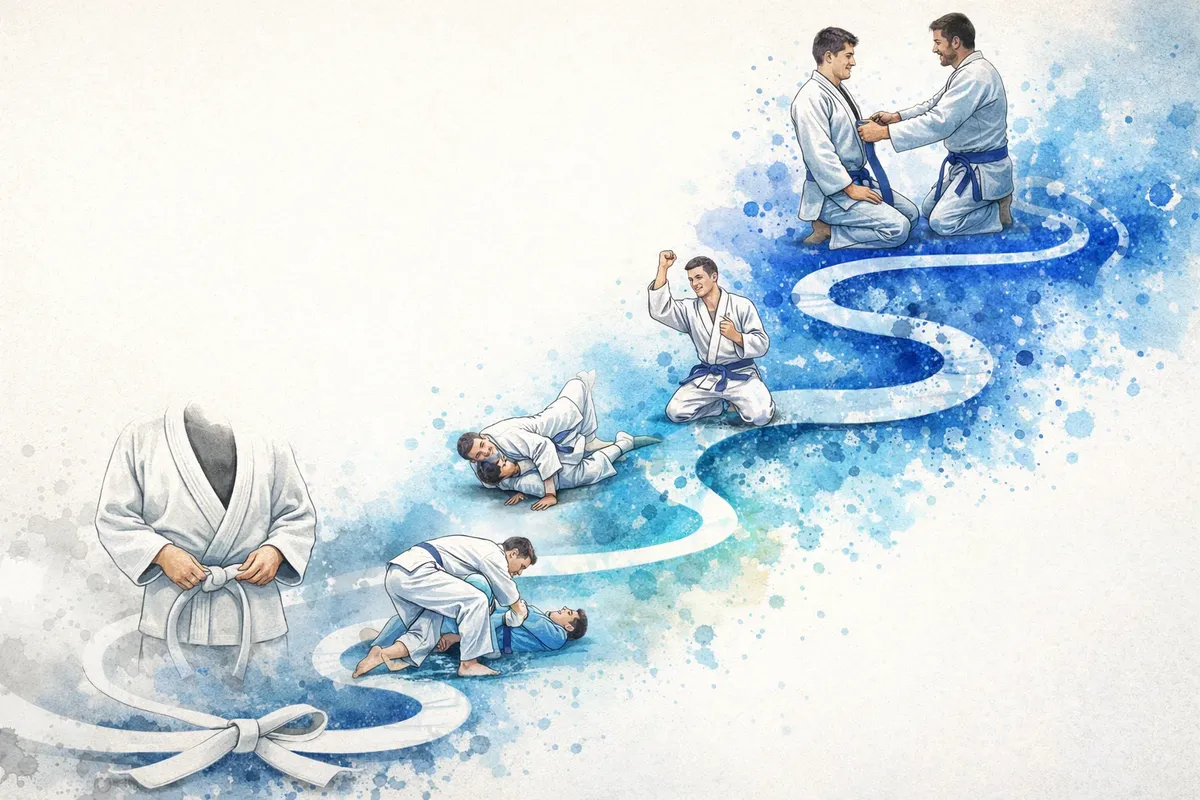
"How long until I get my blue belt?" It's the most common question in any BJJ academy, and for good reason. The blue belt represents your first significant milestone—a tangible recognition that you've moved beyond beginner status and developed real grappling skills.
The short answer is 1-2 years of consistent training. But like most things in BJJ, the real answer is more nuanced. Your path to blue belt depends on numerous factors: training frequency, prior athletic experience, natural aptitude, instruction quality, and perhaps most importantly, how deliberately you approach your development. If you're just getting started, our complete beginner's guide to BJJ covers everything you need to know for your first months on the mat.
Let's break down realistic timelines and what you can do to optimize your journey to blue belt.
Average Time to Blue Belt: What the Data Shows
Based on surveys of thousands of BJJ practitioners and feedback from instructors worldwide, here's what the numbers reveal:
Timeline Distribution
| Time Range | Percentage of Practitioners | Profile |
|---|---|---|
| Under 1 year | 5-10% | Prior grappling experience, high frequency training (5+ days/week) |
| 1-1.5 years | 25-30% | Athletic background, consistent training (3-4 days/week) |
| 1.5-2 years | 40-45% | Average timeline, regular training (2-3 days/week) |
| 2-3 years | 15-20% | Less frequent training, slower progression |
| 3+ years | 5-10% | Inconsistent training, breaks, or very strict promotion standards |
The median time to blue belt is approximately 18 months of consistent training. However, "consistent" is the key word—practitioners who take extended breaks or train sporadically often take 3+ years.
Did You Know: The biggest predictor of blue belt timeline isn't natural talent or athleticism — it's simply showing up. Practitioners who train consistently 3 times per week almost always earn their blue belt faster than those who train 5 times per week but take frequent breaks.
Training Frequency Impact
Your mat time directly correlates with progression speed:
| Training Frequency | Expected Timeline to Blue Belt |
|---|---|
| 5+ sessions/week | 8-14 months |
| 3-4 sessions/week | 12-18 months |
| 2-3 sessions/week | 18-24 months |
| 1 session/week | 3-4+ years |
| Sporadic training | Unpredictable |
This doesn't mean more is always better—training 6+ days per week increases injury risk and burnout potential. Most experts recommend 3-4 quality sessions per week as the sweet spot for sustainable progress.
Warning: Avoid the "more is always better" trap. Training 6-7 days per week as a white belt is one of the fastest paths to injury and burnout. Your body needs rest days to adapt to the demands of grappling, especially in your first year.
Key Takeaway
The median time to blue belt is 18 months with consistent training at 3-4 sessions per week. Training frequency matters, but consistency over time matters more than cramming sessions. Aim for a sustainable schedule you can maintain for years, not weeks.
Factors That Affect Your Blue Belt Timeline
1. Training Frequency and Consistency
This is the single most important factor. Someone training three times per week for 18 months will typically progress faster than someone training twice per week for two years, even though the total hours might be similar. Consistency builds momentum and prevents the regression that comes with breaks.
Key insight: It's better to train twice per week every week than to train five times per week for two months, then take a month off.
2. Prior Athletic Experience
Athletes from related backgrounds often progress faster:
Significant advantage:
- Wrestling (2-4 years experience)
- Judo (2-4 years experience)
- Sambo or catch wrestling
Moderate advantage:
- Other martial arts (striking, MMA)
- Contact sports (rugby, football)
- Gymnastics or dance (body awareness)
Some advantage:
- General athletic background
- Strength training experience
- Yoga (flexibility, body control)
A former wrestler or judoka might earn their blue belt in 8-12 months because they already understand grappling concepts, pressure, and how to use their body against resistance.
Pro Tip: Even if you have no prior grappling experience, you can develop similar advantages by supplementing your mat time with solo drills, movement practice, and studying instructional content. The "prior experience" advantage is mostly about body awareness and comfort with contact — both of which develop naturally with consistent training.
3. Natural Aptitude and Learning Style
Some people are naturally faster learners. But in BJJ, "natural talent" often means:
- Strong kinesthetic awareness
- Good at pattern recognition
- Comfortable with physical contact
- Ability to stay calm under pressure
- Strong problem-solving mindset
If these don't describe you naturally, don't worry—they can all be developed with practice.
4. Instruction Quality
A skilled instructor who can break down techniques clearly and provide personalized feedback will accelerate your learning significantly. Signs of good instruction include:
- Clear explanations of why techniques work
- Corrections tailored to your specific issues
- Structured curriculum that builds progressively
- Regular one-on-one attention
- Emphasis on fundamental movements
5. Training Environment
The people you roll with matter enormously:
- Rolling with higher belts teaches you what's possible
- Rolling with similar skill levels lets you test techniques
- Rolling with beginners helps solidify fundamentals
- A diverse training group develops well-rounded skills
6. Competition Experience
While not required for promotion, competitors often progress faster because:
- Competition exposes weaknesses quickly
- The intensity forces rapid problem-solving
- Reviewing competition footage accelerates learning
- The pressure tests techniques under stress
7. Physical Attributes
While BJJ is designed for smaller practitioners, physical attributes can affect early progression:
- Strength and size provide a short-term advantage (but can mask technical deficiencies)
- Flexibility helps with guard play and escapes
- Cardiovascular fitness affects how many quality rounds you can do
- Age affects recovery time and how frequently you can train
8. Academy Promotion Standards
Different academies have different standards. Some factors include:
- Competition requirements (some schools require competition at white belt)
- Attendance requirements (minimum classes per week)
- Knowledge requirements (ability to demonstrate and explain techniques)
- Rolling ability (how you perform against various opponents)
- "Mat time" minimums (some require 6-12 months at white belt minimum)
Track every roll — log sessions and techniques for free
What Should a Blue Belt Know?
While every academy has different requirements, here's what most instructors expect from a blue belt candidate:
Positional Understanding
From Bottom:
- Solid closed guard with several attack options
- At least one open guard variation you're comfortable with
- Half guard retention and basic attacks
- Mount escape(s) that work under pressure
- Side control escape(s) that work under pressure
- Back survival (hand fighting, escape attempts)
From Top:
- Basic guard passing (at least 2-3 passes)
- Mount control and maintenance
- Side control pressure and transitions
- Back control with seatbelt and hooks
- Knee on belly awareness
Submissions
Expected to be proficient with:
- Armbar (from guard and mount)
- Triangle choke
- Rear naked choke
- Kimura
- Americana
Expected to be familiar with:
- Guillotine choke
- Cross collar choke (in gi)
- Ezekiel choke
- Basic leg attacks (ankle lock)
Sweeps and Reversals
- Hip bump sweep
- Scissor sweep
- Elevator sweep
- Basic half guard sweep
- Mount reversal (trap and roll)
Defense and Survival
- Posture and frame maintenance
- Proper defensive positions
- When and how to tap
- Guard recovery from bad positions
- Turtle position survival
Movement and Transitions
- Smooth hip escapes (shrimping)
- Technical stand-up
- Basic guard retention
- Position-to-position flow
Conceptual Understanding
Beyond techniques, blue belts should understand:
- The positional hierarchy
- When to attack vs. when to escape
- Basic weight distribution and pressure
- The importance of grips
- How techniques chain together
Drill: Test your blue belt readiness with this self-assessment: Can you name the positional hierarchy from worst to best? Can you demonstrate at least two escapes from mount and side control? Can you execute a basic guard pass, sweep, and submission in sequence? If you can answer yes to all three, you're well on your way.
Key Takeaway
Blue belt isn't about memorizing hundreds of techniques — it's about having a solid foundation across all major positions. Focus on reliable escapes from bad positions, a few go-to attacks, and understanding why techniques work rather than just how to do them.
How to Accelerate Your Progress (Legitimately)
Josh Saunders breaks down the most common reasons white belts stall before blue belt — and the specific mindset and habit shifts that separate those who get promoted from those who plateau:
1. Train Smart, Not Just Hard
Quality matters more than quantity. Focus on:
- Being mentally present during technique instruction
- Asking questions when confused
- Drilling with intention, not just going through motions
- Rolling with purpose (working specific positions vs. just surviving)
2. Supplement Your Mat Time
Watch instructional content - YouTube tutorials and paid instructionals reinforce what you learn in class. Watch content related to what you're currently working on.
Visualize techniques - Mental rehearsal is surprisingly effective. Spend 5-10 minutes daily visualizing techniques you're learning.
Study competition footage - Watch high-level competitors and try to understand their patterns and timing.
3. Focus on Fundamentals
Resist the temptation to learn flashy techniques. The fundamentals—posture, pressure, timing, and basic positions—are what separate blue belts from white belts.
Every class, ask yourself:
- Did I work on escapes today?
- Did I practice guard retention?
- Did I drill basic passes?
- Did I work on at least one submission?
4. Roll With Everyone
Don't just roll with people your size or skill level:
- Higher belts will expose your weaknesses
- Lower belts let you practice offense
- Bigger people teach you about pressure
- Smaller people teach you about speed and flexibility
5. Develop a Game Plan
By the time you're approaching blue belt, you should have at least a basic "A-game":
- A guard you prefer to play
- 2-3 passes you use regularly
- 1-2 submissions you hit consistently
- A takedown or pull you're comfortable with
6. Track Your Training
This is where most practitioners leave easy progress on the table. Tracking your training helps you:
- Identify patterns in your rolling sessions
- Notice which techniques are working (and which aren't)
- Ensure balanced training (not neglecting positions)
- Stay accountable to your goals
- See progress that might otherwise feel invisible
7. Be Patient With Plateaus
Everyone hits plateaus—periods where progress feels non-existent. These are normal and usually precede breakthroughs. Common plateau points:
- 3-4 months in (initial novelty wears off)
- 8-10 months in (you know enough to realize how much you don't know)
- 14-16 months in (right before blue belt for many)
8. Take Care of Your Body
You can't progress if you're injured or burned out:
- Sleep 7-9 hours for optimal recovery
- Eat adequate protein for muscle repair
- Stay hydrated before, during, and after training
- Incorporate mobility work and stretching
- Take rest days when needed
Common Mistakes That Slow Progression
Ego Rolling
Treating every roll like a world championship leads to injury, alienated training partners, and missed learning opportunities. Roll to learn, not to win.
Chasing Submissions
White belts who only focus on submissions without developing positional control often struggle to advance. Position before submission.
Neglecting Defense
It's more exciting to work attacks, but defensive skills are what allow you to survive and eventually implement your offense against better opponents.
Inconsistent Training
Taking a month off can feel like taking three months off. Momentum matters in BJJ more than almost any other activity.
Ignoring Fundamentals
Skipping straight to advanced techniques without solid fundamentals creates gaps that become increasingly problematic at higher levels.
Not Asking for Help
Higher belts and instructors want to help you. Don't let pride prevent you from asking questions or requesting extra drilling time.
Over-Training
Training every day sounds dedicated, but it often leads to burnout, injury, and diminishing returns. Recovery is part of training.
Warning: The number one reason white belts stall is inconsistency caused by injury from ego rolling. Treating every sparring round like a competition dramatically increases your injury risk and alienates training partners who could help you improve. Roll to learn, not to win.
Brandon Mccaghren on the single most common mistake white belts make that quietly kills their progression — and how fixing it changes everything:
What Blue Belt Promotion Looks Like
Every academy handles promotions differently, but common approaches include:
A genuinely moving belt promotion captured on video — a reminder of what the moment actually feels like when it finally arrives:
Surprise Promotion
After a particularly good roll or class, the instructor calls you up and awards your blue belt. This is the most common approach.
Formal Testing
Some academies require formal tests where you demonstrate techniques, answer questions, and roll with multiple opponents.
Attendance-Based
Some schools have minimum class requirements (e.g., 100 classes) plus demonstrated proficiency.
Competition Requirements
Some academies require white belts to compete at least once before promotion.
Belt Ceremonies
Some schools do periodic belt ceremonies where multiple students are promoted at once.
Don't Focus on the Belt
This might sound counterintuitive in an article about getting your blue belt, but the belt itself isn't the goal. The goal is becoming a capable grappler who can defend themselves and implement techniques against resistance.
The blue belt will come naturally if you:
- Show up consistently
- Train with intention
- Focus on fundamentals
- Roll with everyone
- Stay patient through plateaus
- Take care of your body
- Track and reflect on your progress
When you stop obsessing about the belt and start focusing on skill development, you'll likely earn it faster anyway—and you'll deserve it when it comes.
Beyond Blue Belt: What's Next?
Earning your blue belt is just the beginning—it's one step in the BJJ belt progression system that stretches from white to black belt. Many practitioners say the real learning starts at blue belt because:
- You now have enough knowledge to start developing your own style
- The techniques become more nuanced
- You're expected to help beginners
- Competition becomes more strategic
Blue belt is often where practitioners start to specialize—developing a guard game, becoming a leg lock specialist, or focusing on wrestling and takedowns.
It's also, unfortunately, where many people quit. The "blue belt blues" is a well-known phenomenon where practitioners lose motivation after achieving their first major goal. Having new goals and tracking ongoing progress helps maintain motivation.
Tracking Your Path to Blue Belt
The practitioners who progress fastest are usually those who train deliberately—knowing what they're working on, tracking what's successful, and identifying areas for improvement.
A training journal or app helps you:
- Record techniques learned and drilled
- Note sparring outcomes and observations
- Track training frequency and consistency
- Identify patterns in your successes and failures
- Set and monitor goals
Looking back at months of training data provides perspective that's impossible to get otherwise. You might feel stuck, but the data shows you're escaping side control twice as often as three months ago. That kind of objective feedback is invaluable.
Ready to accelerate your path to blue belt? Download Rollbook to track your sessions, monitor your progress, and train with intention. Our belt progression tracking helps you visualize your journey, while detailed session logging ensures you never forget what you learned. Start your free trial today and make every session count on your path to blue belt.
Oss!