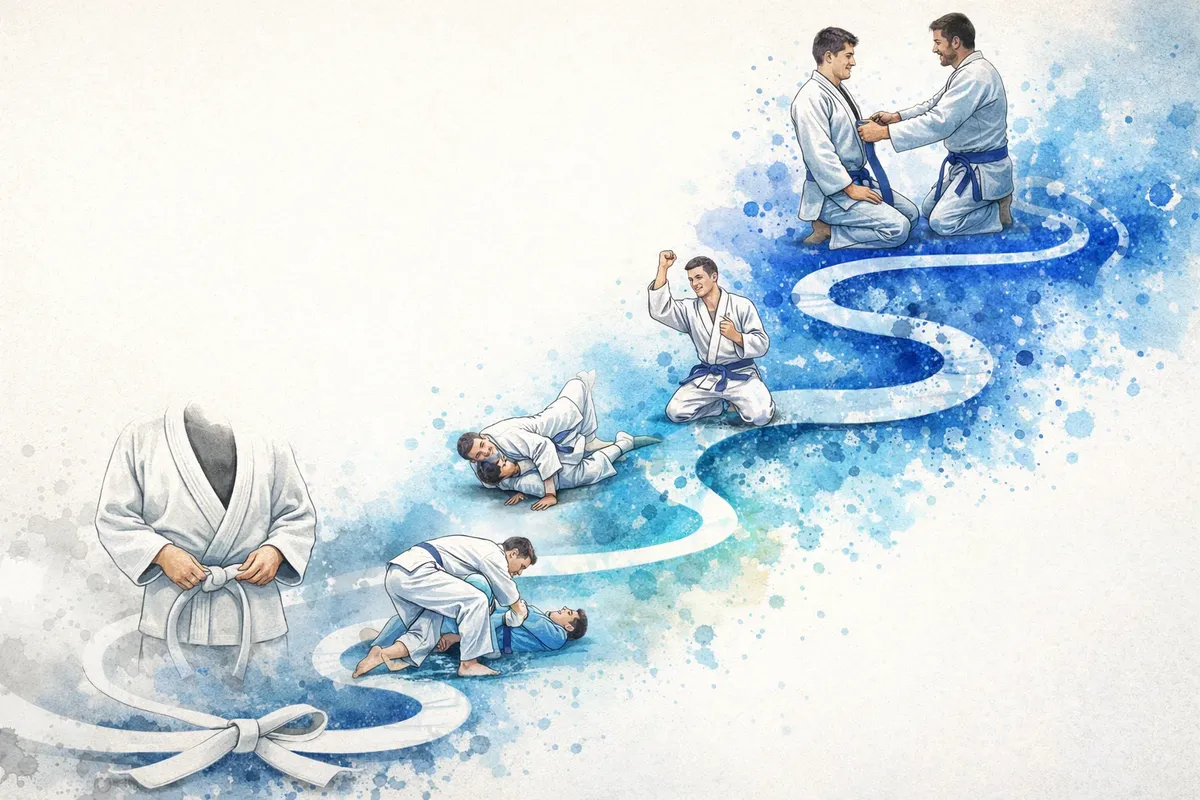
BJJ for Beginners: The Complete Guide to Starting Brazilian Jiu-Jitsu in 2026
Everything you need to know about starting your BJJ journey, from your first class to essential gear, basic positions, and avoiding common beginner mistakes.
Your Journey Into Brazilian Jiu-Jitsu Starts Here
Brazilian Jiu-Jitsu (BJJ) is one of the most effective martial arts in the world, renowned for its ability to allow a smaller, weaker person to defend themselves against larger opponents using leverage, technique, and submissions. Whether you're looking to get in shape, learn self-defense, compete, or simply find a challenging new hobby, BJJ offers something for everyone.
Starting any martial art can feel intimidating, but BJJ academies are known for their welcoming communities and supportive training environments. This comprehensive guide will walk you through everything you need to know before, during, and after your first BJJ class. For a deeper look at promotion timelines, check out our guide on how long it takes to get a blue belt.
What is Brazilian Jiu-Jitsu?
Brazilian Jiu-Jitsu is a grappling-based martial art that focuses on ground fighting and submission holds. Unlike striking arts such as boxing or Muay Thai, BJJ practitioners (often called "grapplers" or "jiujiteiros") aim to control their opponent through positional dominance and force them to submit through joint locks or chokes.
The art originated from Japanese Judo and was developed by the Gracie family in Brazil during the early 20th century. Carlos and Helio Gracie refined the techniques to work effectively for smaller practitioners against larger opponents, emphasizing leverage and technique over strength and athleticism.
Key Principles of BJJ
- Position before submission - Establish dominant control before attempting to finish
- Leverage over strength - Use proper technique to multiply your force
- Patience and timing - Wait for the right moment rather than forcing techniques
- Defense first - Learn to survive and escape before focusing on attacks
Pro Tip: Of these four principles, "defense first" is the one that will accelerate your progress the most as a beginner. If you can survive every position, you will always have the opportunity to learn. If you focus only on attacks, you will spend most of your rolls getting submitted before you can try anything.
What to Expect at Your First BJJ Class
Walking into a BJJ academy for the first time can feel overwhelming. Here's a typical structure for a beginner's class:
Class Structure (Usually 60-90 minutes)
Warm-up (10-15 minutes) Classes typically begin with a warm-up that includes BJJ-specific movements. You'll likely practice:
- Shrimping (hip escape movement)
- Forward and backward rolls
- Technical stand-ups
- Guard retention movements
- Light jogging and stretching
Technique Instruction (30-45 minutes) The instructor will demonstrate techniques, usually showing 2-4 related moves. You'll drill these with a partner, taking turns practicing each technique multiple times. Common beginner techniques include:
- Basic guard positions (closed guard, open guard)
- Simple sweeps from guard
- Mount escapes
- Side control escapes
- Basic submissions like the armbar or rear naked choke
Live Training/Sparring (15-30 minutes) Most classes end with "rolling" - live sparring where you apply what you've learned against a resisting partner. Beginners often start with positional sparring (starting from specific positions) before doing full rounds.
Gym Etiquette to Know
- Bow when entering/leaving the mat - A sign of respect in most academies
- Keep your gi clean - Wash it after every training session
- Trim your nails - Long fingernails and toenails can scratch training partners
- No shoes on the mat - And no bare feet off the mat
- Tap early and often - When caught in a submission, tap your partner or the mat to signal you give up
- Ask before rolling - Always ask higher belts if they want to spar rather than assuming
Warning: Tapping is not losing — it is how you stay safe and keep training. Never let ego prevent you from tapping. Injuries from refusing to tap can sideline you for weeks or months. The best competitors in the world tap hundreds of times in training. Tap early, learn from it, and go again.
Essential Gear for BJJ Beginners
The BJJ Gi (Kimono)
The gi is the traditional uniform for BJJ training. It consists of three parts:
- Jacket (kimono top) - Heavy cotton or pearl weave material
- Pants - Reinforced at the knees for durability
- Belt - Indicates your rank
Beginner Gi Recommendations:
- Budget: $60-100 (Sanabul, Elite Sports)
- Mid-range: $100-150 (Tatami, Fuji)
- Premium: $150-250+ (Shoyoroll, Origin)
For your first class, many academies offer loaner gis or allow you to wear athletic clothing (rash guard and shorts or spats).
No-Gi Gear
Many academies also offer "no-gi" classes where you train without the traditional kimono:
- Rash guard - Tight-fitting athletic shirt that prevents mat burn
- Grappling shorts or spats - Board shorts without pockets or compression pants
- Ear guards - Optional but recommended to prevent cauliflower ear
Other Essentials
- Mouthguard - Protects your teeth during rolls
- Athletic tape - For taping fingers and toes
- Flip flops or sandals - For walking off the mat
- Water bottle - Stay hydrated
- Gym bag - Keep your gear organized and separate from clean clothes
Basic BJJ Positions Every Beginner Should Know
Understanding positions is fundamental to BJJ. Here are the essential positions you'll encounter:
Bottom Positions
Closed Guard Your legs are wrapped around your opponent's torso, controlling them with your hips and legs. This is considered a neutral-to-advantageous position for the bottom person in BJJ.
Half Guard One of your opponent's legs is trapped between your legs. While less secure than closed guard, half guard offers many sweep and submission opportunities.
Open Guard Your legs are not locked around your opponent. Variations include butterfly guard, spider guard, lasso guard, and De La Riva guard.
Top Positions
Mount You're sitting on top of your opponent's torso with your knees on the ground. This is one of the most dominant positions in BJJ, worth 4 points in competition.
Side Control You're chest-to-chest with your opponent, perpendicular to their body, controlling them from the side. A dominant control position often achieved after passing the guard (which scores 3 points).
Back Control You're behind your opponent with your "hooks" (feet) wrapped around their hips and your arms controlling their upper body. The most dominant position, also worth 4 points.
The rear naked choke is the most iconic submission in BJJ and the primary attack from back control. Understanding how to apply it properly, including the grip, the squeeze, and the positioning of your body behind your opponent, is essential knowledge for every beginner.
Rear Naked Choke (RNC)
The rear naked choke is a blood choke applied from back control. You slide one arm under your opponent's chin, lock your hands together behind their head, and squeeze using your back muscles to compress the carotid arteries. When applied correctly, it is one of the highest-percentage submissions in all of grappling and works in both gi and no-gi.
Demonstrated by Stephan Kesting — BJJ Black Belt, Grapplearts Founder
Rear naked choke tutorial by Stephan Kesting — BJJ Black Belt, Grapplearts Founder
Knee on Belly A transitional control position where your knee presses into your opponent's stomach while your other foot posts on the ground for base. Worth 2 points.
When you find yourself stuck under mount — one of the most dominant positions in BJJ — you need reliable escapes. The two most fundamental mount escapes every beginner should learn are the bridge-and-roll (trap and roll) and the elbow-knee escape. These two techniques complement each other: when one is defended, the other often opens up.
Mount Escape: Bridge and Roll
The bridge and roll (also called trap and roll or upa) is your first line of defense from bottom mount. You trap your opponent's arm and same-side foot, then bridge explosively to flip them over. This escape works best when your opponent posts their hands on the mat or reaches for a submission, giving you a limb to trap.
Demonstrated by Gracie University — Gracie Family Official Academy
Mount escape bridge and roll technique by Gracie University
Mount Escape: Elbow-Knee (Kipping)
The elbow-knee escape uses hip escapes (shrimping) to create enough space to slide your knee through and recover guard. Unlike the bridge and roll, this escape does not require you to trap a limb — it works through persistent hip movement and framing. It is the higher-percentage escape at advanced levels and chains perfectly with the bridge and roll.
Demonstrated by John Danaher — Legendary BJJ Coach
Mount escape elbow-knee (kipping) technique by John Danaher — Legendary BJJ Coach
Drill: Practice chaining these two escapes together. Start with the bridge and roll — if it fails (your partner bases out), immediately shrimp to the side and attempt the elbow-knee escape. This two-escape sequence is the backbone of mount survival and will serve you from white belt through black belt.
Neutral Positions
Standing Where most matches and self-defense situations begin. Learning basic wrestling and judo concepts will help your standup game.
Turtle Your opponent is on all fours. While defensive, this position leaves you vulnerable to back takes and chokes.
Beginners end up in turtle frequently — it is a natural reaction when your guard gets passed or you get knocked to all fours during a scramble. Knowing how to escape turtle safely, rather than just curling up and waiting, is a critical early skill.
Turtle Position Escapes
A set of escapes from the turtle position that prevent your opponent from taking your back or applying chokes. Covers how to create space, sit through to guard, granby roll to recover, and stand up safely. The key principle is to never stay static in turtle — always be working toward a better position.
Demonstrated by Stephan Kesting — BJJ Black Belt, Grapplearts Founder
Turtle position escapes by Stephan Kesting — BJJ Black Belt, Grapplearts Founder
Key Takeaway
Understanding positions is the foundation of BJJ. Before you learn any fancy submissions or sweeps, learn to recognize where you are in the positional hierarchy. Know what the dominant positions are, have at least one escape from every bad position (mount, side control, back control, turtle), and focus on survival first. Offense will come naturally once you stop panicking in bad spots.
Essential BJJ Terminology
Learning the language of BJJ will help you follow instructions and communicate with training partners:
- Roll - Spar or practice live
- Tap - Signal submission by tapping your partner or the mat
- Submission - A technique that forces your opponent to tap (armbar, choke, etc.)
- Sweep - Reversing your opponent from bottom to top position
- Pass - Moving around your opponent's legs to establish a dominant position
- Guard - Any position where you're using your legs to control your opponent
- Base - Your stability and balance
- Posture - Your structural alignment, especially important when in someone's guard
- Hooks - Using your feet to control your opponent (especially in back control)
- Underhook - Arm position where your arm is under your opponent's arm
- Overhook - Arm position where your arm is over your opponent's arm
- Oss - A greeting/acknowledgment commonly used in BJJ
How to Find the Right BJJ Gym
Not all BJJ academies are the same. Here's what to look for when choosing where to train:
Key Factors to Consider
Instructor Credentials
- What belt rank is the head instructor?
- Who did they earn their black belt from?
- Do they compete or have competition experience?
Class Schedule
- Do the class times fit your schedule?
- Are there beginner-specific classes?
- How many classes can you attend per week?
Training Culture
- Is the gym competition-focused or more recreational?
- How do higher belts treat beginners?
- Is the intensity level appropriate for your goals?
Cleanliness and Safety
- Are the mats clean and sanitized regularly?
- Is there adequate space for training?
- Are there protocols for injuries or medical emergencies?
Location and Cost
- How far is the commute?
- What's the monthly fee and are there contracts?
- Are there additional fees for belt promotions or testing?
Red Flags to Avoid
- Instructors who can't verify their lineage or credentials
- Gyms that discourage you from training elsewhere
- Aggressive or dangerous training culture
- Poor hygiene or dirty facilities
- High-pressure sales tactics or long-term contract requirements
- Instructors who never roll with students
Trial Classes
Most reputable academies offer a free trial class or week. Take advantage of this to:
- Experience the teaching style
- Meet potential training partners
- Assess the facility and culture
- Determine if it's the right fit for you
Common Beginner Mistakes to Avoid
Physical Mistakes
Using Too Much Strength New practitioners often try to muscle through techniques. This leads to quick exhaustion and missed learning opportunities. Focus on technique and timing instead.
Holding Your Breath Breathing is crucial in BJJ. Many beginners hold their breath during rolls, leading to rapid fatigue. Practice steady breathing even when under pressure.
Not Tapping Early Enough Ego can lead to injuries. When caught in a submission, tap before you feel pain. The submission is already successful if they have the position.
Poor Posture and Base Maintaining good posture in guard and solid base on top are fundamental skills. Work on these from day one.
Did You Know: Research on BJJ injury rates shows that the majority of training injuries happen during sparring, not during drilling. Most injuries occur because one or both partners are using excessive force or refusing to tap. Training at a controlled pace and tapping early reduces your injury risk dramatically — and means more mat time in the long run.
Mental Mistakes
Expecting Quick Progress BJJ has a steep learning curve. Expect to feel lost for the first 6-12 months. Consistent training is more important than talent.
Comparing Yourself to Others Everyone learns at different rates. Focus on your own journey rather than how quickly others are progressing.
Only Training With Similar Skill Levels Rolling with higher belts will accelerate your learning. Rolling with lower belts helps solidify your techniques.
Not Asking Questions Instructors and higher belts are usually happy to help. Don't be afraid to ask for clarification or extra tips.
Your First 30 Days: A Beginner's Roadmap
Week 1: Survival Mode
- Focus on learning gym etiquette and culture
- Start memorizing basic position names
- Practice breakfalls and basic movements at home
- Attend as many classes as your body can handle (usually 2-3)
Week 2: Building Foundation
- Start recognizing common positions during rolls
- Work on one escape from each bad position
- Begin understanding the concept of guard
- Continue building mat fitness and conditioning
Week 3: Adding Offense
- Learn your first sweep from closed guard
- Practice a basic submission (armbar or triangle)
- Start connecting positions to transitions
- Roll with more awareness and less panic
Week 4: Integration
- Begin developing personal preferences (guard style, passing style)
- Identify your biggest weaknesses
- Set specific goals for the next month
- Establish a consistent training schedule
Key Takeaway
Your first month is about building habits, not collecting techniques. Aim to train consistently (2-3 times per week minimum), learn to survive in bad positions before chasing submissions, and take notes after each class on what you learned. The beginners who progress fastest are not the most athletic — they are the most consistent and the most curious.
Physical Preparation for BJJ
Pre-Training Nutrition
Eat a light meal 2-3 hours before class. Good options include:
- Rice with lean protein
- Banana with peanut butter
- Oatmeal with fruit
- Avoid heavy, fatty foods that can cause nausea during rolls
Post-Training Recovery
- Rehydrate immediately
- Eat protein within 30-60 minutes
- Stretch while muscles are warm
- Get adequate sleep for recovery
Supplemental Training
While BJJ itself will improve your fitness, adding these can accelerate progress:
- Yoga or mobility work for flexibility
- Strength training for injury prevention
- Cardio for better gas tank during rolls
- Solo BJJ drills on rest days to reinforce movement patterns
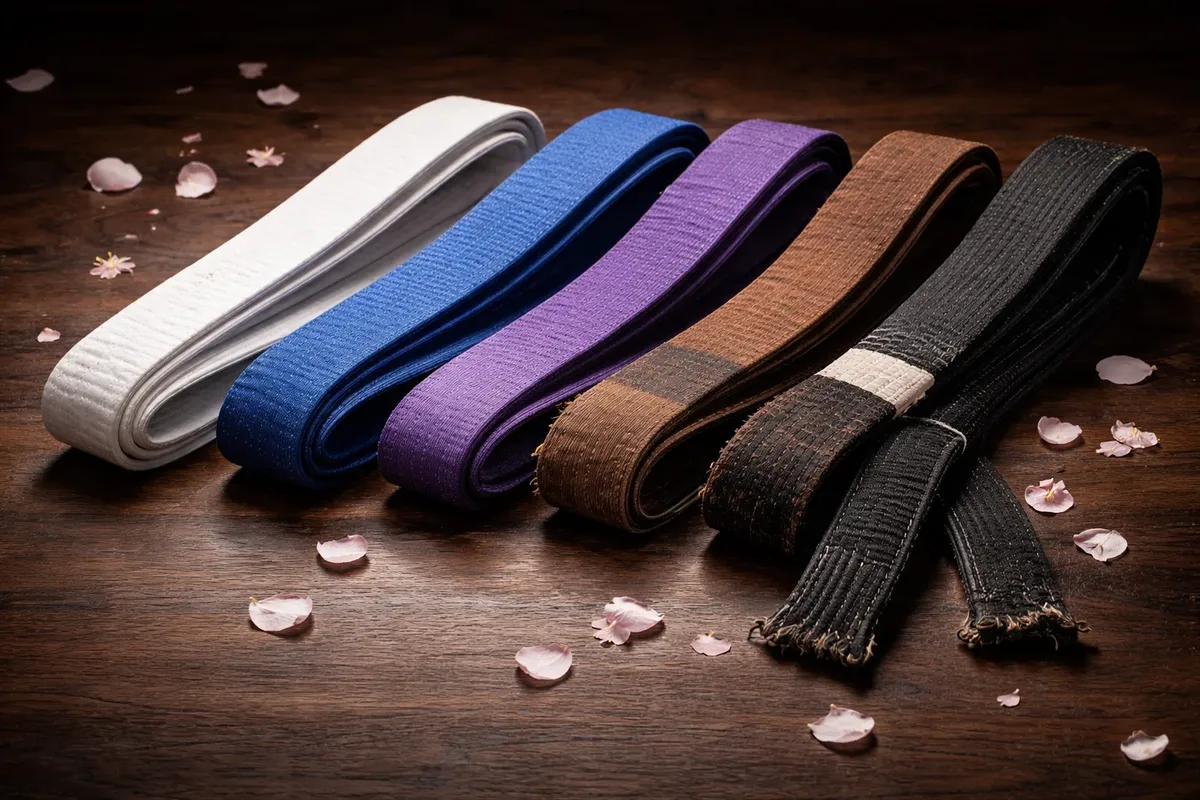
The BJJ Belt System Overview
BJJ uses a belt ranking system to indicate skill level. For a complete breakdown of each rank and what's expected at every level, see our BJJ belt progression system guide:
| Belt | Typical Time at Belt | Key Characteristics |
|---|---|---|
| White | 1-2 years | Learning fundamentals, survival |
| Blue | 2-3 years | Developing a game, connecting techniques |
| Purple | 2-3 years | Refining game, teaching basics |
| Brown | 1-2 years | Polishing details, advanced concepts |
| Black | Lifetime | Mastery, continuous refinement |
Most people quit BJJ at white or blue belt, making consistency the most important factor in long-term progress. The average time to black belt is 8-12 years of consistent training.
Dealing with Common Challenges
Feeling Overwhelmed
This is normal. BJJ has thousands of techniques and variations. Focus on fundamentals and trust the process.
Getting Tapped Frequently
Everyone starts here. Each tap is a learning opportunity. Focus on recognizing how you got caught so you can defend next time.
Soreness and Fatigue
Your body will adapt over time. Start with 2-3 classes per week and gradually increase. Prioritize recovery through sleep, nutrition, and mobility work.
Feeling Like You're Not Improving
Progress in BJJ is often invisible day-to-day. Record yourself rolling occasionally to see improvement over months. Trust your training partners when they say you're getting better.
Staying Safe and Preventing Injuries
Common BJJ Injuries
- Mat burn (knees, feet, forehead)
- Finger and toe injuries
- Neck strains
- Knee injuries (especially in leg lock situations)
- Rib injuries
Prevention Strategies
- Tap early - Ego injuries are the most preventable
- Communicate with partners - Let them know if something hurts
- Warm up properly - Don't skip the beginning of class
- Choose training partners wisely - Avoid the "spaz" who uses excessive force
- Listen to your body - Rest when needed
- Learn to fall - Proper breakfalls prevent many injuries
Start Tracking Your Journey
One of the best ways to accelerate your progress and stay motivated is to track your training. Keeping a detailed log of your sessions helps you:
- Identify patterns and problem areas
- Remember techniques you've learned
- Track your rolling partners and what you worked on
- Visualize your progress over time
- Stay accountable to your training goals
Many practitioners start with a notebook but struggle to maintain consistency. A dedicated BJJ training app makes logging quick and easy, providing insights that would be impossible to gather manually. See our comparison of the best BJJ training apps in 2026 to find the right tool for you.
Take Your First Step
Starting Brazilian Jiu-Jitsu is one of the most rewarding decisions you can make. The art will challenge you physically and mentally, but the community, skills, and personal growth make it worthwhile.
Remember: every black belt was once a clueless white belt on their first day. The only difference is they kept showing up.
Find a reputable academy near you, show up for a trial class, and begin your journey. The mat will be waiting.
Ready to track your BJJ journey from day one? Download Rollbook to log your sessions, track techniques, and visualize your progress. Whether you're preparing for your first class or your hundredth, Rollbook helps you train smarter and stay motivated. Start your free trial today and take control of your development on the mats.
Oss!