BJJ in 2026: Top Trends Shaping the Sport
From no-gi dominance and leg lock evolution to AI-powered training tools and the masters boom, these are the trends defining Brazilian Jiu-Jitsu in 2026.

The State of BJJ in 2026
Brazilian Jiu-Jitsu has never been bigger, more diverse, or more technically sophisticated than it is right now. The global BJJ market, valued at USD 1.2 billion in 2025, is on track to reach USD 2.5 billion by 2033 at a 10% compound annual growth rate. An estimated 3 to 6 million people train worldwide. In the United States alone, roughly 750,000 practitioners are active, a figure that has doubled in the past decade. Interest in BJJ as a search term, as a fitness modality, and as a competitive pursuit has never been higher.
But the numbers only tell part of the story. What is truly reshaping BJJ in 2026 is not just that more people are training. It is how they are training, what they are training, and who they are. The sport's center of gravity has shifted. No-gi has overtaken gi as the dominant competitive format. Leg locks have evolved from a novelty into the backbone of modern positional strategy. Wrestling has become a non-negotiable skill. Technology has entered the training room in ways that would have been unthinkable five years ago. And the demographics of the mat have changed dramatically, with women, masters-age athletes, and youth practitioners entering the sport in record numbers.
This article maps the trends that define BJJ in February 2026. Whether you have been training for twenty years or you are considering your first class, understanding where the sport is headed will shape how you approach your own training.
No-Gi Dominance and ADCC Growth
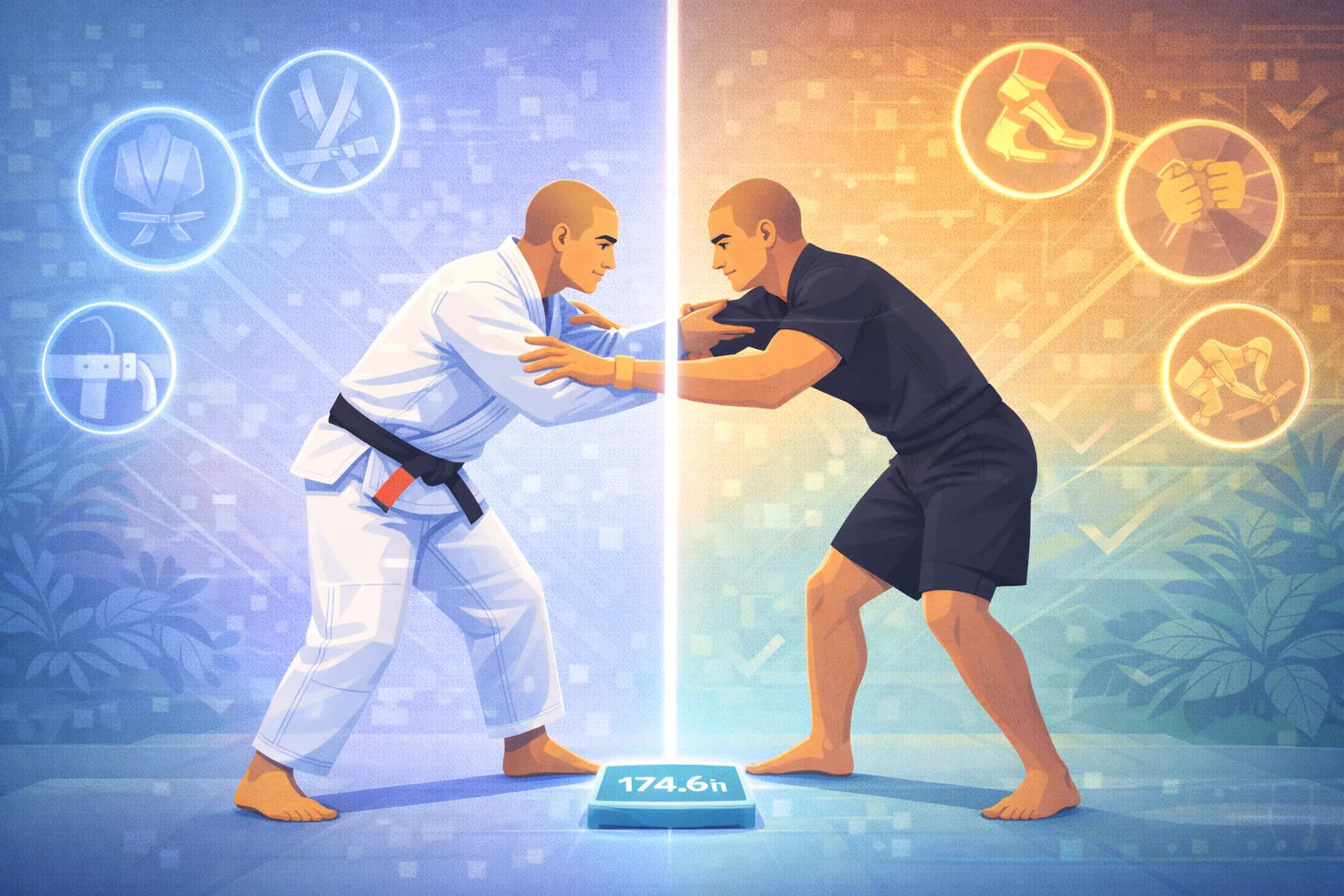
The gi is not dead, but no-gi has definitively become the main event. The 2025 IBJJF No-Gi World Championships was the largest in the event's history, with over 4,000 registered competitors. That number eclipsed the gi Worlds in total registrations for the first time. The trend had been building for years. Now it is simply the reality.
ADCC remains the crown jewel of no-gi competition. The trials circuit has expanded across every continent, with regional qualifiers in Europe, Asia-Oceania, and the Americas feeding elite talent into the main event. Athletes like Felipe Pena, the reigning ADCC +99kg champion, Kaynan Duarte, and Adele Fornarino, who captured double gold at ADCC and won the 2025 IBJJF No-Gi Worlds with a 19-second submission, have elevated no-gi grappling into a legitimate spectator sport. Marlon Tajik, a Swedish grappler training at Atos, won double gold at the 2025 No-Gi Worlds with every match ending by submission, signaling the growing depth of talent outside of Brazil and the United States.
Several forces are driving this shift. No-gi is more accessible: a rash guard and shorts cost a fraction of a quality gi. The pace is faster and more exciting for spectators. The techniques transfer directly to MMA. And the influence of organizations like ADCC, ONE Championship's grappling division, and submission-only rulesets has given no-gi its own identity, distinct from the IBJJF gi circuit.
For a deeper comparison of the two formats and what each offers, see our complete no-gi vs gi guide.
Did You Know: Atos Jiu-Jitsu has won the IBJJF No-Gi Worlds Team Overall title eight times, including three consecutive years from 2023 to 2025 in both male and female divisions. Their dominance reflects a broader institutional shift toward no-gi as the primary competitive focus for elite teams.
None of this means the gi is disappearing. The IBJJF still runs the largest tournament calendar in the sport, and gi technique remains the foundation of most academy curricula. But the energy, the viewership, and the competitive ambition of the sport's best athletes increasingly point toward no-gi. If you are not training no-gi in 2026, you are training an incomplete version of the art.
The Leg Lock Revolution Continues
The leg lock revolution that began in the mid-2010s with the Danaher Death Squad, Eddie Cummings, and later Gordon Ryan was supposed to be a phase. A decade later, leg attacks are not just part of the game. They are the game.
But the meta has evolved. The early leg lock era was defined by athletes hunting heel hooks from 50/50, single leg X, and ashi garami. In 2026, the top competitors have moved past that. Leg entanglements are no longer just submission positions. They are the primary mechanism for sweeps, guard passes, and positional transitions. The heel hook threat still exists, but it functions more like a chess piece that controls space than a finish that ends the match.
From single leg X and irimi ashi garami, elite grapplers now chain into combat base passes, using the opponent's heel hook defense as the trigger for passing sequences. Reverse X with underhooks leads to topside control. K-guard entries create leg exposure that feeds into cross knee passes. The leg lock game has become a passing game, and the passing game has become a leg lock game. The two are inseparable.
This evolution demands a more complete skill set. You cannot simply learn heel hook entries and call yourself modern. You need to understand the positional chess of leg entanglements, including how to attack, how to defend, and how to use both offense and defense as transitions to other phases of the fight. For a foundational overview of the positions and submissions involved, start with our comprehensive leg locks guide and our breakdown of heel hook defense.
Key Takeaway
Leg locks in 2026 are no longer isolated submission attacks. They are integrated into a broader positional game where entanglements serve as platforms for sweeps, passes, and transitions. Understanding the leg lock meta now means understanding modern grappling itself.
Wrestling Integration: The New Meta
Five years ago, a BJJ black belt who could not wrestle was common. In 2026, that practitioner is at a serious disadvantage.
The integration of wrestling into BJJ curricula has accelerated from a nice-to-have into a structural requirement. Academies across the United States and Europe now embed wrestling directly into their regular class schedules rather than offering it as an occasional supplement. Single-leg and double-leg takedowns, clinch control, chain wrestling, and mat return techniques have become standard fare at competitive schools. Many programs employ coaches with Division I or national-level wrestling backgrounds specifically to teach these skills.
The driver is no-gi. Without the gi to grip, takedown ability becomes paramount. You cannot reliably pull guard with a collar grip when there is no collar. The top no-gi competitors are universally strong on their feet, whether they came from a wrestling background or developed those skills specifically for grappling competition.
The crossover traffic runs in both directions. Baron Corbin, the WWE professional wrestler, competed at the 2025 IBJJF Pans and won double gold, demonstrating that wrestling fundamentals translate powerfully to the BJJ mat. Meanwhile, BJJ athletes are increasingly entering freestyle and folk-style events to sharpen their standing skills.
The broader lesson is clear: the walls between grappling disciplines are crumbling. Wrestling, judo, sambo, and BJJ are converging into a unified grappling skill set. The best athletes in 2026 do not identify with a single style. They take what works from every tradition and integrate it into their game.
Neo Jiu-Jitsu: The Convergence of Grappling Styles
Call it neo jiu-jitsu, fusion grappling, or simply modern submission wrestling. The trend is the same: the rigid boundaries between grappling arts are dissolving, and what is emerging is something new.
This convergence is visible everywhere. BJJ academies teach judo throws alongside single legs. Sambo leg lock entries appear in ADCC matches. Catch wrestling's emphasis on pins and cranks influences submission-only rulesets. The old debates about which art is superior have given way to a pragmatic question: what works?
The shift is partly competitive and partly cultural. Events like ADCC, ONE Championship, and the Polaris series reward grappling effectiveness regardless of origin. Athletes like Diogo Reis, named ONE's 2025 Grappler of the Year, draw from multiple traditions without allegiance to any single one. The training environments that produce these athletes look nothing like the single-discipline academies of the past. They are grappling labs where techniques are tested against resistance, refined through data, and adopted based on results.
For practitioners, this means expanding your reference frame. If you have only ever trained BJJ, consider attending a wrestling or judo class. If your gym does not offer standup grappling, find one that does. The future of submission grappling belongs to the most adaptable, not the most traditional.
Technology in Training
BJJ has always been an art that resisted technology. For decades, the prevailing wisdom was simple: get on the mat, train, repeat. That ethos is not wrong, but it is no longer complete. In 2026, technology has become a genuine force multiplier for practitioners at every level.
AI-Powered Video Analysis
The most significant development is AI-driven technique analysis. Athletes and coaches now use video tools that break down match footage frame by frame, identify patterns in an opponent's game, and flag technical errors in a practitioner's own rolling. What once required hours of manual video review can now be surfaced in minutes. The best tools generate personalized training recommendations based on the data, helping practitioners focus their limited mat time on the highest-impact areas.
Training Tracking and Data
The rise of dedicated BJJ training apps has transformed how practitioners log, analyze, and plan their training. Rather than relying on memory or a paper notebook, athletes can now track session frequency, technique repertoire, sparring performance, and recovery metrics in a single platform. The data reveals patterns that intuition alone would miss: which positions you are weakest from, how your performance changes with training volume, and whether your current approach is producing measurable improvement.
Wearable Technology
Heart rate monitors and fitness trackers adapted for grappling are now common on the mats. These devices capture conditioning data during live training, giving practitioners objective feedback on their work rate, recovery intervals, and cardiovascular fitness. For masters-age athletes in particular, wearable data helps calibrate training intensity to avoid overtraining and reduce injury risk.
Motion Capture and Biomechanics
At the elite level, motion-capture technology is being used to analyze technique biomechanics. This deeper understanding of how the body moves during grappling transitions helps coaches identify inefficiencies and injury-prone movement patterns. While this technology is not yet accessible to most recreational practitioners, it represents the direction training science is headed.
Pro Tip: You do not need expensive technology to start training smarter. Simply recording your rolls on a phone and reviewing them after class will reveal more about your game than months of unexamined training. The best time to start tracking your sessions is now.
The Limits of Technology
A word of caution. Technology is a supplement, not a substitute. No app will replace the feel of a live roll. No AI will teach you the timing of a sweep. The mat hours still matter most. But ignoring the tools available in 2026 means leaving real improvement on the table.
Women's BJJ: Explosive Growth
The growth of women's BJJ over the past several years has been one of the most significant demographic shifts in the sport's history. Female participation in major IBJJF tournaments has risen over 50% since 2015. Women are not just training in larger numbers. They are competing at the highest levels, opening academies, and reshaping the culture of the sport.
Athletes like Adele Fornarino, Gabi Garcia, Mackenzie Dern, and Leticia Ribeiro have demonstrated that women's grappling operates at the same level of technical sophistication and competitive intensity as the men's divisions. Fornarino's ADCC double gold and her dominance at the 2025 No-Gi Worlds have made her one of the most prominent faces in competitive grappling, regardless of gender.
The structural support has caught up with the demand. Women-only classes, female-led seminars, and organizations like Girls in Gis and Fight Like a Girl have created pathways for women entering the sport. Many academies now offer women's programs as a core part of their schedule rather than an afterthought. Female-specific gear, from tapered gis to rash guards designed for women's proportions, has expanded the market and reduced one of the smaller but real barriers to entry.
The growth is self-reinforcing. More women on the mat means more role models, more training partners, and a more welcoming environment for the next generation. It also means deeper competition brackets, which pushes technical development and competitive standards higher. This is not a trend that will plateau. The pipeline of young female competitors entering the sport guarantees that women's BJJ will continue to grow in both scale and quality.
The Masters Boom: Over-40 Practitioners
BJJ's fastest-growing competitive demographic is not teenagers or twenty-somethings. It is practitioners over 40.
The 2025 IBJJF World Masters Championship in Las Vegas featured extensive divisions from Master 1 through Master 5, with elite black belt competitors like Roberto Godoi capturing double golds at both Pans and Worlds. The 2026 IBJJF European Championships in Lisbon showcased seasoned veterans including Joao Miyao (Master 1), Sergio Rios (seven major gi medals in 2025), and Adriano Silva as the top-ranked Master 4 competitor. These are not casual hobbyists. They are serious athletes competing at a high level.
But the competitive masters scene is only the visible tip of a much larger movement. Across the United States and globally, practitioners in their 40s, 50s, and 60s are training in numbers that would have been unthinkable a generation ago. They are drawn to BJJ for the same reasons as younger practitioners, with the added motivations of health maintenance, stress management, community, and the intellectual challenge of a pursuit that rewards patience and technique over raw athleticism.
The implications for how academies structure their programs are significant. Smart gym owners are building masters-friendly schedules, offering morning and lunchtime classes that fit working professionals, emphasizing controlled drilling and positional sparring over hard competition rounds, and investing in coaching that addresses the specific recovery and injury-prevention needs of older athletes. Our guide on BJJ over 40 covers the practical strategies for training smart at any age.
Did You Know: IBJJF Masters age divisions start at Master 1 (age 30+) and extend through Master 7 (age 56+). The competitive depth in Master 2 through Master 4 divisions has grown so significantly that podium finishes now require year-round preparation comparable to adult division competition.
Youth Program Expansion
The other end of the age spectrum is growing just as fast. Youth BJJ programs have become a cornerstone of academy business models, and the competitive pipeline they are creating will reshape the sport for decades to come.
Academies across North America now offer structured kids programs starting as young as age four, with age-appropriate curricula that emphasize coordination, discipline, and fundamental movement before introducing competition concepts. Suburban gyms are targeting families as a unit, offering parents-and-kids class schedules that keep entire households on the mat. Some school districts have begun counting BJJ toward physical education credits, further legitimizing the art as a developmental tool.
The youth competition scene has expanded dramatically. IBJJF, NAGA, Grappling Industries, and regional organizations all run robust kids divisions. The talent level of today's 12- and 13-year-old competitors would have been competitive in adult divisions a decade ago. This is the natural result of children starting structured training at five or six years old and accumulating thousands of mat hours before they reach high school.
For the sport's long-term trajectory, youth programs matter enormously. The black belts of 2040 are white belt kids today. The technical ceiling of BJJ will continue to rise as each generation starts earlier, trains with better coaching, and grows up in a more sophisticated grappling ecosystem. If you are a beginner or considering the sport for your child, there has never been a better time to start.
BJJ as Mainstream Fitness
For most of its history in the West, BJJ existed in a niche. It was a martial art practiced by a dedicated subculture, unknown to the broader fitness world. That era is definitively over.
In 2026, BJJ is a mainstream fitness modality. It appears on boutique fitness class schedules alongside cycling, yoga, and HIIT. Corporate wellness programs include it. Fitness influencers with no martial arts background promote it. The average monthly membership at a BJJ academy in the United States ranges from $120 to $200, comparable to premium fitness studios, and demand continues to justify those prices.
What drives the crossover appeal is that BJJ delivers what other fitness modalities promise but often fail to sustain: engagement. The problem-solving nature of grappling keeps the mind occupied in ways that a treadmill never will. The social bonds formed through training create accountability that no app can replicate. The skill progression, measured in techniques learned and belts earned, provides a sense of accomplishment that open-ended fitness routines lack.
The broader martial arts industry in the United States generated $19.4 billion in revenue in 2024, with BJJ capturing an increasing share. The sport's integration into fitness culture is not a fad. It is a structural shift driven by the same forces that made CrossFit and yoga mainstream in the previous decade: a desire for functional movement, community, and a physical practice that also engages the mind.
The challenge for traditional academies is adapting to this new population. Fitness-motivated students have different expectations than competition-focused grapplers. They want clean facilities, structured class formats, and a welcoming atmosphere. They may never compete. But they will train consistently, pay their dues, and become the economic backbone of the academy if the experience meets their expectations.
The BJJ vs Wrestling Debate
The "BJJ vs wrestling" conversation has evolved significantly from its origins in early MMA forums. In 2026, the debate is less about which art is superior and more about how the two disciplines complement and challenge each other.
The argument for wrestling's practical superiority centers on control. Wrestlers dictate where the fight takes place. They decide whether the exchange happens on the feet or on the ground. A dominant wrestler can take a BJJ black belt down at will and use top pressure to neutralize the guard. In a ruleset that rewards positional dominance, like MMA, that control advantage is decisive.
The argument for BJJ's superiority centers on finishing. Wrestling produces positions. BJJ produces submissions. A wrestler who does not understand chokes and joint locks is vulnerable every time the fight goes to the ground. In a submission-only ruleset, the BJJ specialist has the edge because the wrestler has no mechanism to win other than avoiding the loss.
The productive version of this debate recognizes that both perspectives are incomplete. The most effective grapplers in 2026 train both. They take down like wrestlers, pass guard like jiu-jitsu players, and submit from everywhere. The best competition teams in the world have wrestling coaches on staff. The best wrestling programs recognize that ground fighting extends beyond pins and rides.
For the recreational practitioner, the takeaway is straightforward: cross-train. If your academy offers wrestling, attend those classes. If it does not, consider supplementing with a wrestling program. The skills compound. A blue belt with two years of wrestling experience will present problems that a purple belt without takedown ability cannot solve. For context on how the major IBJJF rulesets handle takedowns and standup exchanges, and to plan your 2026 competition calendar, check our dedicated guides.
Key Takeaway
The BJJ vs wrestling debate has matured from tribalism into pragmatism. The best grapplers in 2026 draw from both disciplines. If you are only training one, you are leaving half the grappling equation on the table.
What This Means for Your Training
Every trend in this article points in the same direction: BJJ in 2026 rewards breadth, adaptability, and intention.
If you are a gi-only practitioner, start training no-gi at least once a week. If you have never worked on your wrestling, start now. If your leg lock knowledge is limited to defending heel hooks, it is time to learn the positional game around entanglements. If you are not tracking your training, you are missing patterns that could accelerate your development.
The sport is more accessible, more diverse, and more technically demanding than it has ever been. That is a challenge and an opportunity. The practitioners who thrive will be the ones who stay curious, cross-train deliberately, and use every tool available to them, from the mat to the data on their phone.
The common thread across every trend, from no-gi dominance to the masters boom to AI-powered analysis, is that BJJ is becoming more intentional. The days of simply showing up and rolling are not over, but they are no longer sufficient for anyone serious about improvement. Modern BJJ demands that you train with purpose, track your progress, and adapt your approach based on what the data and your body are telling you.
Stay ahead of the curve and train with purpose. Download Rollbook to track your sessions, monitor your technique development, and turn every roll into actionable data. Whether you are chasing no-gi competition goals, navigating the masters divisions, or just getting started, Rollbook gives you the tools to train smarter in the modern era of BJJ. Start your free trial today.
Oss!