Marcelo Garcia's Guillotine: The Gold Standard Analyzed
A deep analysis of Marcelo Garcia's legendary guillotine choke, X-guard innovation, butterfly guard mastery, and the aggressive style that made him the most exciting submission grappler of his generation.
The People's Champion
Marcelo Garcia is widely considered the most beloved grappler in Brazilian Jiu-Jitsu history. Not because of controversy, not because of trash talk, and not because of social media branding -- but because of pure, joyful, aggressive grappling. In a sport that often rewards stalling, tactical point-fighting, and defensive posturing, Marcelo built his legacy on relentless forward pressure and an almost supernatural ability to find submissions where none seemed to exist. He invented entire positions, submitted world champions across every weight class, and did it all with a genuine smile on his face that made even his opponents respect him.
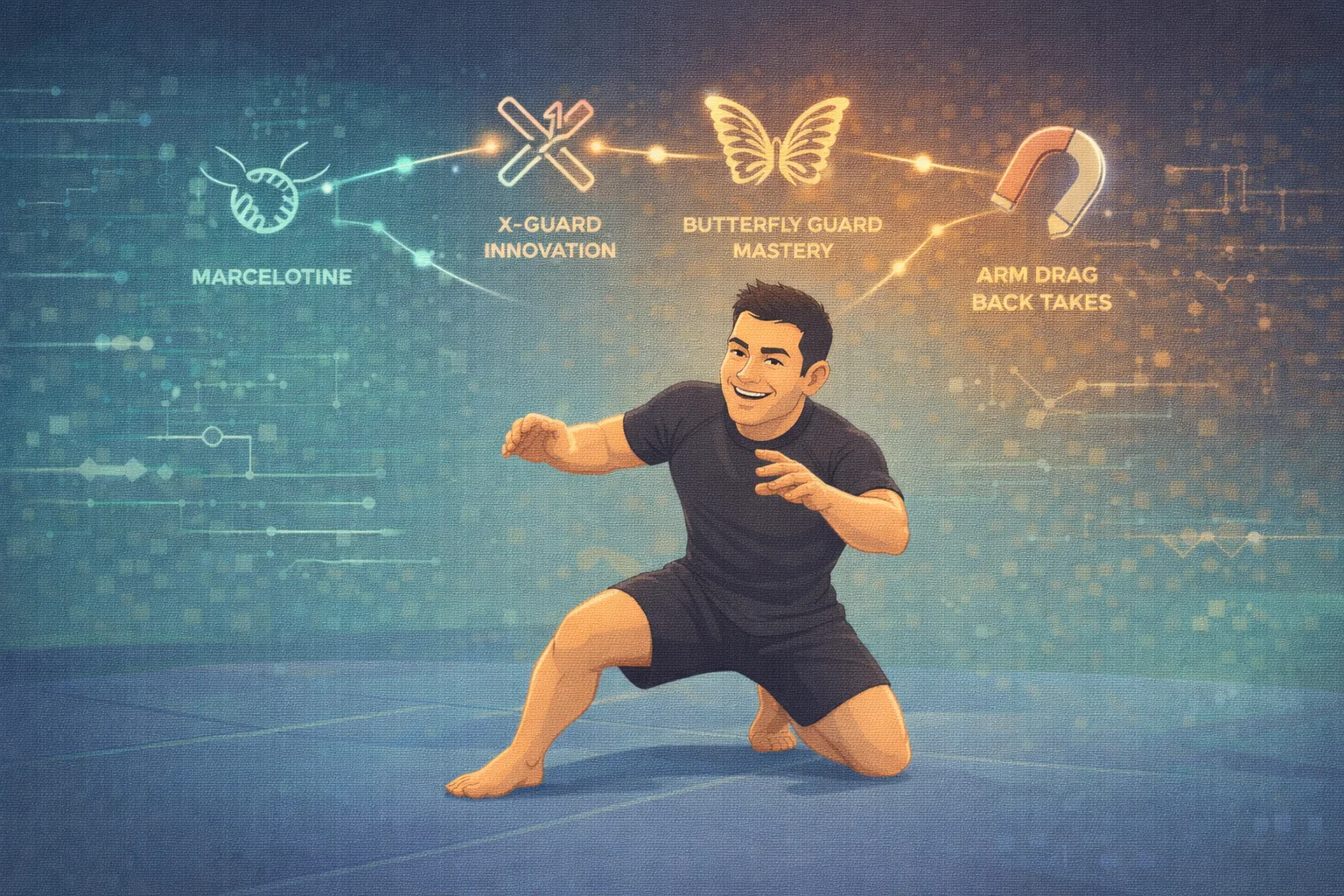
His guillotine choke -- the so-called "Marcelotine" -- became the gold standard for what a submission could be: not just a technique, but a philosophy of attack. When Marcelo locked his hands around your neck, the match was over. But the guillotine was only one weapon in an arsenal that redefined what was possible in no-gi grappling. His X-guard, his butterfly guard, his arm drags, his back takes -- all of it connected into a unified system that remains the blueprint for aggressive submission grappling to this day.
From Rural Brazil to Grappling Royalty
Marcelo Garcia was born on January 17, 1983, in the state of Minas Gerais, Brazil -- far from the traditional jiu-jitsu hubs of Rio de Janeiro and Sao Paulo. He began training as a teenager and showed immediate aptitude, but his physical profile did not suggest future dominance. He was compact, not particularly athletic-looking, and often the smallest person in his training room. None of that mattered once he started competing.
Marcelo trained under the legendary Fabio Gurgel at Alliance BJJ, one of the most successful competition teams in grappling history. Under Gurgel's guidance, he rose through the ranks with remarkable speed, earning his black belt and immediately establishing himself as a force in both gi and no-gi competition. His style was unusual from the beginning -- where most competitors at his level played conservative, point-oriented games, Marcelo threw himself forward with reckless confidence, constantly hunting for submissions and sweeps.
After establishing his competition legacy, Marcelo moved to New York City and opened the Marcelo Garcia Academy, which became a pilgrimage destination for grapplers from around the world. The academy produced a generation of elite competitors and instructors, cementing Marcelo's influence on the sport far beyond his own competitive career.
Did You Know: Marcelo was one of the first elite grapplers to publish full, unedited sparring footage online through his site MGinAction.com. At a time when most world champions guarded their training footage closely, Marcelo made everything available -- wins, losses, experiments, and failures. This level of transparency was revolutionary and inspired a generation of grapplers to study his game in granular detail.
The Guillotine: The "Marcelotine"
The guillotine choke has existed in grappling for as long as grappling has existed. But before Marcelo Garcia, it was widely considered a low-percentage move at the highest levels -- something you might catch a beginner with, but not a submission you could reliably finish against elite black belts. Marcelo changed that perception entirely. His version of the guillotine, now universally known as the "Marcelotine" or high-elbow guillotine, transformed the choke from a secondary attack into one of the most devastating submissions in the sport.
The mechanical innovation was precise and deeply considered. Traditional guillotines attack the windpipe -- they are air chokes that rely on compressing the trachea, which is painful but often escapable because the opponent can tuck their chin and resist. Marcelo's version targets the carotid arteries on the sides of the neck, making it a blood choke that puts opponents to sleep in seconds. The key details: a chin strap grip that wraps high around the jaw and neck rather than digging into the throat, a high elbow position that creates a wedge of forearm and bicep against the carotid, and a distinctive body curl finish where Marcelo pulls his opponent's head down while curling his own torso upward, compressing the neck from multiple angles simultaneously.
What made the Marcelotine truly special was the variety of entries. He hit it from standing, snapping opponents' heads down in the scramble. He hit it from butterfly guard, using his hooks to off-balance opponents and then catching the neck as they posted forward. He hit it in transition, catching opponents moving between positions. The guillotine was not a single technique in Marcelo's game -- it was a constant threat that warped his opponent's decision-making, forcing them to keep their chin tucked and their posture rigid, which opened up every other attack in his arsenal.
The Marcelotine (High-Elbow Guillotine)
From butterfly guard or a front headlock position, secure a chin strap grip around the opponent's neck with the choking arm high on the jaw. Thread the choking arm deep so the blade of the forearm presses against one carotid while the bicep compresses the other. Elevate the elbow of the choking arm above the opponent's shoulder line. Clasp hands (palm-to-palm or gable grip), pull guard or sit back to create an angle, and finish by curling your torso toward the opponent's head while squeezing elbows together. The choke should produce unconsciousness in seconds -- if you feel yourself muscling it, the angle is wrong.
Demonstrated by Marcelo Garcia
A detailed breakdown of the Marcelotine -- Marcelo Garcia's high-elbow guillotine that changed submission grappling forever.
Track every roll — log sessions and techniques for free
X-Guard Innovation
If the Marcelotine was Marcelo's most famous submission, the X-guard was his most important positional innovation. Marcelo is widely credited with either inventing the X-guard or, at minimum, being the first person to develop it into a comprehensive, competition-viable system. Before Marcelo, the position existed in fragments -- scattered techniques without a unifying framework. After Marcelo, the X-guard became a staple of every serious no-gi competitor's game.
The position itself is deceptively simple in concept: from underneath a standing opponent, you thread both legs around their lead leg in an X pattern -- one hook behind the knee, one hook in front of the hip -- while gripping the far ankle with your hands. This configuration gives the bottom player extraordinary mechanical control over the top player's balance. From the X-guard, Marcelo developed sweeps in every direction -- technical stand-ups to single legs, elevator sweeps that launched opponents overhead, and angle-based sweeps that put him directly into dominant positions.
The genius of the X-guard was not just the position itself but how Marcelo entered it. His transitions from butterfly guard to X-guard were seamless -- he would use his butterfly hooks to elevate an opponent, thread his legs through during the moment of weightlessness, and establish the X-guard before his opponent realized what had happened. This connectivity between butterfly guard and X-guard created a layered, unpredictable attack system that larger opponents found nearly impossible to shut down.
X-Guard Sweeps
From butterfly guard, elevate your opponent with a hook sweep attempt. As they post to resist, thread your outside leg behind their lead knee and your inside leg in front of their hip, crossing your feet to form the X. Grip the far ankle with both hands. To sweep: extend your legs to stretch the opponent's base while pulling the far ankle toward you, then technical stand to a single-leg finish. Alternatively, shift your hips to the outside and use the X hooks to topple the opponent laterally. The key is maintaining constant off-balancing pressure so the opponent cannot settle their weight.
Demonstrated by Marcelo Garcia
Butterfly Guard: The Foundation of Everything
To understand Marcelo Garcia's game, you have to understand that the butterfly guard was the engine that powered everything else. It was not one technique among many -- it was the central hub from which every attack originated. His overhook control, underhook battles, arm drags, and explosive hook sweeps all lived within the butterfly guard framework, and every major weapon in his arsenal -- the guillotine, the X-guard, the back take -- was accessible from this single position.
The connections are what matter. When an opponent pressured forward into Marcelo's butterfly guard, they exposed their neck to the snapdown guillotine. When they postured up to avoid the guillotine, they created space for the X-guard entry. When they tried to pass laterally, they gave up the arm drag to back take. And when they froze, trying to figure out which threat to address, Marcelo hit the butterfly hook sweep and ended up on top. Understanding that these are not separate techniques but interconnected branches of a single decision tree is the key to understanding why Marcelo was so difficult to deal with. Every defensive choice his opponents made simply redirected them into a different attack. This integrated approach to no-gi grappling was years ahead of its time.
Training Tip: When drilling Marcelo's butterfly guard system, do not practice each technique in isolation. Instead, chain them together: attempt the hook sweep, and when your partner resists, flow into the arm drag. When the arm drag fails, transition to X-guard. When they defend the X-guard, look for the guillotine. The goal is to internalize the connections between attacks so that your responses become automatic. The butterfly guard is a hub, not a destination.
The North-South Choke
While the Marcelotine received the most attention, Marcelo's second signature submission was arguably just as devastating. The north-south choke -- applied from the north-south position after passing the guard -- became one of his most reliable finishing tools, particularly in later stages of his career. It was a submission that perfectly reflected his style: aggressive, suffocating, and brutally efficient.
The north-south choke requires precise hip positioning and relentless shoulder pressure. From side control or mount, Marcelo would transition to north-south, sprawling his hips low and driving his shoulder into the opponent's neck. He would then thread his choking arm around the neck, clasping his hands and applying a combination of compression and rotation that attacked the carotid arteries. The pressure was compounding -- every breath the opponent took made the choke tighter, and the sprawled hip position made it nearly impossible to create space for an escape.
What made Marcelo's north-south choke unique was the way he set it up. He did not simply arrive in north-south and hope for the best. He used his passing game to tire opponents, then transitioned smoothly into the choke position, often catching opponents in the brief moment of relief they felt when they thought the guard pass was the worst of it. By the time they realized the choke was coming, it was already locked in.
North-South Choke
From side control, transition to north-south by walking your body around your opponent's head until you are chest-to-chest, facing their feet. Sprawl your hips low to maximize pressure. Thread your near arm under the opponent's neck, palm facing up, until your bicep is positioned against one side of the neck and your shoulder drives into the other. Clasp your hands together (gable grip or palm-to-palm), drop your chest onto the opponent's face to prevent them from turning, and squeeze while driving your hips toward the mat. The finish comes from the combination of shoulder pressure and arm compression on the carotid arteries.
Demonstrated by Marcelo Garcia
Back Attacks: The Arm Drag Pipeline
There is a strong argument that Marcelo Garcia is the greatest back-taker in grappling history. His ability to get behind opponents -- from any position, against any size -- was perhaps his most remarkable skill. And the engine of his back-taking game was the arm drag, a deceptively simple technique that he elevated into high art.
The arm drag from butterfly guard was Marcelo's signature transition. Seated in butterfly guard with his hooks in, he would grip his opponent's wrist or tricep, yank the arm across their body, and simultaneously shoot his hips to the side, arriving on the opponent's back before they could turn to face him. The entire sequence took less than a second at full speed. What made it so effective was not just the speed but the setup -- Marcelo used his butterfly guard attacks (hook sweeps, X-guard entries, guillotine threats) to force reactions that exposed the arm drag opportunity. By the time the arm drag came, the opponent was already defending three other things.
Once on the back, Marcelo was clinical. He favored a distinctive palm-to-palm grip variation of the rear naked choke, which he found more secure than the traditional figure-four grip. His seatbelt control (over-under grip across the chest) and body triangle or hook control kept opponents locked in place while he worked toward the finish. His back attack rate at ADCC was extraordinary -- once he took the back, the submission was virtually guaranteed. The pipeline from butterfly guard to arm drag to back control to rear naked choke was the most efficient kill chain in competitive grappling.
Competition Record: ADCC Legend
Marcelo Garcia's competition resume is one of the most impressive in grappling history, and it is defined above all by his dominance at ADCC (Abu Dhabi Combat Club), the most prestigious no-gi submission grappling tournament in the world. He is a 4-time ADCC World Champion, winning the -77kg division in 2003, 2005, 2007, and 2011 -- and he reached the absolute division final in 2007, falling only to Robert Drysdale. He is also a 5-time IBJJF World Champion (2004, 2006, 2009, 2010, 2011) and a multiple-time Pan American champion.
His 2003 ADCC debut at age 20 shocked the grappling world. An unknown young Brazilian walked into the bracket and submitted his way through a field of established veterans, announcing himself as a generational talent in the most emphatic way possible. His 2007 ADCC was perhaps his peak -- winning his weight class and reaching the absolute division final, submitting opponents who outweighed him by 30, 50, even 80 pounds along the way. Watching a 170-pound Marcelo Garcia choke unconscious a 250-pound world-class grappler was the kind of moment that reminded everyone why jiu-jitsu was invented in the first place.
His 2011 ADCC run was his farewell to major competition -- and he treated it like a victory lap. He submitted his way through the bracket one final time, finishing 3 of his 4 matches by submission, proving that even at the end of his competitive career, nobody could stop what he did. It was a fitting conclusion to a competitive journey that redefined what was possible in submission grappling.
Highlights from Marcelo Garcia's legendary ADCC 2011 campaign -- his final major tournament and one of the greatest individual performances in grappling history.
Study Drill: Watch Marcelo's ADCC matches chronologically from 2003 to 2011. Pay attention to how his game evolved over time -- the core weapons (guillotine, arm drag, X-guard) remained consistent, but his entries and setups became increasingly refined. Note how he adjusts his approach based on his opponent's size: against smaller opponents he is more aggressive with sweeps, while against larger opponents he relies more heavily on the arm drag to back take pipeline. Track his submission rate across tournaments -- it is remarkably consistent.
How to Study Marcelo Garcia
The good news for anyone wanting to study Marcelo Garcia's game is that he made it easier than any other elite grappler in history. His MGinAction archive is the most comprehensive training resource any world champion has ever published -- thousands of hours of rolling footage, drilling sessions, and technique demonstrations, all filmed at his academy over the course of years. Free YouTube content includes ADCC competition highlights and technique breakdowns that provide an excellent starting point.
When studying Marcelo, the most important thing to focus on is not individual techniques but the connections between positions. His butterfly guard, guillotine, X-guard, and back takes form an integrated system -- each position feeds into the others, and understanding the transitions between them is far more valuable than drilling any single technique in isolation. Pay particular attention to how he deals with larger opponents, because his solutions to size disparity are applicable to every grappler.
It is also valuable to contrast Marcelo's style with other elite grapplers to understand what makes his approach unique. Where systematic coaches build their games around logical frameworks and positional hierarchies, Marcelo's game is built around aggression and flow -- constant forward pressure that creates opportunities through sheer relentlessness. Where fundamentals-first grapplers emphasize perfect execution of basic positions, Marcelo innovated entirely new positions and attacks. Understanding these contrasts helps you identify which elements of Marcelo's game are most applicable to your own style and body type.
A comprehensive rewind of Marcelo Garcia's ADCC 2011 tournament -- breaking down each match and the techniques that defined his farewell performance.
Key Takeaway
Marcelo Garcia's greatness was not built on any single technique -- it was built on an integrated system where every position connected to every other position. The butterfly guard fed the guillotine, the guillotine setup fed the arm drag, the arm drag fed the back take, and the threat of the back take made the butterfly guard sweeps more effective. When you study Marcelo, study the connections. When you train like Marcelo, train the transitions. The goal is not to master five separate techniques but to build one seamless, aggressive, forward-moving game.
Ready to Build Your Own Submission Game?
Marcelo Garcia proved that you do not need to be the biggest, the strongest, or the most athletic to dominate in grappling. You need an integrated system, relentless aggression, and the willingness to attack from everywhere. Whether you are working on your guillotine, developing your butterfly guard, or learning to take the back, the lesson from Marcelo is the same: connect everything, keep moving forward, and never stop hunting for the finish.
Start tracking your guillotine attempts, your butterfly guard sweeps, and your back take success rate. Download Rollbook to log your training sessions, monitor which techniques are working, and build the kind of connected, aggressive game that Marcelo Garcia made the gold standard.
Oss!