Roger Gracie's Mount: Why Simple Perfection Beats Complexity
An in-depth analysis of Roger Gracie's devastating mount game, cross collar choke mastery, and the philosophy of fundamental perfection that made him the greatest competitive BJJ player of all time.
The Case for Simplicity
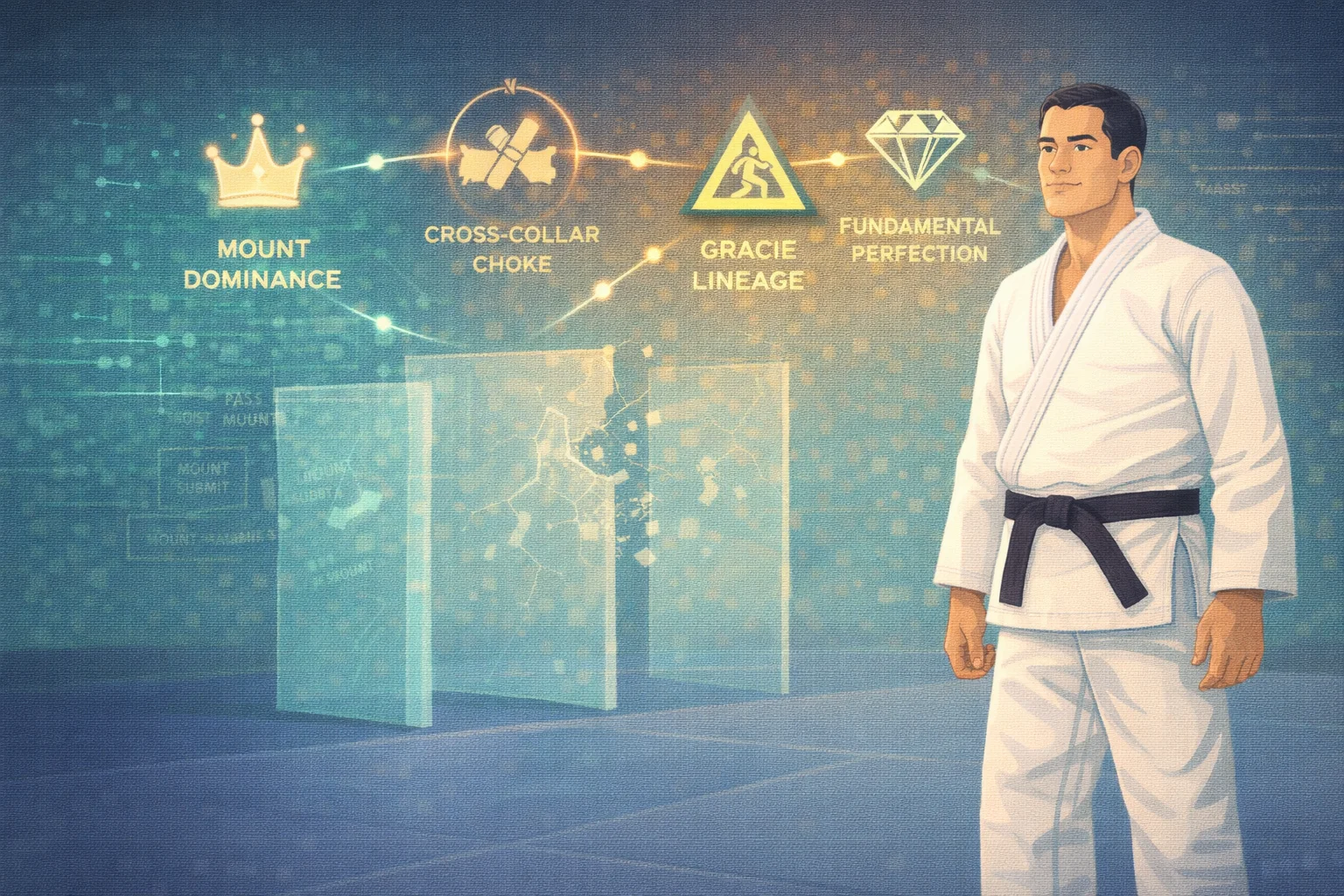
In an era of increasingly complex guards, spinning inversions, and berimbolos, one man dominated world championship Brazilian Jiu-Jitsu by doing what every white belt learns on their very first day: get to mount and choke. Roger Gracie did not revolutionize technique. He did not invent a new guard or a novel submission system. He took the most basic position in grappling -- full mount -- and the most elementary gi submission -- the cross collar choke -- and refined them to a level of perfection that the best fighters on the planet could not solve, even when they knew exactly what was coming.
Roger's career stands as the most compelling argument in the history of combat sports for the supremacy of fundamentals over complexity. While his contemporaries expanded their arsenals in every direction, Roger went deep rather than wide. The result was not just success but a kind of dominance that borders on the surreal: ten World Championship gold medals, submission victories over every elite grappler of his generation, and a tournament performance in 2009 that may never be matched. His legacy is not a technique -- it is a philosophy. And that philosophy says something profound about what it means to truly master a craft.
The Gracie Lineage
Roger Gracie was born on September 26, 1981, in Rio de Janeiro, Brazil, into the most storied family in martial arts history. His mother, Reila Gracie, was the daughter of Carlos Gracie, the co-founder of Brazilian Jiu-Jitsu. His father, Mauricio Motta Gomes, is a seventh-degree coral belt and one of the most respected instructors in the art. Roger's bloodline runs directly through the founding of BJJ itself -- he is not a branch of the family tree but the trunk.
Roger received his black belt from Carlos Gracie Jr., the head of the Gracie Barra organization and one of the most influential figures in modern BJJ. But Roger's path diverged from the typical Gracie Barra trajectory when he relocated to London, where he established the Roger Gracie Academy. From that base in England, far from the competitive hotbed of Rio de Janeiro, he continued to travel back to compete -- and continued to win at a rate that no one in the sport has matched before or since.
Did You Know: Roger Gracie is a 10x IBJJF World Champion -- the most in history -- with titles spanning from 2004 to 2010 across both weight and absolute divisions. He is also a 2x ADCC champion, winning the +99kg division in 2005 and the absolute division in 2007. No other competitor has matched this combined record across both gi and no-gi world championships.
The Mount: Roger's Throne
Every grappler learns the mount position in their first week of training. The concept is elemental: sit on top of your opponent, use gravity and body weight to control them, and attack. But the distance between a beginner's mount and Roger Gracie's mount is the distance between a student playing scales and a concert pianist performing Rachmaninoff. The notes are the same. The execution is from another world.
Roger's mount was not flashy -- it was an anvil. He rode low on his opponent's hips, distributing his weight with a precision that turned 205 pounds into what felt like an immovable force. His grapevine hooks -- legs threaded inside his opponent's legs -- eliminated the upa (bridge escape) before it could begin. His head positioning and upper body control neutralized the elbow-knee escape, the other fundamental mount escape that every competitor drills thousands of times. He did not scramble to maintain mount. He settled into it with a patience that bordered on ruthlessness, waiting for his opponent to exhaust their escape attempts before beginning his attack.
The key to Roger's mount control was anticipation. He did not react to escapes -- he preempted them. When an opponent shifted their hips to create space for the elbow escape, Roger's weight was already there, filling the gap. When they loaded for a bridge, his base was already adjusted to absorb it. This level of positional sensitivity cannot be taught through drilling alone. It comes from thousands of hours of live sparring against world-class opponents, building an intuitive understanding of weight distribution that operates below conscious thought.
Roger's Mount Control
Low hip positioning with grapevine hooks to eliminate bridge escapes. Head control on the near side to prevent the elbow-knee escape. Weight distributed through the chest and hips rather than sitting upright. Hands establish collar grips early, creating a dual threat: control and choke setup simultaneously. The mount is not a position to rush through -- it is the destination.
Demonstrated by Roger Gracie
Roger Gracie teaching his approach to mount control -- notice the emphasis on low hips, grapevine hooks, and patient pressure over explosive movement.
The Cross Collar Choke: The Inevitable Finish
This was the move. The technique that defined a career, a legacy, and an entire philosophy of competition. The cross collar choke from mount is the first submission most gi practitioners learn, and it is the technique that Roger Gracie used to submit multiple black belt world champions on the biggest stages in the sport. Everyone in the building knew it was coming. Everyone on the mat had drilled the defense a thousand times. Nobody could stop it.
The mechanics of Roger's cross collar choke were deceptively simple. The first grip -- thumb inside the collar, fingers wrapping the fabric -- was set deep, past the opponent's chin line, with the knuckles driving into the side of the neck. This grip alone was often enough to begin restricting blood flow. Roger would then wait. Not rush. Not force. He held the first grip and maintained his mount, letting his opponent react, letting them burn energy trying to strip a grip that was set like rebar in concrete. When the second hand entered the opposite collar, the choke was already finished -- the opponent just did not know it yet.
What separated Roger's cross collar choke from everyone else's was not the grip itself but the body mechanics behind it. He used his entire torso to drive the choke, dropping his chest toward the mat as his forearms closed like a vise around the neck. His hips stayed heavy on the mount to prevent the desperate bridge that every opponent attempted in their final seconds of consciousness. The squeeze was not muscular -- it was structural, generated by the alignment of his skeleton rather than the contraction of his forearms. This is why it worked against opponents who outweighed him and against opponents who had spent years specifically preparing to defend it.
Cross Collar Choke from Mount
From mounted position, establish a deep first grip with the thumb inside the collar on the far side of the opponent's neck. Maintain mount pressure and patience -- do not rush the second grip. When the opponent's defensive hands are occupied, feed the second hand into the opposite collar, palm up. Drop the chest toward the mat and pull the elbows toward your own hips, creating a shearing force across both carotid arteries. The power comes from chest-to-mat pressure, not arm strength.
Demonstrated by Roger Gracie
Roger Gracie demonstrating the perfect cross collar choke from mount -- the single most successful technique in world championship BJJ history.
Closed Guard Mastery
Roger's dominance from mount tends to overshadow another dimension of his game that was equally fundamental and equally devastating: his closed guard. When Roger was on his back, he played the most basic guard in jiu-jitsu -- legs wrapped around his opponent's waist, controlling posture with collar and sleeve grips. There were no rubber guard innovations, no deep de la Riva entanglements, no worm guard lapel wraps. Just closed guard, executed at an impossibly high level.
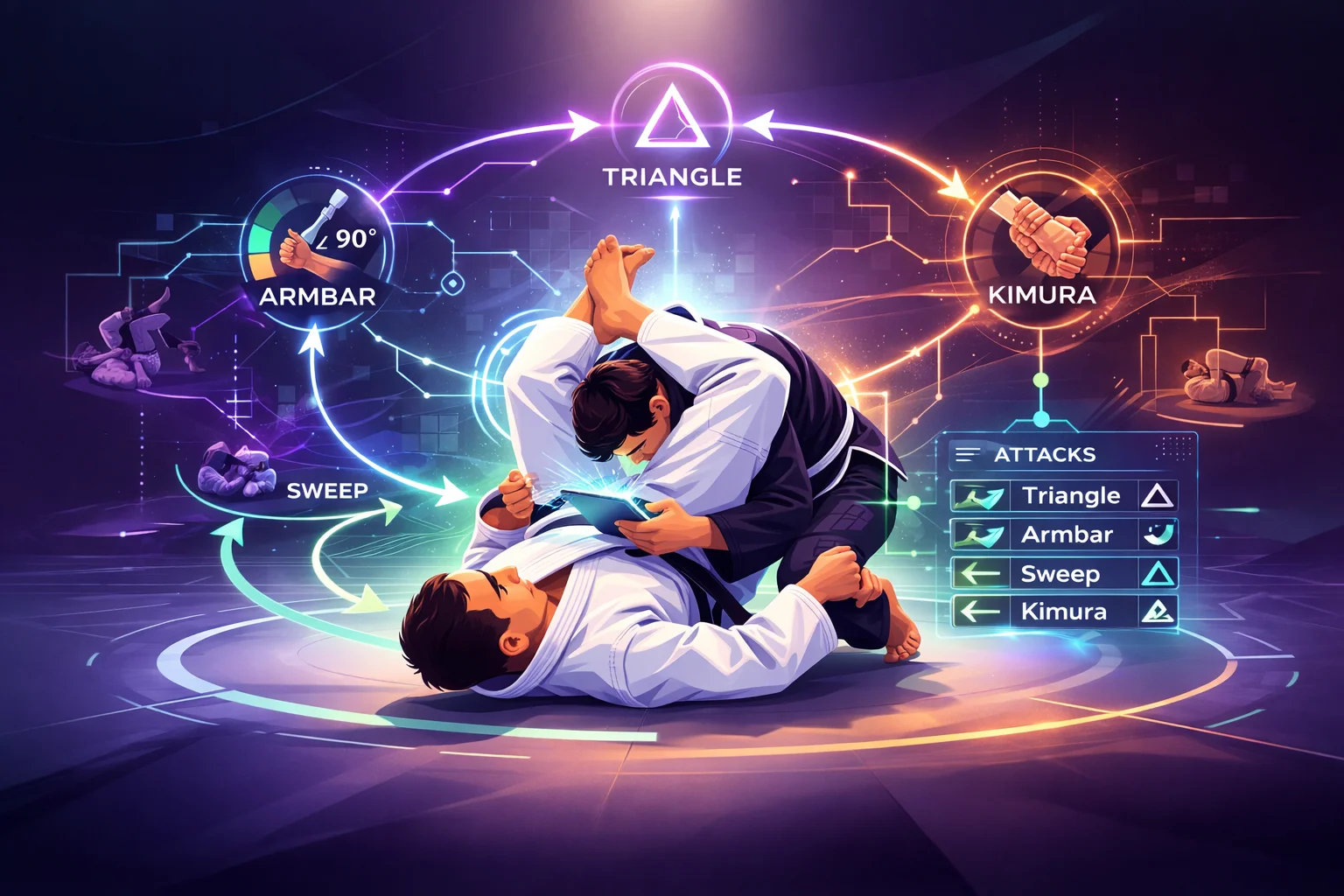
From closed guard, Roger used the same philosophy that governed his entire game: limit his opponent's options and then exploit the few that remained. His posture control was suffocating, dragging his opponent's head down to his chest and holding it there with an iron collar grip. From that broken-posture position, he threatened the armbar, the triangle choke, and the hip bump sweep -- techniques that every blue belt knows but that Roger finished against the best black belts alive. When the sweep landed, he was in mount. When the submission landed, the match was over. The closed guard was not a defensive position for Roger -- it was a launching pad for the same fundamental attacks that defined every other aspect of his game. For a deeper dive into building a complete attack system from this position, see our breakdown of the closed guard attack system.
Guard Passing to Mount: The Chain
The brilliance of Roger Gracie's competitive game was not in any single technique but in the chain that connected them. His game plan was transparent to everyone: pass the guard, establish side control, advance to mount, finish with the cross collar choke. There was no mystery, no hidden variation, no plan B. And yet nobody could stop the sequence, because each link in the chain was forged with the same obsessive attention to detail.
Roger's guard passing relied on fundamental techniques -- the torreando pass and the knee cut -- executed with perfect timing and crushing pressure. He did not attempt to pass with speed or with elaborate misdirection. He pressured his opponent's guard, waited for the opening created by their defensive movement, and drove through it with his full body weight. The pass was not an end in itself -- it was the first step toward mount. Once he cleared the legs and established side control, the transition to mount was seamless, almost automatic. For practitioners looking to build a similar foundational passing game, our guard passing fundamentals guide covers the core concepts.
Key Takeaway
Roger Gracie's entire competitive game can be described in one sentence: pass the guard, take mount, cross collar choke. The power was not in the complexity of the plan but in the depth of execution at every step. When you can do simple things at an extraordinary level, complexity becomes unnecessary.
Competition Record: The Numbers
The raw statistics of Roger Gracie's competitive career are staggering in their consistency. Ten IBJJF World Championship gold medals -- more than any other competitor in history -- earned between 2004 and 2010 across both the super-heavy weight division and the absolute (open weight) division. Two ADCC World Championship titles -- the +99kg division in 2005 and the absolute division in 2007 -- proving his dominance extended beyond the gi into no-gi competition as well.
His list of defeated opponents reads like a hall of fame roster. Marcus "Buchecha" Almeida, Romulo Barral, Xande Ribeiro, Ronaldo "Jacare" Souza -- each of them a world champion in their own right, each of them submitted or decisively defeated by Roger's fundamental game. But no single tournament encapsulates Roger's greatness like the 2009 Mundials. In what is widely considered the greatest single tournament performance in BJJ history, Roger entered both the super-heavy and absolute divisions and submitted every single opponent in every single match. Not a points victory. Not an advantage. Submission after submission, against the best grapplers on the planet, using the techniques that everyone in the building had been specifically training to defend. He also crossed over into professional MMA, compiling an 8-2 record with six submission victories in promotions including Strikeforce, the UFC, and ONE Championship.
Study Drill: Find Roger Gracie's 2009 Mundials competition footage and watch every match in sequence. Pay attention not to the submissions themselves but to the transitions that precede them -- the guard pass to side control to mount chain. Note how consistent his positional progression is across different opponents with different body types and different games. This consistency is the hallmark of true mastery.
How to Study Roger Gracie
Studying Roger Gracie's game requires a different approach than studying most modern competitors. There is no elaborate system to diagram, no complex matrix of positions and transitions to memorize. Instead, the study of Roger's game is the study of details -- small, almost invisible adjustments in grip placement, hip angle, weight distribution, and timing that transform basic techniques into unstoppable ones.
Start with his competition footage from the Mundials. Watch his mount transitions repeatedly, focusing on the moment he secures the position. Notice how his hips settle, where his hands go first, how his grapevine hooks engage. Then watch the choke. Watch where his first grip enters the collar -- not just which side, but how deep, at what angle, with what part of his hand making initial contact with the fabric. These details are where the mastery lives.
Roger's instructional content is more limited than some of his contemporaries, but the competition footage is deeply instructive precisely because his game is so consistent. You are not watching a different game plan each match -- you are watching the same game plan executed against different defenses, and you can learn enormous amounts by observing how he adapts the details while keeping the structure identical.
Analysis of Roger Gracie's mount techniques -- study the grip details and weight distribution that make his fundamental approach so effective against elite competition.
Philosophy: Depth Over Breadth
Roger Gracie's approach to jiu-jitsu stands in stark contrast to the dominant trend in modern BJJ toward ever-increasing specialization and novelty. The contemporary competition landscape rewards innovation -- new guards, new leg lock entries, new transitions that opponents have not yet developed defenses for. Coaches like John Danaher built intricate systems of leg entanglements that transformed no-gi grappling. Athletes like Marcelo Garcia pioneered new positions and submission entries that expanded the boundaries of what was possible on the mat. These are legitimate paths to excellence, and they have produced extraordinary competitors.
But Roger proved something different. He proved that there is another path -- one that does not require constant innovation, one that does not demand an ever-expanding technical repertoire. His path was depth. Rather than learning a hundred techniques at a functional level, he chose a handful of techniques and pursued a level of mastery that most practitioners never approach. The result was not a limited game but an unstoppable one. His opponents knew the technique. They had drilled the defense. They had studied the footage. And they still could not stop the cross collar choke from mount, because the gap between knowing a technique and having truly mastered it is vast -- and Roger lived on the far side of that gap.
The lesson for practitioners at every level is not to abandon new techniques or to ignore the evolution of the art. It is to ensure that your fundamentals are genuinely deep before you expand. A solid mount, a reliable guard pass, a functional closed guard -- these are the foundations that every complex game is built upon. If your A-game is not yet at a level where training partners who know it is coming still cannot stop it, then your time is better spent deepening that A-game than adding a B-game. Roger Gracie's career is the proof. For more on building a structured path of development through the belts, see our belt progression system.
Training Tip: Choose one position and one submission and commit to using them in every sparring round for an entire month. Track your success rate and note the specific defenses that give you trouble. Then spend the next month solving those specific problems. This is the Roger Gracie method -- not learning more techniques, but making your existing techniques work against people who know they are coming.
Key Takeaway
Roger Gracie's legacy is the ultimate argument for fundamental mastery. Ten World Championships, earned with the most basic techniques in the art, against opponents who knew exactly what was coming. The lesson is clear: depth beats breadth, patience beats speed, and perfection of the basics beats a collection of the advanced. Master your mount. Master your choke. The rest will follow.
Ready to Master the Fundamentals?
Roger Gracie built the greatest competitive record in BJJ history by perfecting the basics. Your journey toward fundamental mastery starts with consistent training, deliberate practice, and tracking your progress over time. Rollbook helps you log every session, track your techniques, and measure your development -- so you can focus on building depth in the positions that matter most.
Download Rollbook and start training like the GOAT trained: with patience, precision, and an obsessive commitment to the fundamentals.
Oss!