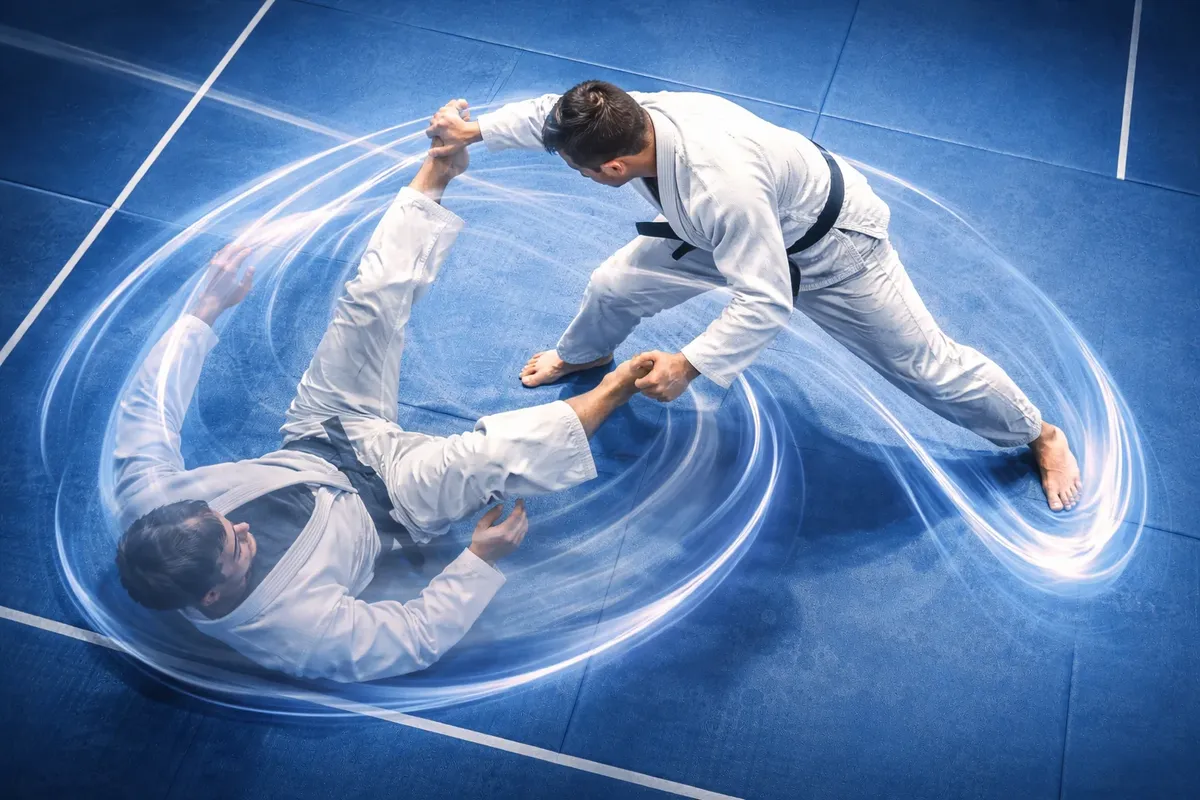
Mikey Musumeci's Guard System: Breaking Down the Walls Concept
A comprehensive analysis of Mikey Musumeci's revolutionary 'Walls' concept for guard passing, his butterfly guard system, and the systematic approach that earned him multiple world titles.

The Mind That Systematized Guard Passing
Mikey Musumeci does not teach techniques. He teaches systems. That distinction is the single most important thing to understand about his approach to Brazilian Jiu-Jitsu, and it is the reason why a four-time IBJJF World Champion and ONE Championship titleholder has managed to change how an entire generation of grapplers thinks about getting past the legs.
Most guard passing instruction follows a familiar pattern: here is a torreando pass, here is a knee cut, here is a leg drag. You learn them individually, drill them separately, and then walk onto the mat hoping the right moment for each one appears. Musumeci saw a fundamental problem with this approach. Isolated techniques, no matter how well drilled, leave you reactive. You wait for the opening instead of creating it. You rely on recognition instead of understanding.
His answer was the Walls concept, a framework that reduces the infinite complexity of guard passing into a progressive, systematic sequence. Instead of memorizing dozens of disconnected passes, you learn to identify which "wall" your opponent has built, break through it, and advance to the next one. Every pass you already know slots into this framework. Every new technique you learn has a clear place within it.
If you are new to the fundamentals of guard passing, start there first. This article builds on those foundational concepts with Musumeci's advanced systematic approach.
The Problem with Traditional Guard Passing Instruction
Walk into most BJJ academies and guard passing class follows a predictable structure. The instructor shows a pass. You drill it with a compliant partner. You spar and try to use it against resistance. Sometimes it works. Often it does not. You learn another pass the next week.
The issue is the gap between knowing a technique and understanding when, why, and how to deploy it within a live exchange. A guard player does not sit still while you set up your preferred pass. They create frames with their feet, shins, knees, and arms. They re-guard, invert, and attack. Each defensive action presents a different puzzle, and a collection of memorized techniques gives you no systematic method for solving it.
Musumeci's innovation was recognizing that all guard defense follows the same structural logic. The guard player uses their body to create barriers between you and side control. Those barriers are predictable, layered, and sequential. If you understand the layers, you understand every guard.
Conceptual Shift: Musumeci describes the guard as a "collection of frames and hooks." Rather than seeing closed guard, butterfly guard, and de la Riva as fundamentally different positions, he views them as different configurations of the same defensive tools: the feet, knees, and hips creating barriers that the passer must systematically dismantle.
Understanding the Walls Concept
The Walls concept structures guard passing as a sequential problem. Your opponent's guard creates layered defenses, and each layer is a "wall" you must break through before advancing. Musumeci typically identifies three primary walls, each defined by a specific part of the opponent's body:
- Wall 1: The feet and ankles
- Wall 2: The knees and shins
- Wall 3: The hips and core (including arm frames)
The critical insight is that these walls exist in order. You cannot meaningfully attack Wall 2 until Wall 1 is cleared. You cannot break Wall 3 until Wall 2 is neutralized. Attempting to skip walls is the single most common reason passes fail. The guard player who re-establishes a foot on your hip after you have cleared their knees has rebuilt Wall 1, and you are back to the beginning.
This sequential logic means that every sparring round, every competition match, and every drilling session becomes a diagnostic exercise. When your pass fails, you can identify exactly which wall stopped you and focus your training accordingly.
Key Takeaway
Guard passing failures are not random. They occur at specific, identifiable walls. By learning to diagnose which wall is stopping you, you transform vague frustration into targeted improvement. Track your passing attempts and note where they break down to accelerate your development.
Track every roll — log sessions and techniques for free
Wall 1: Controlling the Feet
Wall 1 is the first line of defense in any guard. Before you can do anything else, you must deal with your opponent's feet. Feet on your hips create distance. Feet on your biceps strip your grips. Feet hooking behind your knees compromise your base. Until you neutralize the feet, nothing else matters.
Musumeci teaches two primary methods for clearing Wall 1, which he calls "collecting the feet."
Method 1: Gripping the Ankles
The most direct approach is to grip both of your opponent's ankles simultaneously. By controlling the ankles, you remove the opponent's ability to push, pull, or redirect you with their feet. This grip also prevents them from establishing hooks for butterfly guard, de la Riva, or single leg X.
The key detail is that you must collect both feet, not just one. Controlling a single ankle while leaving the other foot free gives the guard player enough mobility to re-establish distance, attack sweeps, or transition to a different guard configuration. Both feet must be neutralized to truly clear Wall 1.
Method 2: Shelfing the Feet
The second method involves "shelfing" the opponent's feet, placing them on your body in a controlled position where they cannot generate pushing force. Rather than gripping the ankles, you position yourself so that the opponent's feet rest passively against your thighs or torso without the angle or leverage to push you away.
Shelfing is particularly effective in no-gi, where ankle grips are harder to maintain due to the absence of gi pants. It is also useful against guard players who are skilled at stripping grips, because the control comes from positioning rather than grip strength.
Wall 1: Foot Collection
Control both of your opponent's feet simultaneously using ankle grips or shelfing. The goal is to neutralize pushing force and prevent guard establishment. Both feet must be addressed; controlling only one leaves the guard player with enough mobility to re-guard or attack. This is the mandatory first step before any pass can begin.
Demonstrated by Mikey Musumeci
Mikey Musumeci breaks down the first steps to passing guard, including foot collection and the foundational concepts of the Walls system (BJJ Fanatics).
Wall 2: Clearing the Knees
Once the feet are neutralized, the opponent's next line of defense is their knees and shins. Knee shields, shin-on-shin frames, and butterfly hooks all operate at this level. The knees create a secondary barrier that prevents you from closing the distance to their hips.
Wall 2 is where the passer must choose between two fundamental passing directions: inside or outside.
Outside Passing (Torreando)
Outside passing means moving around the opponent's legs to reach side control. The classic torreando, or bullfighter pass, is the primary tool here. After collecting the feet in Wall 1, the passer redirects the opponent's knees to one side while stepping around to the other. Musumeci also teaches the reverse torreando, which uses different grips and angles to achieve the same goal from the opposite direction.
The torreando is especially effective as a Wall 2 solution because it exploits the moment when the opponent's knees are their only remaining barrier. Without foot control to maintain distance, the guard player's knee frames become easier to redirect.
Inside Passing
Inside passing means going between or over the opponent's legs rather than around them. The knee cut is the primary inside pass, and it directly attacks the knee-level wall by splitting the opponent's legs with your shin and driving through to side control.
Musumeci emphasizes that the choice between inside and outside passing should be reactive, not predetermined. The guard player's response to your Wall 1 clearance dictates which direction is available. If they try to re-establish butterfly hooks, the torreando opens up. If they extend their legs to create distance, the knee cut becomes available. The passer who can read these reactions and flow between inside and outside passing becomes very difficult to stop.
Wall 2: Torreando (Outside Square Passing)
After clearing Wall 1, redirect both knees to one side and step around to the opposite side. The reverse torreando variation uses alternate grips for no-gi effectiveness. Combine with knee-on-belly pressure after clearing the knees to consolidate position. The key is timing: attack Wall 2 immediately after neutralizing the feet, before the guard player can rebuild Wall 1.
Demonstrated by Mikey Musumeci
Mikey Musumeci demonstrates guard passing fundamentals including torreando mechanics and the transition from foot control to knee clearance (BJJ Fanatics).
Wall 3: Breaking the Hip Line
Wall 3 is the final and most difficult barrier. At this level, you are dealing with advanced frames created by the opponent's hips, arms, and core. These include arm frames against your shoulders or neck, the knee-on-chest frame, and hip escapes that recreate distance even when you have cleared the first two walls.
This is where many guard passes die. You have controlled the feet, cleared the knees, moved into a strong position, and then a well-timed hip escape or arm frame sends you back to square one. Musumeci addresses Wall 3 with a toolkit of techniques designed to remove these final frames and complete the pass.
Knee Cut Finishing Details
The knee cut pass, initiated during Wall 2, often meets resistance at Wall 3. The opponent frames against your chest, blocks your crossface, or shrimps to re-guard. Musumeci teaches several solutions:
- Rau drag: Grip the opponent's far arm and drag it across their body, removing the arm frame and exposing the back
- Duck under: When the opponent posts their arm to frame, duck underneath it to remove the barrier and advance to side control
- Long step: Step your trailing leg far behind the opponent to flatten them and eliminate the hip escape
Dealing with Knee-on-Chest Frames
One of the most frustrating Wall 3 defenses is the knee-on-chest frame, where the opponent brings their knee to their chest to prevent you from establishing chest-to-chest contact. Musumeci addresses this using the same conceptual logic: identify the frame, choose the appropriate removal technique, and advance. The bicep grip is a key detail here, controlling the arm that supports the knee frame to prevent the opponent from maintaining the barrier.
Wall 3: Rau Drag to Back Exposure
When the opponent frames against your chest during a knee cut pass, grip their far wrist and drag it across their body toward you. This simultaneously removes their primary frame and rotates their torso, exposing the back. From here, you can complete the pass to side control or transition directly to a back take. The rau drag is most effective when combined with strong crossface pressure from the opposite arm.
Demonstrated by Mikey Musumeci
Training Tip: When drilling Wall 3 techniques, have your partner apply genuine resistance with their frames. The rau drag, duck under, and long step only develop proper timing and sensitivity against a partner who is actively trying to re-guard. Compliant drilling builds the wrong habits at this level.
The 3 Boxes of Attacks
Beyond the Walls concept for passing, Musumeci uses another framework he calls the "3 Boxes of Attacks." This system organizes the offensive options available at each stage of a guard exchange into three categories:
- Submissions: Direct finishing attacks such as heel hook exposure, neck attacks, and arm locks
- Passes: Advancing through or around the guard to achieve a dominant position
- Back Takes: Transitioning to the opponent's back for rear control
The power of this framework is that it turns every guard interaction into a three-way dilemma. If the opponent defends the submission, they expose a passing lane. If they block the pass, they create an opening for a back take. If they defend the back take, they become vulnerable to the submission.
Musumeci's guard game is built on chaining these three boxes together so that every defensive reaction opens an attack from a different box. This is fundamentally different from the traditional approach of attempting one technique at a time and starting over when it fails.
For grapplers interested in the submission box, particularly the leg lock game, Musumeci's butterfly ashi position (covered below) is one of the most dangerous entry points in modern BJJ. Understanding heel hook defense is essential for safely training these exchanges from both sides.
Key Takeaway
The 3 Boxes of Attacks transform single-threat offense into multi-threat offense. Instead of attempting isolated passes, submissions, or back takes, chain them together so that defending one creates the opening for another. This principle applies at every belt level and in every position, from closed guard to the most complex open guard exchanges.
Mikey's Guard Game: Butterfly and Single Leg X
While the Walls concept defines Musumeci's approach to passing, his guard game is equally systematic and equally devastating. His primary guard positions are butterfly guard and single leg X (which he plays in a hybrid configuration he calls "butterfly ashi"), and they exemplify the same conceptual thinking that drives his passing.
Butterfly Guard Foundations
Butterfly guard uses hooks (your feet hooked inside your opponent's thighs) and underhooks to create a platform for sweeps, back takes, and transitions to leg entanglements. Unlike closed guard, which locks the opponent in place, butterfly guard is dynamic. It uses elevation and off-balancing to force reactions.
The guard player's legs function as dynamic frames that can off-balance both standing and kneeling passers. The butterfly hook creates upward lifting force, and when combined with an underhook and a well-timed hip extension, it generates enough power to sweep opponents significantly larger and heavier.
Musumeci's butterfly guard integrates directly with his Walls concept from the defensive side. When a passer clears Wall 1 and begins attacking Wall 2, Musumeci uses butterfly hooks to re-establish foot contact and rebuild the first wall. This cycling between guard retention and offensive hooks is a cornerstone of his bottom game.
Single Leg X and Butterfly Ashi
Musumeci's butterfly ashi position is a hybrid between butterfly guard and single leg X that has become one of the most feared positions in competitive grappling. In this configuration, the attacker hooks their outside foot behind the opponent's leg while posting the sole of the inside foot on the same hip, creating two points of contact on a single leg.
The position sacrifices some control of the opponent's free leg in exchange for overwhelming control of the target leg. With two contact points on one hip, the attacker can manage distance even if the defender removes one post. Musumeci often reinforces this control by gripping below the knee of the target leg, adding a third layer of distance management.
From butterfly ashi, Musumeci can sweep, enter ashi garami positions for leg lock attacks, or transition to the back. The position also makes it remarkably easy to switch between legs: because both feet are inside the opponent's legs, the attacker only needs to pummel one knee out and the other in to change targets.
The effectiveness of this position is proven at the highest level. Musumeci holds the record for the fastest submission in an IBJJF World Championships final, winning the 2019 roosterweight final in just twelve seconds with an ankle lock.
Butterfly Ashi (Hybrid Single Leg X)
Hook the outside foot behind the opponent's leg at the hip joint while posting the inside foot's sole on the same hip. This creates two points of contact that maintain control even if one post is removed. Add a grip below the knee of the target leg for a third layer of distance management. From here, attack with sweeps, ashi garami transitions for heel hooks, or switch to the opposite leg by pummeling your knees.
Demonstrated by Mikey Musumeci
Safety Note: Butterfly ashi and single leg X positions provide direct entries into heel hook and knee bar attacks. Always train leg entanglements with controlled partners who understand proper tapping etiquette. Beginners should focus on positional control before adding submission attacks. Review our heel hook defense guide before training these exchanges live.
From Concept to Competition: Musumeci's Record
The proof of any system is in its results, and Musumeci's competitive record is among the most impressive in BJJ history.
IBJJF World Championships:
- Four-time black belt World Champion (all gi titles: light-featherweight in 2017 and 2018, roosterweight in 2019 and 2021)
- First American to win multiple IBJJF World Championships at black belt
- Titles across both roosterweight and light-featherweight divisions
- Holds the record for the fastest submission in a Worlds final (12 seconds, 2019)
ONE Championship:
- Inaugural ONE Flyweight Submission Grappling World Champion (2023)
- Maintained an undefeated record in the division with multiple title defenses
What makes these achievements remarkable is their context. Musumeci competes at the lightest weight classes, where his opponents are as technical and as fast as he is. His victories come from systematic understanding that is deeper and more refined than his competition. He has beaten opponents who knew exactly what he wanted to do and still could not stop it, the hallmark of a truly systematic fighter.
His success spans both gi and no-gi, demonstrating that the Walls concept and his guard systems are rooted in body mechanics and positional logic, not grip configurations. For a deeper understanding of how training differs across these formats, see our breakdown of no-gi vs. gi BJJ.
Applying the Walls to Your Own Game
The Walls concept is not reserved for elite competitors. Its greatest strength is its scalability. A white belt can use the same framework as a world champion because the underlying logic does not change across skill levels. Here is how to begin integrating it into your training.
Step 1: Diagnose Your Passing Failures
For your next ten sparring rounds, pay attention to where your passes fail. Are you getting stopped by feet on your hips (Wall 1)? Knee shields and shin frames (Wall 2)? Arm frames and hip escapes when you are close to passing (Wall 3)? Most grapplers have a specific wall that stops them most often, and identifying it is the first step toward fixing it.
Step 2: Drill Wall-Specific Solutions
Once you know your problem wall, drill the solutions for that specific barrier:
- Wall 1 problems: Practice foot collection and shelfing drills. Start from open guard with your partner's feet on your hips and work on controlling both ankles simultaneously.
- Wall 2 problems: Drill torreando and reverse torreando from a position where the feet are already controlled. Practice switching between inside and outside passing based on your partner's reaction.
- Wall 3 problems: Drill the rau drag, duck under, and long step against active resistance. Have your partner frame aggressively so you develop timing for each removal technique.
Step 3: Chain the Walls Together
Once you can clear each wall individually, begin drilling the transitions between them. Start from full open guard and work through Wall 1 to Wall 2 to Wall 3 in sequence, with your partner providing progressive resistance at each level.
Step 4: Add the 3 Boxes
As your wall-by-wall passing improves, begin incorporating submission threats and back take opportunities at each wall. When your partner defends your torreando at Wall 2, look for a leg entanglement. When they frame at Wall 3, look for the back. The passes themselves become setups for the other two boxes.
Partner Drill - Progressive Wall Breaking: Start in open guard. The guard player establishes full guard (all three walls active). The passer works to clear Wall 1 only, then resets. Repeat five times. Then drill clearing Walls 1 and 2 before resetting. Repeat five times. Finally, drill the full sequence from Wall 1 through Wall 3 to side control. This progressive approach builds comfort and confidence at each level before chaining them together. If you are just beginning your BJJ journey, our complete beginner's guide covers the foundational guard positions you will encounter in this drill.
Wall Identification Sparring
During live sparring, narrate internally (or out loud with a willing partner) which wall you are currently facing. "I need to collect the feet. That is Wall 1. Now the knee shield, Wall 2. Now the arm frame, Wall 3." This conscious identification builds the pattern recognition that eventually becomes automatic. After each round, note which wall stopped you most often and target that wall in your next drilling session.
Demonstrated by Mikey Musumeci
Why Concepts Beat Techniques
Musumeci's approach to BJJ represents a broader shift in how the art is taught and understood. Traditional instruction emphasizes technique memorization: learn this move, then that move, then another move. Conceptual instruction emphasizes understanding the principles that make all techniques work.
The Walls concept does not replace the torreando, knee cut, or leg drag. It organizes them. It tells you when each one is appropriate, why it works in that moment, and what to do when it fails. A practitioner who understands the Walls does not need to memorize a separate answer for every guard. They need to identify which wall they are facing and apply the appropriate solution.
This is why Musumeci's system scales from white belt to black belt. A white belt learning to collect feet and clear knees is working on the same conceptual framework as a black belt chaining torreando-to-leg-drag-to-back-take at Wall 2. The techniques become more sophisticated, but the logic remains identical.
The same principle drives his guard game. Butterfly guard and single leg X are not just positions; they are applications of the universal principle that guards are built from frames and hooks. Understanding which frames and hooks create which barriers, and how to establish, maintain, and re-establish them, is the foundation of Musumeci's guard that made even Gordon Ryan acknowledge the difficulty of passing it.
Ready to systematize your guard passing? Download Rollbook to track your progress through each wall, log your passing attempts, and identify where your passes break down. Start your free trial today.
Oss!