Closed Guard Attack System: Sweeps, Submissions, and Control
Build a complete closed guard game with proven submissions, high-percentage sweeps, and systematic attack chains that keep your opponent constantly defending.
The Foundation of Every Guard Game
The closed guard is where Brazilian Jiu-Jitsu begins. It is the first guard you learn, the last guard your opponents want to be stuck in, and the position that Roger Gracie used to win ten IBJJF World Championships at black belt. Despite the explosion of modern open guard systems, the closed guard remains one of the most dangerous positions in all of grappling.
Why? Because when your legs are locked around someone's waist, they cannot pass. They cannot disengage. They are trapped in your world, forced to deal with your attacks on your terms. Every second they spend inside your closed guard is a second where you control the distance, the tempo, and the threat level.
This guide will give you a complete closed guard attack system: the control fundamentals that make everything else work, the core submissions and sweeps you need, and the attack chains that turn individual techniques into a relentless offensive machine. If you are new to grappling, start with our complete beginner's guide to BJJ to understand the foundational positions first.
Why the Closed Guard Still Works
There is a persistent myth in modern BJJ that closed guard is outdated. Competitors pull to de la Riva, berimbolo through inversions, and hunt leg locks from open guard positions. So why would anyone choose closed guard?
The answer is simple: it works. Roger Gracie proved this at the highest level of competition imaginable. He submitted world-class black belts with cross collar chokes from closed guard and mount, techniques every white belt learns in their first week. His opponents knew what was coming. They trained specifically to stop it. They still got submitted.
Roger's success was not about secret techniques. It was about depth of understanding. His posture breaking was unbreakable. His grip fighting was relentless. His attack chains were so systematic that defending one threat created two more. He demonstrated that mastery of fundamentals beats novelty every time.
Beyond competition, closed guard is the most effective self-defense guard position. You control the distance completely, prevent strikes, and can work to stand up or sweep from a position of relative safety. No other guard offers this combination of offensive potential and defensive security.
Historical Note: Roger Gracie won IBJJF World Championships in 2004, 2005, 2006, 2007, 2008, 2009, and 2010 at black belt, plus his famous comeback in 2017. His game was built on closed guard, mount, and cross collar chokes. Many of his opponents knew exactly what he planned to do and still could not stop it.
Controlling from Closed Guard
Before you can attack, you must control. The single most important concept in closed guard is posture breaking. When your opponent has an upright posture with a straight spine and good base, they can defend everything. When their posture is broken and their head is at your chest level, every attack in your arsenal becomes available.
Breaking Posture
Posture breaking is not a single action but a constant battle. Your opponent's entire job from inside your closed guard is to get their posture back. Your job is to never let them have it.
Primary Methods:
- Collar and sleeve pull: Grip their collar behind the neck with one hand and their sleeve at the wrist with the other. Pull them forward while squeezing your knees together and crunching your legs toward you. This combination of upper body pulling and lower body squeezing is extremely difficult to resist.
- Head hug: Overhook their neck and pull their head to your chest. Flare their posting elbow outward to remove their base. Once their head is at chest level, transition to collar grips for attacks.
- Two-on-one arm control: Grip both hands on one of their arms (wrist and tricep). Drag the arm across your body to break their posture on that side, creating angles for sweeps and back takes.
Making Them Carry Your Weight
One of the most underappreciated closed guard concepts is using gravity as a weapon. When you lock your ankles behind their back and crunch your legs forward, you are forcing the top player to support your body weight in addition to their own. This is exhausting. Every minute they spend carrying your weight is a minute where their arms get heavier, their posture breaks more easily, and their reactions slow down.
Squeeze your knees tight against their ribcage. Keep your hips angled slightly to create pressure. Do not just hang passively. Actively pull and crunch, making them fight for every inch of posture.
Grip Fighting
Grip fighting from closed guard sets up everything. In the gi, prioritize cross collar grips (for chokes and posture control), sleeve grips (for arm isolation), and lapel grips (for sweeps). In no-gi, fight for wrist control, collar ties, and underhooks.
The key principle: never let your opponent establish their grips first. If they get both hands on your hips or biceps, they are beginning their guard break sequence. Strip their grips aggressively by bridging your hips, pummeling under their arms, or simply pulling their hands away.
Key Takeaway
Control comes before attack. If you cannot consistently break your opponent's posture and maintain grips, none of the submissions or sweeps in this guide will work. Spend time every training session just fighting for posture breaks and grips from closed guard before worrying about finishing techniques.
Core Submissions from Closed Guard
The closed guard offers a devastating arsenal of submissions that attack the neck, the arms, and the shoulders. Each of these techniques is high-percentage on its own, but they become truly dangerous when chained together.
Cross Collar Choke (Gi)
The cross collar choke is Roger Gracie's signature technique and arguably the most disrespected submission in BJJ. Everyone knows it is coming. Very few people can stop it when applied correctly.
Execution:
- Break your opponent's posture using a collar grip behind the neck
- Feed your first hand deep into their far collar, fingers inside, thumb on top
- Use this grip to maintain posture control while feeding your second hand into the opposite collar
- Pull your elbows tight to your ribs and expand your chest while squeezing your forearms against both sides of the neck
Key Details:
- Depth of grip is everything. Your knuckles should be touching the back of their neck on each side
- The choke comes from your forearms pressing into the carotid arteries, not from squeezing with your hands
- If they try to posture up with one grip set, use the collar grip to pull them back down before setting the second grip
- If they peel one grip, the arm they use to peel becomes exposed for armbar or triangle attacks
Triangle Choke
The triangle choke is the most versatile submission you can attack from closed guard. We have a complete breakdown in our triangle choke mastery guide, but here are the closed guard specifics.
Execution:
- Break posture and control one wrist (push it to your hip)
- Push their opposite arm across your centerline
- Open your guard, hip escape to the side of the trapped arm, and shoot your leg high over the back of their neck
- Lock the triangle by placing the back of your knee over your opposite ankle
- Angle off (not straight on) and squeeze your knees together while pulling their head down
Key Details:
- The one-arm-in, one-arm-out configuration is essential. Both arms in or both arms out will not finish
- Angle your body 30-45 degrees to the side for maximum squeeze
- Pull their trapped arm across your body to use their own shoulder against them
Triangle Choke from Closed Guard
Prof. Diogo Ferreira demonstrates how to attack the triangle from closed guard using belt control and proper angle for a high-percentage finish.
Demonstrated by Prof. Diogo Ferreira — Gracie Barra
Triangle Choke from Closed Guard — Prof. Diogo Ferreira, Gracie Barra
Armbar from Guard
The armbar from closed guard is one of the highest-percentage submissions in BJJ history. It attacks the elbow joint by hyperextending it against your hips.
Execution:
- Break posture and isolate one arm by gripping the wrist and pulling it across your centerline
- Place your foot on their hip on the same side as the trapped arm for leverage
- Swing your opposite leg high over their head, clamping it tight against their ear
- Pinch your knees together, keep their thumb pointing up, and lift your hips to apply pressure
Key Details:
- Control the arm at the wrist throughout the entire technique. If you lose the wrist, they escape
- Keep your hips tight against their shoulder. Any space allows them to pull the arm free
- Squeeze your knees together to prevent them from stacking you
- The finish comes from your hips lifting, not from pulling the arm down
Kimura from Guard
The kimura targets the shoulder joint with a figure-four grip. It is particularly effective when your opponent posts an arm on the mat or pushes into your chest.
Execution:
- When they post a hand on the mat or on your chest, grab their wrist with your same-side hand
- Sit up slightly and thread your opposite arm over their arm and behind their elbow
- Grip your own wrist to complete the figure-four
- Open your guard slightly, hip escape to create an angle, and rotate their arm behind their back
Key Details:
- Your grip must be tight. Grab your own wrist, not your fingers
- Hip escape to the side to create the angle needed for the rotation
- If they are very strong, use your legs to help control their posture while you work the finish
- The kimura transitions beautifully to sweeps if they resist the submission
Guillotine Choke (No-Gi Emphasis)
The guillotine is your primary closed guard attack when the opponent dives their head low, whether to attempt a pass or because you pulled them into a front headlock position.
Execution:
- When their head drops to one side, wrap your arm around their neck (blade of your wrist against the throat)
- Clasp your hands together (palm-to-palm or Gable grip)
- Close your guard if it is open, pulling your legs tight
- Arch your back and pull upward with your arms while squeezing your guard closed
Key Details:
- The arm-in guillotine (their arm trapped inside) finishes more reliably in closed guard than the head-only variation
- Pull your elbow to the ceiling, not toward your body
- Your guard squeeze prevents them from backing out or rolling through
Omoplata
The omoplata attacks the shoulder using your legs as a lever. It is one of the most versatile techniques from closed guard because even if the submission itself does not finish, it creates sweeps, back takes, and transitions to other attacks.
Execution:
- From broken posture, isolate one arm and push it across your body
- Open your guard and swing your leg over their shoulder on the isolated arm side
- Pivot your body perpendicular to theirs, sitting up as you rotate
- Control their hips to prevent the forward roll escape, then lean forward to apply pressure to the shoulder
Key Details:
- The pivot is essential. You must turn your body 90 degrees to face the same direction as your opponent
- Control their belt or waistband to prevent the most common escape (rolling forward)
- If they do roll, follow them and come up on top into a dominant position
Training Tip: Do not try to learn all six submissions at once. Pick two that complement each other (such as armbar and triangle, or hip bump sweep and kimura) and drill them for a month before adding more. Depth beats breadth in skill development.
Essential Sweeps from Closed Guard
Sweeps reverse the position, putting you on top. A strong sweep game is essential because it forces your opponent to choose: defend the submission and get swept, or defend the sweep and get submitted.
Scissor Sweep
The scissor sweep is the most fundamental closed guard sweep and one of the first techniques every practitioner should learn.
Execution:
- Break posture and secure a collar grip (behind the neck) and a sleeve grip (at the wrist)
- Open your guard and place your shin across their stomach (this is your "scissor")
- Your other leg goes flat on the mat, foot hooking behind their knee
- Pull with your collar grip, push with your shin, and kick their knee out with your bottom leg simultaneously
Key Details:
- The sweep works through a combination of push-pull. You pull them forward with the collar grip while pushing them sideways with your shin
- Your bottom leg kicking their knee away removes their base
- Follow through immediately to mount. Do not pause at the sweep point
Hip Bump Sweep
The hip bump sweep is explosive and aggressive. It works when your opponent sits upright with good posture, making it the perfect complement to techniques that require broken posture.
Execution:
- Time the sweep when your opponent has an upright posture
- Post one hand behind you on the mat
- Sit up explosively, driving your hips into their body
- Turn your torso toward the posted hand as you drive forward, toppling them over
Key Details:
- Commitment is everything. A half-hearted hip bump does nothing but tire you out
- If they post a hand to stop the sweep, immediately transition to kimura or guillotine
- The hip bump is as much about creating reactions as it is about completing the sweep
Flower (Pendulum) Sweep
The flower sweep uses a large pendulum motion with your legs to generate sweeping force. It is highly effective against opponents who keep a low, heavy base.
Execution:
- Break posture and grip their sleeve and same-side collar (or belt/pants)
- Open your guard and swing one leg high in an arc (the "pendulum") while pulling them with your grips
- Your other foot plants on the mat near their knee for leverage
- The momentum of your swinging leg combined with your grips creates an irresistible sweeping force
Key Details:
- The bigger your leg swing, the more force you generate. Think of your leg as a pendulum building momentum
- Control their arm on the side you are sweeping toward so they cannot post
- Land in mount and immediately establish control
Elevator Sweep
The elevator sweep uses a butterfly-style hook from within closed guard to elevate and topple your opponent.
Execution:
- Underhook one of their arms while controlling the other at the sleeve or wrist
- Open your guard and place one foot as a butterfly hook on their inner thigh
- Pull with the underhook, block their posting arm, and elevate with your hook
- Roll them over your hook to land in top position
Key Details:
- The underhook is critical for controlling their weight distribution
- Elevate at an angle, not straight up. You want to topple them diagonally
- This sweep chains naturally from failed arm attacks where you already have the underhook
Key Takeaway
Each sweep works best in a specific scenario: scissor sweep when posture is broken, hip bump when they sit upright, flower sweep against a heavy base, and elevator sweep when you have an underhook. Recognizing which sweep to use based on your opponent's posture and position is what separates effective guard players from those who force techniques that do not fit the situation.
Building Attack Chains
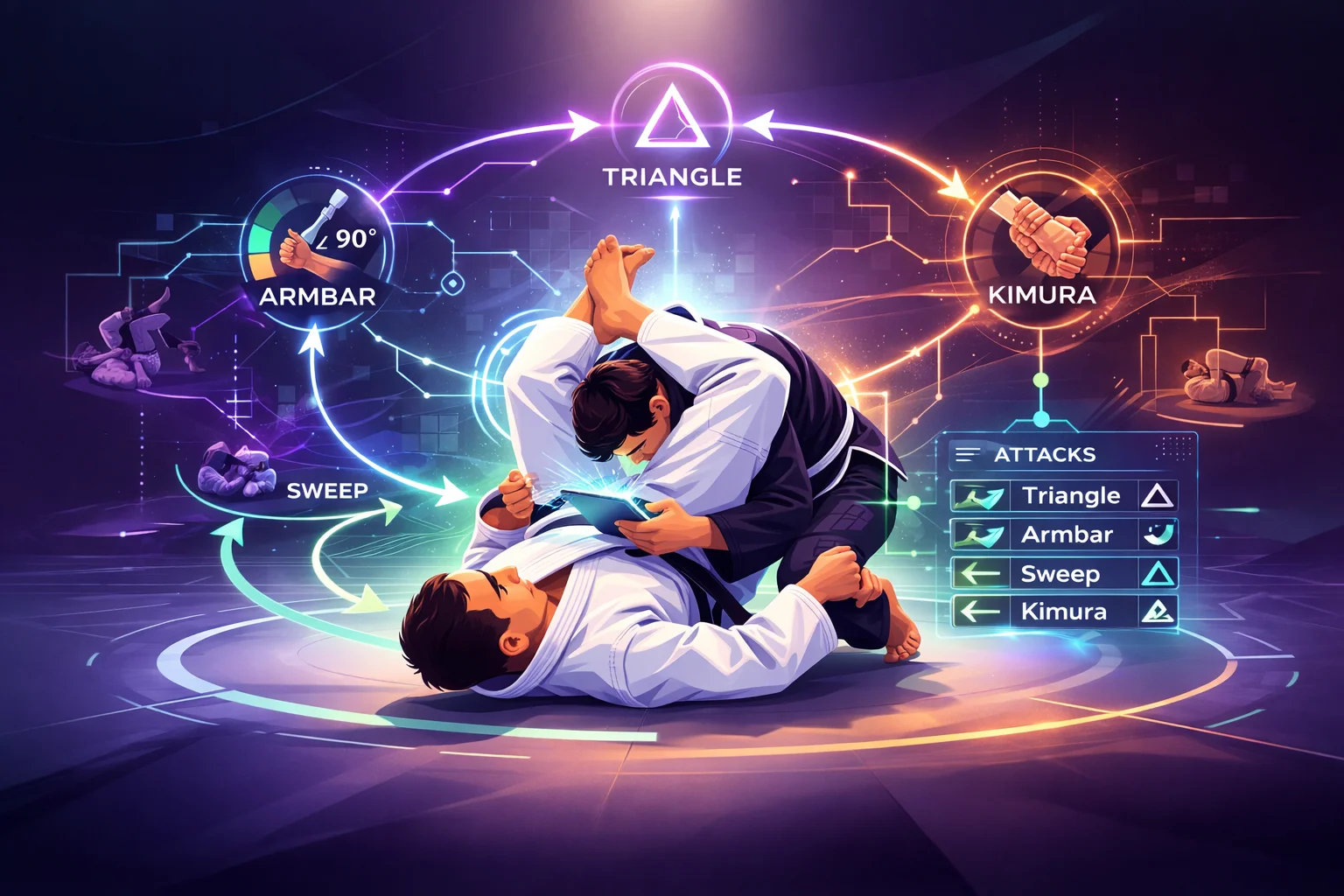
Individual techniques are useful. Attack chains are devastating. The concept is straightforward: every attack you throw forces a defensive reaction, and that reaction exposes your opponent to the next attack. When you chain attacks properly, your opponent is always one step behind, choosing between two bad options.
Chain 1: Hip Bump, Kimura, Guillotine
This is the classic closed guard chain for when your opponent has good posture.
The Flow:
- Hip Bump Sweep — You sit up explosively to sweep them. They post their hand on the mat to stop the sweep.
- Kimura — Their posted hand is now isolated and vulnerable. Grab the wrist, thread the figure-four, and attack the kimura.
- Guillotine — If they pull their arm free from the kimura attempt, their posture collapses forward and their head drops. Wrap the neck and sink the guillotine.
Each technique creates the opening for the next. The hip bump forces the hand post. The kimura attempt forces them to pull their arm free. The arm pull drops their head into guillotine range.
Chain 2: Armbar, Triangle, Omoplata
This is the fundamental attack triangle (pun intended) that links three of the most dangerous submissions in BJJ.
The Flow:
- Armbar — You isolate an arm and attack the armbar from guard. They stack you or pull their arm free.
- Triangle — As they defend the armbar, they push one arm through while pulling the other back, creating the one-in-one-out configuration for the triangle. Lock it up.
- Omoplata — If they posture out of the triangle or stack you hard, release the triangle lock and spin under the trapped arm for the omoplata.
This chain can cycle endlessly. If the omoplata fails, you can return to the armbar or triangle. Your opponent must defend three different joint locks and chokes without giving up any of them.
Armlock from Triangle Position
Matt Darcy shows how to transition from triangle choke to armlock, demonstrating the seamless attack chain that makes closed guard so dangerous.
Demonstrated by Matt Darcy — BJJ Black Belt
Armlock from Triangle — Matt Darcy
Chain 3: Scissor Sweep to Cross Collar Choke
This chain punishes opponents who over-commit to defending the sweep.
The Flow:
- Scissor Sweep — Set up with collar and sleeve grips, shin across the stomach. They base hard to resist the sweep.
- Cross Collar Choke — Because they are leaning forward to resist, their neck is exposed and your collar grip is already in place. Feed the second hand and finish the choke.
The beauty of this chain is that defending the sweep requires the exact posture that makes the choke work. They cannot solve both problems simultaneously.
The Decision Framework
The underlying principle behind all attack chains is making your opponent choose between two bad options. Every defensive reaction should expose a new vulnerability:
- They posture up? Hip bump or pull them back down
- They lean forward? Collar choke or guillotine
- They post a hand? Kimura or sweep
- They defend with both arms? Triangle or armbar from the exposed arm
- They try to stand? Sweep or transition to open guard attacks
When you build your closed guard this way, you are not throwing random techniques and hoping something lands. You are running a system where every move has a purpose and every defense has a counter.
Roger Gracie: Closed Guard Fundamentals
Roger Gracie demonstrates his fundamental approach to closed guard — the position control, posture breaking, and attack entries that made him the greatest competitor in BJJ history.
Demonstrated by Roger Gracie — 10x IBJJF World Champion
Roger Gracie: Closed Guard Fundamentals — 10x IBJJF World Champion
Closed Guard for Self-Defense
In a real confrontation, closed guard is the single most important guard position. This is not debatable. While open guards offer creative offensive options on the mat, they are dangerous in a fight because they leave space for the top person to strike or disengage.
Why Closed Guard Is the Best Self-Defense Guard
Distance management: With your legs locked around their waist, your opponent cannot create space to throw powerful punches. They are forced into clinch range where strikes are much less effective.
Strike prevention: By breaking their posture and pulling their head to your chest, you eliminate their ability to generate force. They cannot wind up for a punch when their forehead is pinned to your sternum.
Positional options: From closed guard you can sweep to mount (a dominant position for controlling a fight), stand up safely using technical standup, or apply submissions to end the confrontation.
The Self-Defense Closed Guard Protocol
- Close your guard immediately — Lock your ankles and squeeze
- Break posture — Pull their head down. Do not let them sit upright
- Control their arms — Wrist and sleeve control prevents strikes
- Choose your exit: Sweep to mount, stand up, or submit
Self-Defense Reality: In a street altercation, always prioritize getting to your feet or to a dominant top position. Submissions from guard should be a last resort because the ground is an inherently dangerous place in an uncontrolled environment. Use closed guard as a control position to create a safe opportunity to stand or sweep, not as a place to hunt for armbars.
Know Your Enemy: How They Want to Pass
Understanding how your opponent plans to escape closed guard makes your retention and attacks stronger. The most common guard break involves getting both hands on your hips, standing up with good posture, and prying your ankles apart. Once they open your guard, they will attempt to pass using techniques like the double unders stack pass.
Double Unders Stack Pass — Gracie Barra Brasil. Understanding how your opponent wants to pass helps you retain your guard.
Knowing these passing sequences helps you recognize them early and disrupt them before they develop. When they grab your hips, strip the grips. When they try to stand, pull them back down or transition to open guard hooks before they get established. For a deeper look at the passer's perspective, check out our guard passing breakdown. And remember, once your guard is open, you are exposed to dangerous leg lock entries and passing combinations that are much harder to defend. If you do get caught in an open guard exchange, knowing your heel hook defense becomes critical. Keeping your guard closed, or recovering it quickly, should always be the priority.
Common Closed Guard Mistakes
Even experienced practitioners fall into these traps. Recognizing and correcting them will accelerate your guard game significantly.
1. Opening Guard Without Purpose
Your closed guard is a locked door. Do not open it unless you have a specific reason: executing a sweep, transitioning to an attack that requires an open guard, or adjusting your hip angle. Opening your guard without purpose gives your opponent what they want for free.
2. Not Breaking Posture
If you are lying flat on your back with your guard closed but your opponent is sitting upright with a straight spine, you are in a bad version of closed guard. Nothing works from here. Breaking posture is not optional; it is the prerequisite for everything.
3. Playing a Passive Guard
Closed guard is not a resting position. If you are not actively attacking, grip fighting, or adjusting your position, your opponent is recovering their posture, setting up their guard break, and planning their escape. The bottom player in closed guard should be the busier fighter.
4. Not Using Your Hips
Your hips are the engine of your closed guard. Hip escapes create angles for triangles and armbars. Hip bumps create sweeps and kimura entries. Hip lifts break posture. If your hips are flat and static, your closed guard is half as effective as it should be.
5. Reaching for Submissions Without Setup
Throwing a random armbar or triangle without breaking posture first, without isolating an arm, without creating an angle, is a recipe for getting passed. Every submission needs a setup. Respect the process.
Self-Check Drill: Next time you roll, set a rule for yourself: you must break your opponent's posture before attempting any submission or sweep from closed guard. If their head is not at your chest level, you have not earned the right to attack yet. This single rule will transform your guard game.
Drilling Your Closed Guard
A dangerous closed guard is built through deliberate practice. Here are the drills that will develop each component of your game.
Solo Drills
Hip Escape Repetitions Lie on your back and perform hip escapes left and right across the mat. Focus on the hip movement, not the distance traveled. This is the foundation of every triangle, armbar, and omoplata entry.
Volume: 3 sets of 20 each side. For more solo training ideas, see our guide to solo BJJ drills and home exercises.
Bridge and Roll Lie flat and practice explosive bridges. Alternate between straight bridges (for bump sweeps) and bridges with a turn (for escapes and sweeps).
Volume: 3 sets of 15 each direction.
Guard Sit-Ups From your back, practice sitting up explosively as if hitting a hip bump sweep. Post your hand behind you and return to your back. This builds the core strength and explosiveness the hip bump demands.
Volume: 3 sets of 12.
Partner Drills
Posture Break Sparring Start in closed guard. The bottom player's only objective is to break and maintain broken posture for 10 seconds. The top player fights to maintain or recover posture. Three-minute rounds, then switch.
Attack Chain Flow Drilling With a cooperative partner, practice the three attack chains described above. Start slow: hip bump, kimura, guillotine. Armbar, triangle, omoplata. Scissor sweep, cross collar choke. Increase speed as the movements become automatic.
Volume: 5 minutes per chain, then live rolling starting from closed guard.
Positional Sparring: Closed Guard Only Start in closed guard. Bottom player can submit or sweep. Top player can pass or submit. Reset every time the position changes. This is the single best drill for developing a complete closed guard game because it forces you to use everything.
Time: 5-minute rounds, 3 rounds each position.
Progression Plan: Spend your first month focusing on posture breaks and one sweep (scissor sweep). Month two, add one submission (armbar or triangle) and one chain. Month three, add the remaining techniques and begin flowing between chains. Building systematically prevents overwhelm and builds real skill.
Tracking Your Closed Guard Development
The closed guard system has many moving parts: posture breaks, grip fights, submissions, sweeps, and chains. Tracking your training data reveals patterns you would never notice otherwise.
What to Track:
- Which submissions are you finishing most often?
- Which sweeps are landing, and which are getting stuffed?
- Where in the attack chain are you getting stuck?
- Are you breaking posture consistently, or are opponents maintaining their base?
- How often is your guard getting opened or passed?
Review Questions:
- Is your hip bump creating kimura and guillotine opportunities, or dying on the vine?
- Are your armbar attempts leading to triangles and omoplatas, or are you losing position?
- Which opponents are giving you the most trouble, and what are they doing differently?
This kind of deliberate analysis turns rolling time into learning time. You stop repeating the same mistakes and start building on what works.
Ready to build a dangerous closed guard? Download Rollbook to track your submission attempts, log which attack chains work best, and see your closed guard success rate improve over time. Our technique tracking helps you train deliberately. Start your free trial today.
Oss!