By Philipp — Rollbook · Updated November 4, 2026
The Guillotine Choke: Variations, Setups and How to Escape It
The guillotine works from standing, closed guard, half guard and mount. How to finish it, the arm-in, high-elbow and ten-finger variations, the best setups, how to escape it, and when it's legal in IBJJF.
On this page
What Is the Guillotine Choke?
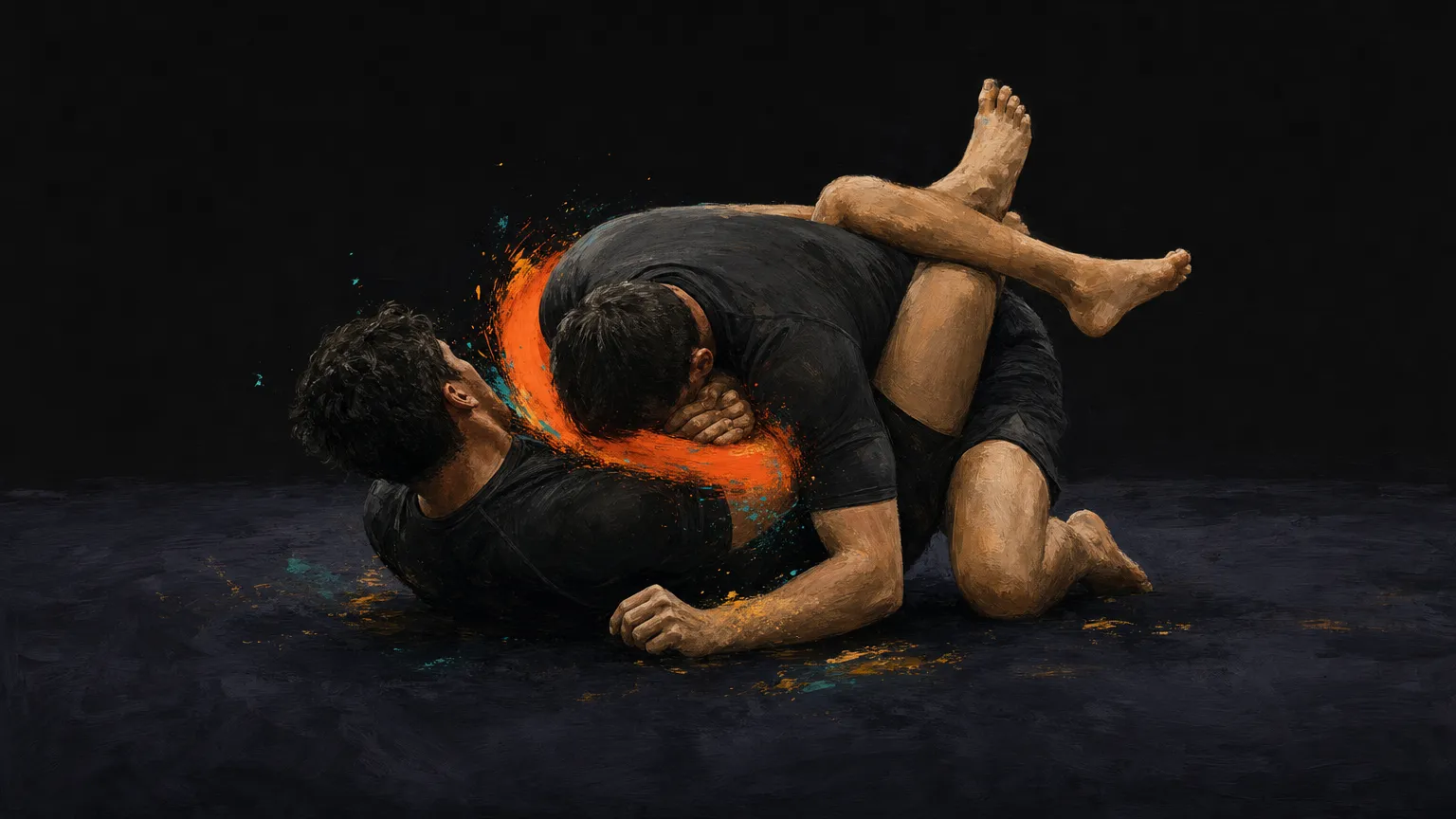
The guillotine is a choke from the front. Your opponent's head goes under your armpit, your arm wraps around their neck with your forearm under their chin, and your hands lock together. Squeezing up into the neck finishes it. Depending on where your forearm presses, it's an air choke on the windpipe or a blood choke on the sides of the neck.
The name comes from the arm across the neck, which looks like the blade of a guillotine. In judo, the same choke is mae hadaka jime, the "front naked choke".
It's one of the most versatile chokes in grappling. It works standing, from closed guard, half guard and mount, and it's a classic answer to a double leg takedown. It still finishes matches at the top level: at ADCC 2026, Ana Mayordomo won the women's –55 kg bronze with a guillotine on Mayssa Bastos.
The guillotine in one sentence: their head under your armpit, your forearm under their chin, your hands locked, and their body stretched away from you while you pull up into the neck.
How to Finish the Guillotine
These steps are for the standard guillotine from closed guard, the version most people learn first.
- Wait for the head to drop. The guillotine is there when your opponent's head comes forward and down, for example when they try to pass or lean in.
- Wrap the neck. Your arm goes around the back of their neck and your forearm comes under their chin, with your palm facing your own chest. Their head stays tight under your armpit.
- Lock your hands. Grab your choking hand with your other hand. Check that only the neck is inside your grip, unless you want the arm-in version below.
- Keep them on your strong side. That's the side of your choking arm. If their head and body drift to the other side, the choke loses its power.
- Finish with your arms and legs together. Pull up with your arms while your legs stretch their hips away from you. Arm strength alone rarely finishes it.
- Choke, don't crank. Twisting or cranking the head turns the guillotine into a neck crank that can injure the spine. Squeeze steadily and let go the moment your partner taps.
Safety: A guillotine can put someone to sleep in seconds and can hurt the neck when it's cranked. Finish it slowly in training, never with a jerk, and release at the first tap.
Guillotine Variations
Arm-Out (the Standard Guillotine)
Only the head is inside your grip. It's the fastest one to grab, and it's the version that punishes a careless takedown. It's also the easiest to defend: an opponent who walks to your weak side or drives a shoulder into you can shut it down.
Arm-In
One of your opponent's arms is trapped inside the choke, next to their head. Their own shoulder presses into one side of their neck, so it works as a blood choke. When the choke isn't tight, the arm-in still gives you head-and-arm control, a strong position from half guard or against a turtled opponent. From there you can switch to the darce, the anaconda or the arm triangle.
High-Elbow (the Marcelotine)
Only the head is inside again, but your choking elbow points up toward the ceiling and sits above their shoulder. Lifting the elbow drives your forearm deeper into the neck, and it takes away the shoulder pressure your opponent would use to fight the choke.
It's nicknamed the Marcelotine after Marcelo Garcia, who made it famous on his way to four ADCC titles. It leads to fewer follow-up attacks than the arm-in, so it suits a player who commits to the finish. Our Marcelo Garcia guillotine breakdown covers how he set it up.
Ten-Finger
This one swaps the wrap for a grip. Both hands stack under the chin, and your elbow holds their head tight against your side. Curling your wrists upward drives your thumb knuckles into the windpipe, so it's an air choke. It's a favorite off a sprawl: catch the chin as they shoot, pin their head to the mat and curl the wrists. Chris Brennan, a BJJ black belt and MMA fighter, is the coach best known for it.
Guillotine Setups
- Against a takedown. When someone shoots with their head in front of your body, sprawl and wrap the neck. Many guillotines happen in that split second, before the takedown lands.
- From closed guard. When they lean in or drop their head to pass, sit up and wrap the neck. It also chains with the kimura and the hip bump sweep: when they yank their arm out of a kimura, their head often falls forward into the guillotine. Our closed guard attack system shows the full chain.
- From the front headlock. Snap their head down from standing, or catch it when they're on their knees. The same front headlock leads to the guillotine, the darce and the anaconda, depending on how they move.
- From half guard. On the bottom, catch the neck when they drive their head in. On top, when they come up on their side for an underhook, their head and arm are there for an arm-in guillotine.
- From mount. When they lift their head to bridge or sit up, the neck is open for a mounted guillotine.
Common Guillotine Mistakes
- Choking on the jaw. If your forearm sits on the jaw instead of under the chin, it hurts but doesn't finish.
- No hip control. If their hips are free, they walk to your weak side and the choke dies. Control the hips with your guard or your legs.
- Pulling with your arms only. The finish comes from your arms and legs together, stretching their body away while you pull up.
- Holding a lost guillotine. If they've passed your guard and the choke isn't on, let go. Holding it while they settle into side control can get you choked instead (see the Von Flue below).
- Cranking the neck. A crank is dangerous for your partner, and in IBJJF events a neck crank without a choke is illegal.
How to Escape the Guillotine
Before it's locked:
- Keep your head up and your posture straight when you shoot or pass. A low head in front of your opponent's chest is an invitation.
- Fight the hand reaching for your neck before the grip closes.
Once it's on:
- Grab their choking forearm with both hands and pull it down to take pressure off your neck.
- Move to the weak side, the side opposite their choking arm. If they choke with their right arm, go to their left. Moving to the strong side, where your head is trapped, makes the choke tighter.
- Pass their legs to the weak side and settle into side control. From there the guillotine has lost its angle.
- If they keep holding on, lock your hands and drive your near shoulder into their neck. That's the Von Flue choke, named after Jason Von Flue, who put Alex Karalexis to sleep with it at UFC Ultimate Fight Night 3 in 2006.
Don't:
- Slam out of it. Slams are illegal at every age in IBJJF events, and dropping someone on their head is dangerous anywhere.
- Wait once it's tight. If the choke is locked and you're fading, tap.
Is the Guillotine Legal in IBJJF?
Yes, from age 16 up, at every belt, in the gi and in no-gi. IBJJF's table of illegal techniques bans the frontal guillotine for kids aged 4 to 15, along with the arm triangle, the triangle when pulling the head, and the Ezekiel.
Two more rules matter for guillotine players. White belts can't jump into closed guard while their opponent is standing, so a jumping guillotine into closed guard is out at white belt: the referee stops the match and restarts it standing. And slams are illegal at every age, which covers lifting and dropping someone to break the choke. See our IBJJF illegal techniques guide for the full list.
Guillotine FAQ
Why is it called the guillotine?
The arm across the front of the neck looks like the blade of a guillotine. In judo it's mae hadaka jime, the "front naked choke", the mirror image of the rear naked choke.
Is the guillotine a blood choke or an air choke?
It can be either. Pressure on the windpipe makes it an air choke, as in the ten-finger guillotine. Pressure on the sides of the neck makes it a blood choke, as in the arm-in and high-elbow versions.
What's the difference between the arm-in and arm-out guillotine?
In the arm-in, one of your opponent's arms is trapped inside the choke with their head. In the arm-out, only the head is inside. The arm-in gives you more control and follow-ups. The arm-out is faster to grab.
What is the Marcelotine?
The high-elbow guillotine, nicknamed after Marcelo Garcia, who made it famous. Your choking elbow sits above your opponent's shoulder, pointing up, which tightens the choke and blocks their shoulder.
How long does a guillotine take to put someone out?
Seconds. A 2020 study of fully resisting, highly trained grapplers timed 11 no-gi chokes, guillotines among them. The chokes' averages ranged from 6.2 to 10.5 seconds, 9 seconds overall, and the differences between them weren't significant.
Is the guillotine legal for kids?
Not in IBJJF events. The frontal guillotine is illegal for kids aged 4 to 15. Other organizers write their own kids rules, so check the rulebook before a kids tournament.
How do you escape a guillotine?
Pull their choking forearm down with both hands, then move to the side opposite their choking arm and pass to side control. If they still hold on there, the Von Flue choke is waiting for them.
Sources
- Guillotine choke (Wikipedia): mae hadaka jime, air versus blood choke, and the counter to the double leg
- Marcelo Garcia (Wikipedia): the "high wrist" guillotine he popularized
- Jason Von Flue (Wikipedia): the 2006 shoulder choke against Alex Karalexis that gave the Von Flue its name
- What is the Von Flue choke? (Evolve): why you pass to the side opposite the choking arm
- Chris Brennan's 10 finger guillotine (Grapplearts): first published in Ultimate Grappling, December 2006
- Which chokes put people to sleep fastest (Jits Magazine): Stellpflug et al. (2020), Time to unconsciousness from sportive chokes in fully resisting highly trained combatants
- IBJJF Books & Videos: the rules book and the "Illegal moves by age and category" table (January 2024 edition)
- ADCC 2026 results: Ana Mayordomo's guillotine for bronze
Working on your front headlock? Log your guillotine setups and finishes in your Rollbook technique journal, and see which ones land in sparring. Rollbook is free on iOS and Android.
Oss!