BJJ for Kids: A Parent's Complete Guide
Everything parents need to know about enrolling their child in Brazilian Jiu-Jitsu — from choosing the right academy and understanding class structure to supporting your young grappler's journey.

Why BJJ Is Different from Other Kids' Activities
Most youth sports teach kids to run faster, throw harder, or score more points. Brazilian Jiu-Jitsu teaches them something fundamentally different: how to solve problems under pressure using their mind and body together, without relying on size, speed, or aggression.
There is no ball to chase and no scoreboard counting goals. On the mat, a child faces a direct, personal challenge — a training partner trying to control them — and must work through that challenge using technique, leverage, and composure. That experience builds a kind of quiet, durable confidence that team sports rarely replicate.
BJJ is also one of the few physical activities where a smaller child can succeed against a larger one. The entire art was built on that premise. The Gracie family developed Brazilian Jiu-Jitsu specifically so a smaller, weaker person could defend themselves against a bigger opponent using proper technique. That principle applies to adults and children alike, and it is one of the reasons BJJ resonates so deeply with kids who may not thrive in traditional sports.
In 2026, youth BJJ enrollment is at an all-time high. The sport's growth in schools, after-school programs, and dedicated kids' academies reflects a broader shift in how parents think about extracurricular activities. They are looking for something that builds character, teaches practical life skills, and keeps their child physically active — and BJJ delivers on all three. If you are brand new to the art yourself, our complete beginner's guide covers the fundamentals from an adult perspective.
Benefits of BJJ for Children
The benefits of kids' BJJ are well-documented, both anecdotally by thousands of coaches and parents and increasingly through academic research. They fall into three categories: physical, mental, and social.
Physical Benefits
BJJ is a full-body workout disguised as play. In every class, children develop:
- Coordination and body awareness. Grappling movements like shrimping, bridging, and technical stand-ups build proprioception — the sense of where your body is in space. Research from occupational therapy studies has found that BJJ is particularly effective for children with developmental coordination challenges because it relies on kinesthetic learning rather than memorization.
- Functional strength. BJJ builds grip strength, core stability, hip mobility, and pushing/pulling power through natural, compound movements rather than isolated exercises.
- Cardiovascular fitness. A typical kids' class includes warm-ups, drilling, and live positional rounds that keep heart rates elevated in a way that feels like playing, not exercising.
- Flexibility and mobility. Guard work, inversions, and the constant need to create and recover frames develop a level of hip and shoulder flexibility that most kids simply do not get from team sports.
Mental Benefits
This is where BJJ separates itself from the pack.
- Confidence. Not the loud, performative kind — the quiet, internal kind that comes from knowing you can handle adversity. When a child escapes a bad position or submits a training partner for the first time, that experience registers differently than scoring a goal. It is deeply personal and impossible to attribute to luck.
- Discipline and focus. BJJ classes require children to listen, watch a demonstration, remember a sequence of movements, and execute them with a partner. That feedback loop — instruction, practice, correction, repetition — trains sustained attention in a way that carries directly into the classroom.
- Resilience. Every child who trains BJJ will get tapped. They will be put in uncomfortable positions. They will struggle. And they will learn that struggling is not failing — it is the process. A five-month study of 113 children published in the Journal of Sports Science and Medicine found that BJJ training improved self-control and reduced aggression more effectively than other combat sports.
- Problem-solving. BJJ is often described as "physical chess." Every position presents a puzzle: how do I escape this pin? How do I advance to a better position? How do I set a trap? Children who train BJJ learn to think sequentially and strategically under pressure.
Social Benefits
- Respect and sportsmanship. Every class begins and ends with a handshake or a bow. Children learn to treat training partners with respect, regardless of outcome.
- Confidence against bullying. BJJ gives children a practical, scalable self-defense skill. They learn to control a situation without throwing punches, which research consistently links to reduced victimization and improved assertiveness. The goal is not to teach kids to fight — it is to teach them that they do not need to be afraid.
- Community and belonging. Kids' BJJ programs create tight-knit peer groups. Children train together, encourage each other, and celebrate each other's promotions. That sense of belonging matters, especially for kids who feel out of place in traditional team sport environments.
Did You Know: A peer-reviewed study of youth BJJ practitioners found that 96.4% of parents reported measurable improvements in their child's confidence, and 87.5% reported reductions in anxiety, after consistent training.
What Age Should Kids Start BJJ?
Most academies offer classes for children as young as four. Whether that is the right age for your child depends on their individual temperament and development, but here are general guidelines:
Age 3-5 (Tiny Tots)
Classes at this age are heavily play-based. Think animal walks, tumbling, simple takedown games, and basic movement patterns. There is little to no sparring. The goal is exposure: getting comfortable on the mat, learning to follow instructions in a group, and developing basic coordination. Not every child is ready for a structured class at three or four, and that is fine. There is no developmental advantage to starting at three versus five.
Age 6-8 (Kids)
This is the sweet spot where most children are developmentally ready for structured BJJ instruction. They can follow multi-step directions, work cooperatively with a partner, and begin to understand cause-and-effect in technique (if I grip here and move my hips there, my partner falls). Classes include warm-ups, technique drilling, cooperative games, and light positional sparring.
Age 9-12 (Juniors)
Children in this range can handle more technical complexity. Classes introduce combination attacks, half guard work, sweeps from multiple guard positions, and longer live rolling rounds. This is also when many kids begin competing, if they are interested.
Age 13-17 (Teens)
Teen classes closely mirror adult curricula. Rolling is longer and more intense. Technique instruction covers advanced positions and transitions. Many academies integrate teens into adult fundamentals classes, which can accelerate their development significantly.
Key Takeaway
There is no single "perfect" age to start BJJ. Children as young as four can benefit from play-based programs, but the 6-8 range is when most kids are developmentally ready for structured technique instruction. Starting later is not a disadvantage — a motivated 10-year-old will catch up quickly.
What to Expect in a Kids BJJ Class
If you have never watched a kids' BJJ class, the format may surprise you. It looks nothing like an adult kickboxing or karate class. There is no yelling, no board breaking, and no standing in rows throwing punches at the air.
A typical kids' class runs 45 to 60 minutes and follows this structure:
Warm-Up (10-15 Minutes)
Classes begin with BJJ-specific movement drills: shrimping (a fundamental hip escape), forward rolls, backward rolls, sprawls, and "ninja walks" across the mat. For younger kids, these are often wrapped in games — "shark and minnow" is a common favorite — to make the movement patterns fun. The warm-up also builds the athletic base children need for grappling: hip mobility, core engagement, and spatial awareness.
Technique Instruction (15-20 Minutes)
The instructor demonstrates one to three techniques, then children pair up and drill them with repetition. A good instructor breaks each technique into clear, age-appropriate steps and circulates to provide individual corrections. Common early techniques include basic takedowns, pin escapes, guard recovery, and simple submissions.
Most quality programs use a rotating curriculum — often in 8- to 12-week cycles — so children revisit fundamental concepts regularly while layering in new material. Week one might focus on escapes, week five on sweeps, and week nine on offensive systems.
Positional Sparring and Games (10-15 Minutes)
Younger children (under 8) typically play structured games that reinforce technique: "king of the mat" from specific positions, escape challenges, or takedown games. Older children do positional sparring — starting from a set position (e.g., one partner in side control) and working from there. Full live rolling is usually introduced around age 8-9, with strict rules about pace and control.
Cool-Down and Character Talk (5 Minutes)
Many programs close with a brief stretch and a short character lesson — topics like respect, perseverance, or handling conflict. This is not filler. Academies that intentionally integrate character development into their curriculum produce students who understand that BJJ is about more than technique.
The Kids Belt System
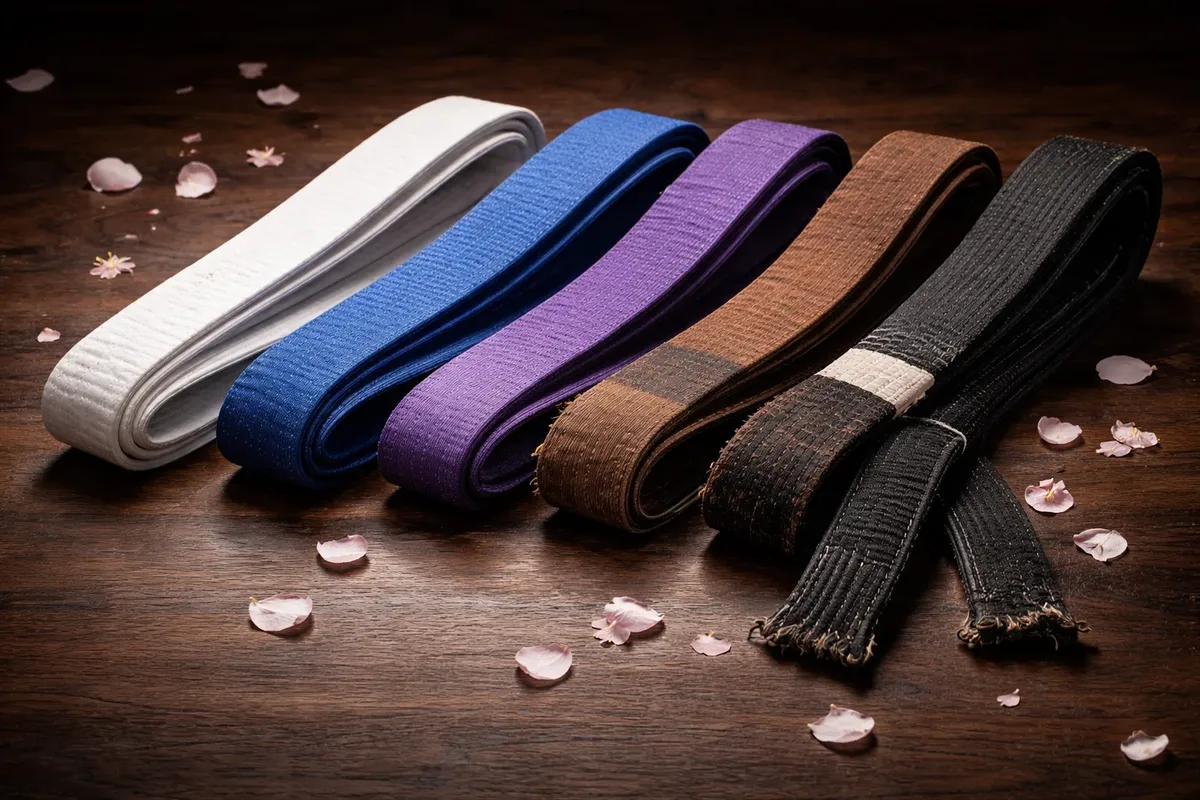
Youth BJJ uses a different belt progression than adults. Instead of the standard white-blue-purple-brown-black system, children progress through a series of intermediate belts with stripes at each level:
- White Belt — Entry level. Focus on core movements, basic positions, and mat etiquette.
- Gray Belt (with white, solid, and black variants) — Fundamental guards, basic sweeps, and simple submissions.
- Yellow Belt (with white, solid, and black variants) — Expanded guard work, pass combinations, and defensive systems.
- Orange Belt (with white, solid, and black variants) — Intermediate techniques, takedown combinations, and competitive preparation.
- Green Belt (with white, solid, and black variants) — Advanced positions, complex transitions, and near-adult-level technical understanding.
Each belt level typically includes four stripes, earned through a combination of attendance, technique demonstration, and live sparring requirements. At age 16, youth practitioners transition to the adult belt system, typically at blue belt. For a complete breakdown of how promotion works, see our guide to the BJJ belt progression system.
Choosing the Right Academy
Not all kids' programs are created equal. The quality of your child's experience depends almost entirely on the academy you choose. Here is what to look for — and what to avoid.
Green Flags
- Qualified, dedicated kids' instructors. The head coach may be a world champion, but what matters for your child is who teaches the kids' class. Look for instructors with specific experience teaching children, not just adult competitors filling a time slot. A great kids' instructor breaks down technique clearly, manages energy levels, keeps every child engaged, and creates a safe environment where it is okay to struggle.
- Clean, well-maintained facility. Mat hygiene is non-negotiable. Mats should be cleaned after every class with an appropriate disinfectant. The changing rooms should be clean. The facility should not smell like neglect.
- Age-appropriate class groupings. A program that puts 5-year-olds and 12-year-olds in the same class is a red flag. Look for at least two age divisions, and ideally three or four.
- Structured curriculum. Ask how the program is organized. A quality program has a clear progression path — not just random techniques pulled from whatever the instructor felt like teaching that day.
- Low student-to-instructor ratio. Kids need individual feedback. If there are 25 children on the mat and one instructor with no assistants, your child is not getting coached.
- Trial classes. Any reputable academy will let your child try one or two classes before committing. If a gym demands a contract before your child steps on the mat, walk away.
- Parents can observe. You should be welcome to watch class. Academies that prevent parents from observing should be viewed with skepticism.
Red Flags
- Excessive competition pressure. If the coach is pushing five-year-olds to compete or publicly shaming children who lose, the program prioritizes trophies over development.
- No safety protocols. If there are no visible rules about sparring intensity, no discussion of tapping, and no separation by size during live training, your child's safety is at risk.
- Hard sell tactics. High-pressure sales pitches, mandatory long-term contracts before a trial, and expensive "testing fees" for belt promotions are signs of a business-first, student-second operation.
- Dirty facility. Skin infections like ringworm and staph are real risks in grappling. If the mats look grimy, the gym towels smell, or the bathrooms are unkempt, do not enroll your child.
- Instructor ego. If the kids' instructor berates children, shows favoritism, or seems more interested in demonstrating their own skill than teaching, find another gym.
Pro Tip: Visit three academies before committing. Watch a full kids' class at each one. Pay less attention to the facility's marketing and more attention to how the children on the mat interact with the instructor. Are they focused? Are they smiling? Do they look comfortable asking questions? That tells you everything you need to know.
Gi vs No-Gi for Kids
If you are choosing between gi and no-gi classes for your child, here is the practical breakdown.
Starting in the gi is generally recommended for younger children. The gi provides more grips and friction, which slows the pace and gives kids more time to think through positions. It also teaches precise grip placement, leverage, and control — foundational skills that transfer directly to no-gi. Most youth BJJ curricula are built around gi training, and the kids' belt system (which provides a powerful motivational framework through visible promotions) is tied to gi practice.
No-gi has its own advantages. It is faster-paced and more athletic, which appeals to some kids. It develops scrambling ability, wrestling fundamentals, and body-based control. Children who also train wrestling or are interested in MMA often gravitate toward no-gi.
The best approach is both. If your child's academy offers both gi and no-gi classes, let them try each and train whichever they enjoy. Enjoyment is the single best predictor of long-term retention, and at the youth level, keeping your child on the mat matters more than optimizing their training split.
For a deeper comparison of the two styles, our guide to no-gi vs gi BJJ covers the technical and strategic differences in detail.
Youth Competition: IBJJF Kids Divisions and When to Compete
Competition is an optional but valuable part of a child's BJJ development. It teaches them to perform under pressure, manage nerves, and handle both winning and losing with composure. But the timing and approach matter.
IBJJF Kids Divisions
The International Brazilian Jiu-Jitsu Federation (IBJJF) is the largest and most structured competitive organization for youth BJJ. Their kids' divisions are divided into narrow age brackets — typically by single year or two-year range — to account for the dramatic physical differences between children at different developmental stages. A 7-year-old and a 9-year-old may only be two years apart, but the gap in size, strength, and coordination is enormous. Narrow age brackets keep competition fair.
Key features of IBJJF kids' competition:
- Age divisions from 4 to 17, with categories like Mightymite (youngest), Peewee, Junior, and Teen.
- Weight classes within each age division ensure children compete against opponents of similar size. Kids are weighed in their gi, and a 2-pound allowance is standard.
- Restricted techniques by age. Younger divisions prohibit more advanced submissions — particularly leg locks, wrist locks, and certain chokes — with restrictions loosening as competitors age. This is a critical safety measure.
- Shorter match times than adult divisions, scaled to attention span and endurance.
- Belt requirements for registration, enforced by the IBJJF's youth belt system.
For the full rule set, including point scoring and legal techniques by age, see our complete guide to IBJJF rules. If your child is preparing for their first event, our first tournament guide walks through everything from registration to warm-up routines.
When Should Kids Start Competing?
There is no universal right answer, but here are principles that apply broadly:
- The child should want to compete. This is the most important factor. Competition should never be forced. If your child expresses interest, encourage them. If they do not, let them train without pressure and revisit the conversation later.
- They should have a baseline of live sparring experience. A child who has never done positional sparring in class is not ready for competition. Most coaches recommend at least 6 to 12 months of consistent training before a first tournament.
- Start with a local, low-key event. Your child's first competition does not need to be a major IBJJF event. Many regions have local tournaments with a relaxed atmosphere designed specifically for first-time competitors. Let them experience the environment before scaling up.
- Frame it as a learning experience, not a test. Before the tournament, talk to your child about what they will experience: the waiting, the nerves, the referee, the unfamiliar opponent. After the tournament, ask what they learned — not whether they won.
Supporting Your Child Without Being a "Mat Parent"
Every BJJ coach has stories about "mat parents" — the parent who coaches from the sideline during class, argues with the referee at tournaments, pushes their child to train through injury, or treats their child's belt promotion timeline as a personal achievement.
Do not be that parent.
Your role is to support, not to direct. Here is how to do that well:
During Class
- Drop off and let the coach coach. If you stay to watch, sit quietly. Do not call instructions to your child from the sideline. Do not gesture. Do not make faces when they make a mistake. The instructor is responsible for what happens on the mat.
- Do not compare your child to other children. Every child develops at a different pace. The 7-year-old who dominates the class now may quit next year. The child who struggles today may become the most dedicated student in the program.
At Tournaments
- Stay calm. Your child will look to you during the match. If they see anxiety, frustration, or anger, they will absorb it. If they see a calm, supportive face, they will feel safe to perform.
- Do not coach from the stands. Your child cannot process tactical instructions shouted over crowd noise during a live match. Stick to simple encouragement: "You've got this." "Breathe." "Good job."
- Celebrate effort, not outcomes. Win or lose, tell them you are proud of them for stepping on the mat. Ask what they learned. Do not immediately launch into technique analysis.
At Home
- Let them set the pace. If your child wants to train twice a week, that is enough. If they want to train five times a week, support it. If they want to take a break, let them. Burnout is the number one reason kids quit any activity, and pressure from parents is a leading cause of burnout.
- Show genuine interest without taking over. Ask about class. Let them show you a technique. Watch a competition together. But do not make BJJ the defining feature of your relationship with your child.
- Trust the coach. If you have concerns about your child's progress, talk to the coach privately. Do not undermine the coach's authority in front of your child.
Common Parent Concerns
Is BJJ Safe for Children?
Yes, when practiced in a reputable academy with qualified instruction and age-appropriate sparring rules. BJJ is a grappling art — there is no striking, no kicking, and no headshots. The emphasis on control and the tap-out mechanism (where a child can end any exchange immediately by tapping) make it inherently safer than many contact sports.
A 2025 study analyzing pediatric martial arts injuries found that BJJ accounted for a small fraction of total youth martial arts injuries, with the majority being minor sprains and strains treated without hospital admission. Compared to youth soccer, basketball, and football, the injury rate in BJJ is comparable or lower, particularly for concussions, which are exceptionally rare in grappling.
That said, injuries can happen in any physical activity. Fingers get jammed, knees get tweaked, and the occasional mat burn is a rite of passage. The risk is real but manageable, especially in programs with clear safety protocols and proper supervision.
Does BJJ Make Kids Aggressive?
This is one of the most common misconceptions, and the research says the opposite. A controlled study comparing the effects of BJJ and MMA on children found that BJJ training specifically reduced aggression and improved pro-social behaviors like cooperation and self-control. The structure of BJJ — the emphasis on respect, the ritual of bowing, the requirement to control your partner without injuring them — teaches restraint, not violence.
Children who train BJJ learn that they can handle a physical confrontation, and that knowledge paradoxically makes them less likely to seek one out. They have nothing to prove.
How Much Does Kids BJJ Cost?
Costs vary significantly by region, but here are typical ranges in 2026:
- Monthly tuition: $100-$200/month for two to three classes per week. Family discounts are common if multiple children (or a parent) enroll.
- Gi (uniform): $40-$80 for a quality kids' gi. Some academies include a gi with enrollment; others require you to purchase one.
- Competition fees: $60-$120 per event for registration, plus travel costs if applicable.
- Belt testing fees: Some academies charge $30-$50 for formal belt promotions. Others include promotions in tuition. Ask about this before enrolling.
Relative to other structured youth activities — competitive gymnastics, travel soccer, hockey — BJJ is moderately priced. The equipment costs are minimal (one gi, a mouthguard, and optionally a rash guard for no-gi), and there is no mandatory competition expense.
Pro Tip: Many academies offer a free trial week and waive the registration fee for new students. Ask about family rates if you or a sibling are also interested in training. Some academies also offer scholarship spots for families with financial constraints — it never hurts to ask.
Your Next Steps
If you have read this far, you are already doing the research that separates a thoughtful parent from one who signs up blindly. Here is a simple action plan:
- Find three academies in your area with dedicated kids' programs. Check their websites, read reviews, and look for the green flags described above.
- Schedule trial classes at each one. Bring your child. Watch the class. Pay attention to the instructor, the other kids, and the overall atmosphere.
- Talk to your child after each trial. Which gym did they like best? Where did they feel most comfortable? Their preference matters more than your analysis.
- Commit to consistency. Two classes per week for three months is enough time for your child to develop a foundation, make friends, and decide whether BJJ is something they want to pursue long-term.
- Track their journey. Log sessions, note what they are learning, and celebrate milestones — first stripe, first escape from mount, first time they rolled without freezing up. The best BJJ training apps make this easy.
BJJ has the potential to be the most valuable extracurricular activity your child ever does. Not because of trophies or belt colors, but because of what it teaches them about themselves: that they are tougher than they think, that hard work compounds, and that they can face any challenge on the mat or off it.
Ready to track your child's BJJ journey from white belt to their first stripe and beyond? Download Rollbook to log training sessions, monitor belt progression, and celebrate every milestone together as a family. Start your free trial today.
Oss!